

Shinrin-yoku’s immune-boosting power isn’t magic; it’s a measurable biological response to specific forest compounds called phytoncides.
- Breathing in phytoncides directly increases the number and activity of Natural Killer (NK) cells, your body’s first line of defense against viruses and tumors.
- Achieving this requires a state of “sensory immersion,” which is blocked by digital distractions and a workout-focused mindset.
Recommendation: Practice a full digital detox and aim for at least two hours a week in a natural setting, focusing on passive sensory reception rather than physical exertion to trigger the effect.
In the relentless pace of urban life, you feel a persistent, low-grade exhaustion. The advice you hear is always the same: “get some fresh air,” or “take a walk in the park.” While well-intentioned, this advice misses the fundamental point. It treats nature as a mere change of scenery, a passive backdrop to our busy lives. We often approach it with the same goal-oriented mindset we apply to work, turning a walk into another task to be completed.
But what if the true benefit wasn’t in the walking, but in the receiving? What if the forest wasn’t just a place, but a pharmacy? The ancient Japanese practice of Shinrin-yoku, or “forest bathing,” is not about exercise. It is a precise, science-backed biological protocol. It is the conscious practice of immersing your senses in the forest atmosphere to absorb specific airborne chemical compounds that actively modulate your immune system.
The key lies in understanding that this isn’t a vague wellness trend. It’s a targeted intervention to increase the number and activity of your Natural Killer (NK) cells—the elite soldiers of your immune system. This guide will move beyond the platitudes and decode the science. We will explore how to find and use nature, even within the city, to trigger this powerful physiological response, detailing the minimum dose required, the common mistakes that negate the benefits, and how to bring a piece of this healing power back into your home.
For those who prefer a more visual format, the following video offers a beautiful and immersive sensory experience, perfectly complementing the principles we are about to discuss. It serves as an excellent tool for understanding the serene, receptive state at the heart of Shinrin-yoku.
To navigate the science and practice of this profound technique, this article breaks down the essential components. The following summary outlines the key areas we will explore, from the biological mechanisms at play to the practical steps for effective implementation.
Summary: Your Scientific Guide to Forest Bathing for Immune Health
- Why Breathing Forest Air Lowers Stress Hormones for 7 Days?
- How to Find “Micro-Wilderness” in a Concrete Jungle for Lunch Breaks?
- Hiking for Miles or Sitting Still: Which Restores Attention Span Better?
- The Mistake of Bringing Your Phone “Just for Photos” That Blocks Immersion
- When to Go Outside: The Minimum Dose Required for Mental Health
- Why Dragging Your Poles Ruins the Upper Body Workout Benefit?
- Why Poor Ventilation Increases Respiratory Infection Risk by 30% in Winter?
- How to Modify Your Home Environment to Reduce Chronic Inflammation Risks
Why Breathing Forest Air Lowers Stress Hormones for 7 Days?
The prolonged calming effect of forest air is not merely psychological; it’s a direct biochemical reaction. When you inhale in a forest, you are breathing in a complex cocktail of volatile organic compounds called phytoncides, which are trees’ natural defense against pests and disease. These molecules, particularly from evergreen trees, directly interact with your body, reducing cortisol levels and triggering a cascade of immune benefits that last long after you’ve left the woods.
This isn’t a fleeting feeling of relaxation. Research shows that the physiological changes, including a reduction in stress hormones and a significant increase in the number and activity of NK cells, can be measured for up to seven days following a two-day forest bathing trip. The forest air essentially provides your body with a chemical signal to switch from the sympathetic (“fight-or-flight”) nervous system to the parasympathetic (“rest-and-digest”) system.
This sustained effect means that a single, immersive weekend trip can provide a week-long immune “tune-up.” The key is the duration and immersion, allowing your body to fully absorb and process these powerful compounds. By maintaining this effect with follow-up protocols, you can establish a new, lower baseline for stress and a higher state of immune readiness.
How to Find “Micro-Wilderness” in a Concrete Jungle for Lunch Breaks?
You don’t need a national park to practice Shinrin-yoku; the key is finding a “micro-wilderness” and focusing on sensory immersion, even for 20 minutes. An urban park with mature trees, a quiet churchyard, or even a single, large tree on a university campus can serve as your sanctuary. The goal is to find a spot where you can minimize urban noise and maximize your connection to a living organism.
This practice is about quality, not quantity, of space. The key is to shift your focus from the surrounding city to the details of the nature in front of you. Instead of seeing a “tree,” you train your senses to perceive the texture of its bark, the scent of its leaves, the pattern of dappled light filtering through its canopy. This act of deep, focused observation is what triggers the shift into the parasympathetic state.
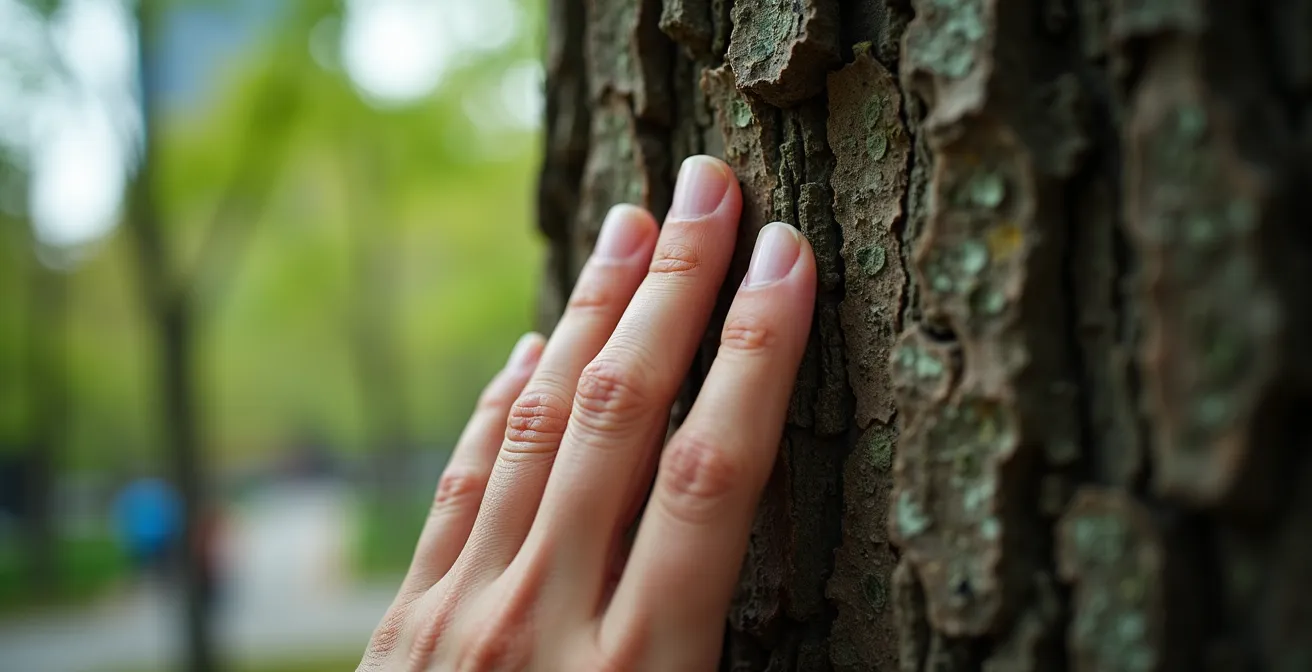
As the image above illustrates, the connection is made through touch, sight, and presence. Not all trees are created equal in this regard. Some emit more potent phytoncides than others. As a study in the journal Immunopharmacology & Immunotoxicology explains, phytoncides significantly enhance human NK activity by inducing the production of anti-cancer proteins. Knowing which trees are most effective can turn a simple lunch break into a targeted immune-boosting session.
This table, based on an analysis of phytoncide emissions, can help you become a phytoncide hunter in your own city.
| Tree Species | Phytoncide Emission Level | Best Time for Exposure | Common Urban Locations |
|---|---|---|---|
| Pine (Pinus) | High (α-pinene) | Early morning, humid days | Parks, boulevards |
| Cedar (Cedrus) | High (cedrol) | After rainfall | Government buildings |
| Oak (Quercus) | Moderate | Spring/Summer mornings | Historic districts |
| Eucalyptus | High (eucalyptol) | Hot afternoons | Coastal urban areas |
Hiking for Miles or Sitting Still: Which Restores Attention Span Better?
The answer, rooted in neurobiology, is that sitting still is profoundly more effective for attention restoration. Our urban lives demand constant “directed attention,” a state of high cognitive load that leads to mental fatigue. A strenuous hike, while physically beneficial, still requires directed attention for navigation and physical effort. In contrast, sitting still in a natural setting allows the brain to enter a state of “soft fascination,” where attention is held effortlessly by gentle, moving stimuli like rustling leaves or flowing water. This is the state that recharges our cognitive batteries.
The goal of Shinrin-yoku is not to expend energy, but to receive information from the environment. It is a shift from an active, doing state to a passive, receiving mode. This is where the true magic happens for both the mind and the immune system. Physical activity can even be a distraction from the primary goal of sensory absorption.
Japanese Forest Bathing vs. City Walking Study
A pivotal controlled study highlights this difference perfectly. One group of male subjects practiced forest bathing, involving slow walks and stationary observation. A control group engaged in city tourism with similar levels of physical activity. The results were stark: the forest bathing group showed a significant increase in NK cell activity and anti-cancer protein expression that lasted for over a week. The city group showed no such immune benefits. This proves that the environment and the parasympathetic “receiving” state are the active ingredients, not the physical exertion itself.
This doesn’t mean you must remain completely motionless, but the pace should be exceptionally slow, often described as a “deer’s pace.” It’s about wandering without a destination. The recommended minimum effective dose, according to Japanese research, is spending at least 120 minutes per week in nature to reap these benefits. This time is best spent in a state of quiet observation, allowing your brain and body to sync with the forest’s rhythm.
The Mistake of Bringing Your Phone “Just for Photos” That Blocks Immersion
The single greatest obstacle to effective forest bathing in the modern era is the smartphone. The justification of “just for photos” or “for emergencies” is a cognitive trap. Every notification, every urge to check email, and even the act of composing a photograph keeps your brain tethered to the world of directed attention and sympathetic arousal. It physically prevents the transition into the restorative parasympathetic state required for the immune benefits to take hold.
The phone acts as a portal back to the very stress you are trying to escape. Its presence, even in your pocket, creates a low-level anxiety and an attentional pull that severs your sensory connection to the forest. You cannot simultaneously be open to the subtle signals of the woods—the scent of pine, the feeling of moss, the sound of a distant bird—while a part of your brain is monitoring a digital device. True sensory immersion is an all-or-nothing proposition.
To benefit from Shinrin-yoku, you must create a boundary. This means making a conscious decision to disconnect completely before you even step onto the trail. This isn’t about Luddism; it’s about understanding the neurobiology of attention. You are creating the necessary internal conditions for the forest’s chemistry to work on your body’s chemistry.
Your Action Plan: Digital Detox for Full Immersion
- Turn off all devices before entering the forest, or leave them in the car. Inform someone of your route beforehand if you are concerned about safety.
- Bring a small, simple notebook and a pencil for analog sketching or jotting down observations if you feel the need to capture the moment.
- Practice ‘soft fascination’: Find a comfortable spot and simply watch a single natural process, like leaves fluttering in the wind, for five uninterrupted minutes.
- Consciously engage all five senses: Actively touch the bark of a tree, smell the damp earth, listen for distinct bird calls, taste the clean air, and notice the different shades of green.
- Commit to staying for a minimum of two hours. Research from Dr. Qing Li at the Nippon Medical School shows this duration is key for a full experience that improves sleep, mood, focus, and stress levels.
When to Go Outside: The Minimum Dose Required for Mental Health
While any time in nature is better than none, certain conditions maximize the physiological benefits of Shinrin-yoku. Phytoncide concentration in the air is not constant; it is influenced by time of day, temperature, and humidity. The highest concentrations are typically found in the early morning, on warm and humid days, and especially after rainfall, which helps release these volatile compounds from soil and foliage.

The misty, particle-rich air of a forest at dawn, as seen here, is essentially a dense, inhalable dose of immune-boosting medicine. The effect is rapid and measurable; research demonstrates as much as a 6-fold increase in pinene (a common phytoncide) blood levels after just one hour of forest walking. Choosing these optimal times means you get a more potent dose in the same amount of time, making your practice more efficient.
The duration of exposure is also critical. While a 20-minute walk can lower stress, the profound and lasting impact on the immune system requires a greater commitment. The consensus points to a “minimum effective dose” of about two hours.
Female Forest Bathing Immune Response Study
A study focused on female subjects further solidifies this. After a three-day, two-night forest bathing trip, participants showed significantly increased NK cell numbers and activity. Crucially, the study also measured a boost in intracellular anti-cancer proteins like perforin and granulysin. These effects were confirmed to last for at least seven days post-trip, alongside decreased levels of stress hormones in their urine. This confirms the powerful, gender-neutral, and lasting immune-boosting effects of a properly administered dose of forest exposure.
Why Dragging Your Poles Ruins the Upper Body Workout Benefit?
This question contains a flawed premise. The goal of Shinrin-yoku is not an “upper body workout.” Approaching the forest with an exercise mindset, where poles are used for propulsion and calorie burning, is directly counterproductive to the practice. Dragging your poles, or even using them aggressively for Nordic walking, keeps your body and mind in a state of exertion and sympathetic nervous system dominance. It turns the experience into one of “expending” energy rather than “receiving” it.
In the context of forest bathing, poles should be seen not as workout equipment, but as sensory tools. They are extensions of your hands, allowing you to interact with the forest floor without constantly bending over. They provide stability on uneven ground, which in turn allows your mind to relax and focus on your surroundings rather than on the fear of falling. Their purpose is to facilitate a state of calm, slow, and safe observation.
Using poles in this way transforms them. They become instruments for gently probing the texture of moss, for testing the firmness of the ground, or for providing a third point of contact with the earth while you stand still to listen. This shift in perspective is crucial. As research consistently shows, spending time in nature benefits your physiological and psychological well-being far more when you adopt this receptive, non-exercise-oriented approach.
The following protocol reframes the use of poles from tools of effort to tools of connection:
- Use poles primarily for stability on uneven ground, allowing for a slower, more deliberate pace.
- Employ pole tips to gently probe the texture of moss, fungi, or leaf litter without disturbing them.
- Rest your pole tips on the ground and your hands on the grips while standing still for observation, using them as a stabilizing anchor.
- Adopt a “grazing deer” pace—incredibly slow, with frequent pauses to look, listen, and smell.
- Focus your intention on receiving the forest’s sensory input, not on expending your own physical energy.
Why Poor Ventilation Increases Respiratory Infection Risk by 30% in Winter?
In winter, we seal our homes against the cold, creating stagnant indoor environments. This poor ventilation allows a buildup of airborne pathogens, volatile organic compounds (VOCs) from furnishings, and fine particulate matter (PM2.5). This constant, low-level exposure irritates our respiratory systems and places a chronic strain on our immune defenses, making us more susceptible to infection. The risk isn’t just theoretical; the World Health Organization reports that indoor air pollution contributes to nearly 4 million premature deaths annually worldwide.
Our modern indoor life effectively de-trains our immune system. We live in a temperature-controlled, artificially lit world, breathing recycled air. This creates a fragile state where our bodies are ill-equipped to handle real-world pathogens. The lack of fresh, complex air and natural stimuli weakens the very immune functions designed to protect us.
This is where the practice of forest bathing, especially in winter, becomes a powerful health intervention. It serves as a direct antidote to what is often termed “Sick Building Syndrome.”
Winter Shinrin-Yoku as a Health Intervention
Winter forest bathing offers unique benefits. The cold, crisp air often carries potent phytoncides from evergreen trees like pines and firs, which are particularly active in lower temperatures. This exposure acts as a form of “immune training.” By breathing in this complex, natural air and exposing our bodies to gentle environmental stressors like cool temperatures, we stimulate and strengthen our immune responses. The presence of negative ions, often found near moving water even in winter, further helps to clear the airways. It’s a direct counter-measure to the pathogenic, inflammatory environment of our sealed winter homes.
Key Takeaways
- Phytoncides, chemical compounds released by trees, are the primary drivers of the immune boost, directly increasing NK cell activity for up to 7 days.
- The goal is “sensory immersion” in a parasympathetic state; this is more important than physical exercise and is impossible with digital distractions.
- You can practice Shinrin-yoku in urban “micro-wildernesses” by choosing the right trees and times, and even extend its benefits at home.
How to Modify Your Home Environment to Reduce Chronic Inflammation Risks
While nothing can replace true forest immersion, you can actively modify your home environment to reduce the chronic inflammation caused by modern indoor living and create a “sensory bridge” to your Shinrin-yoku practice. The goal is to consciously reverse the triggers that put your body in a state of constant, low-grade alert. This involves purifying your air, regulating your light, and curating your soundscape.
Our homes are often filled with sources of inflammation, from the air we breathe to the artificial light that disrupts our hormones. By systematically identifying and replacing these triggers with nature-inspired alternatives, you can create a more restorative and less stressful living space. This process supports the benefits gained during your time outdoors and helps maintain a stronger, more balanced immune system on a daily basis.
The following table, based on information from medical analyses of indoor pollution, starkly contrasts the inflammatory triggers in a typical home with the solutions offered by forest bathing, providing a clear roadmap for change.
| Home Inflammation Trigger | Health Impact | Forest Bathing Antidote |
|---|---|---|
| Poor ventilation (PM2.5 buildup) | Chronic respiratory irritation | Negative ions clear airways |
| VOCs from synthetic materials | Oxidative stress | Phytoncides boost antioxidants |
| Blue light after dark | Disrupted cortisol cycle | Natural light regulates hormones |
| Electronic noise pollution | Sympathetic stress response | Forest sounds activate parasympathetic |
By implementing a home protocol, you build a foundation of well-being that makes your time in nature even more effective. You create a baseline of calm from which to venture out, and a sanctuary to return to. The following steps provide a practical guide to building this “Home-Forest Sensory Bridge”:
- Install high-quality HEPA air purifiers in your bedroom and main living area to capture inflammatory PM2.5 particles.
- Use a humidifier to maintain indoor humidity between 40-60%, a range that helps prevent airway irritation and mold growth.
- Incorporate a diffuser with 100% pure, high-quality essential oils from trees like pine, cedar, or cypress to bring phytoncides indoors.
- Replace jarring electronic noises in the evening with high-fidelity recordings of forest sounds or gentle streams to activate the parasympathetic response.
- Eliminate synthetic air fresheners and scented candles, which are major sources of VOCs, opting for natural alternatives instead.
- Introduce a few air-purifying indoor plants, such as Snake Plants or Spider Plants, which can help filter toxins and may emit their own beneficial compounds.
Your journey into Shinrin-yoku begins not with a thousand-mile hike, but with a single, conscious breath. Start today by implementing the Home-Forest Sensory Bridge protocol to create a healthier indoor foundation, and plan your first two-hour, disconnected session in a local park or forest to experience the profound biological benefits for yourself.