
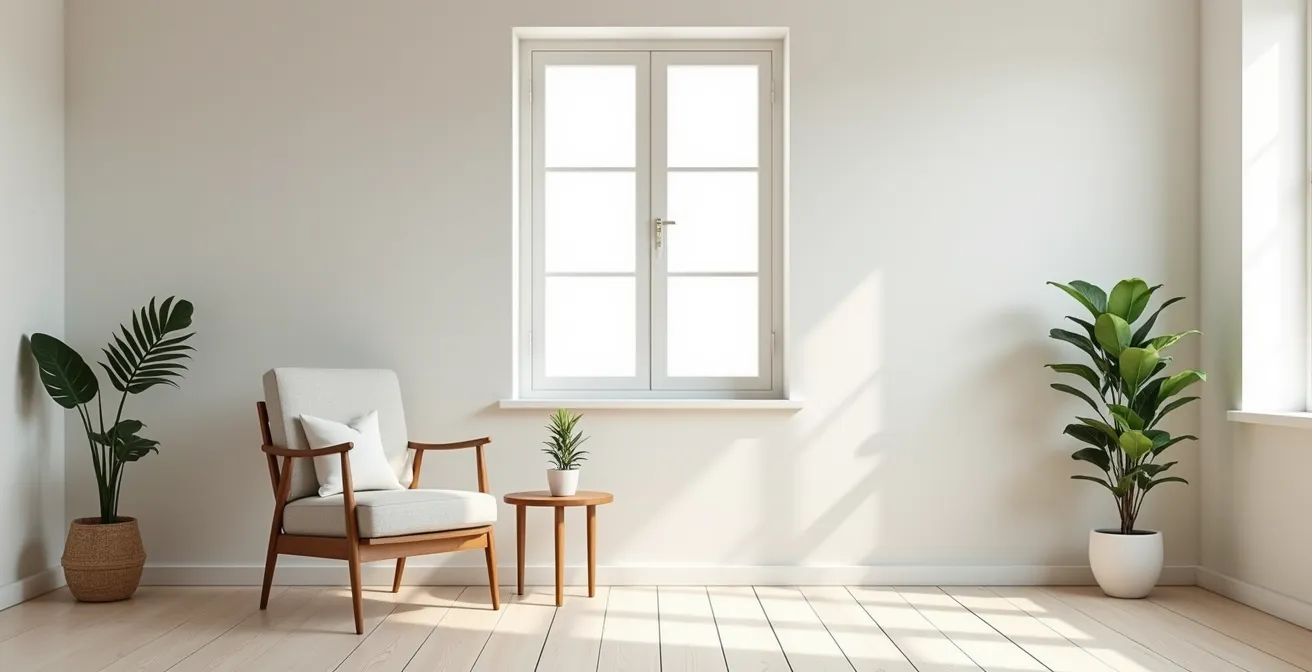
A cluttered home isn’t just messy—it’s actively draining your brain’s processing power and fueling daily stress.
- Visual clutter constantly competes for your attention, increasing the stress hormone cortisol and reducing your ability to focus.
- Implementing simple systems for daily intake and choosing strategic starting points can create lasting change without the overwhelm of a massive overhaul.
Recommendation: Shift your mindset from ‘cleaning’ to ‘designing a low-stimulus environment’ to intentionally reclaim your mental energy and focus.
If your home feels less like a sanctuary and more like a second job, you’re not alone. For overwhelmed parents and executives, the constant presence of ‘stuff’—piles of mail, overflowing shelves, disorganized rooms—creates a persistent, low-grade hum of stress. This isn’t just a feeling; it’s a neurological reality. The mental fog that descends after a long day is often exacerbated by a home environment that demands constant, subconscious processing from a brain that is already depleted.
Common advice often revolves around marathon cleaning sessions or rigid rules about discarding possessions. While well-intentioned, these approaches often fail because they treat the symptom, not the cause. They focus on the ‘what’ (the mess) without addressing the ‘why’ (the impact on your brain).
But what if the solution wasn’t about achieving a picture-perfect home, but about engaging in a strategic act of cognitive resource management? The real key to liberation from clutter-induced stress lies in understanding its effect on your brain’s limited processing power. This guide reframes decluttering entirely: it’s not a chore, but an intentional process of designing a low-stimulus environment to reclaim your focus, reduce your daily stress levels, and clear the mental fog for good.
This article will guide you through the science behind visual clutter and stress, provide structured systems to stop pile-ups before they start, and help you overcome the psychological barriers to letting go. We will explore how to make strategic choices, from your pantry to your furniture arrangement, to create a home that calms your mind instead of overwhelming it.
Summary: How to Declutter Your Visual Field to Lower Daily Stress Levels
- Why Owning Fewer Things Gives You Back 5 Hours a Week?
- How to Process Mail and Items Immediately to Stop Pile-Ups?
- Closed Cabinets or Open Shelves: Which Is Better for a Calm Mind?
- The Fear-Based Mistake That Keeps You Holding onto Junk for 10 Years
- Where to Start: The Junk Drawer or the Garage for Momentum?
- How to Organize Your Pantry so You Never Order Takeout on Tuesday?
- Why Open Shelving Increases Cortisol Levels in Cluttered Minds?
- How to Arrange Furniture in Small Spaces to Prevent Stagnant Airflow
Why Owning Fewer Things Gives You Back 5 Hours a Week?
Every object in your visual field sends a signal to your brain, demanding to be categorized, evaluated, or ignored. When your environment is cluttered, your brain is forced into a state of continuous partial attention, splitting its resources to process a multitude of unimportant stimuli. This isn’t just distracting; it’s a significant drain on your cognitive load. According to findings from the Princeton University Neuroscience Institute, a disorganized environment overwhelms the brain’s visual cortex, impairing its ability to process information and focus. This directly contributes to that feeling of mental fog and exhaustion, even when you haven’t been actively “working.”
The stress response is physiological. Research from UCLA’s Center on Everyday Lives of Families reveals the tangible impact, showing that living in a cluttered space can lead to a 30% increase in stress levels, particularly for women. This is because the visual “noise” constantly signals to your brain that your work is never done, preventing true mental rest and recovery.
By consciously owning fewer things, you are not just tidying up; you are reducing the number of decisions your brain has to make each day. The “5 hours a week” isn’t just about less time spent cleaning. It’s about reclaiming the mental energy previously spent on managing, navigating, and subconsciously processing your possessions. This reclaimed processing power can then be redirected toward what truly matters: your family, your work, and your well-being.
How to Process Mail and Items Immediately to Stop Pile-Ups?
The most persistent clutter often starts at the entrance of our homes. Mail, packages, keys, and items from the day’s errands form “doom piles” that slowly expand, creating a visual reminder of pending tasks. The key to stopping this is not a bigger pile, but a better system. The goal is to create a “cognitive landing strip”—a designated, streamlined zone designed for immediate processing, not temporary storage.
This system is built on the “touch it once” principle. When an item enters your home, you make an immediate decision: act, file, or discard. To make this effortless, your landing strip should be equipped with the necessary tools. This means having a shredder, a recycling bin, and a simple “action” tray right where you need them. If a bill needs to be paid or a form needs to be signed, and it takes less than two minutes, do it immediately. This simple rule prevents the mental weight of a task from lingering for days.
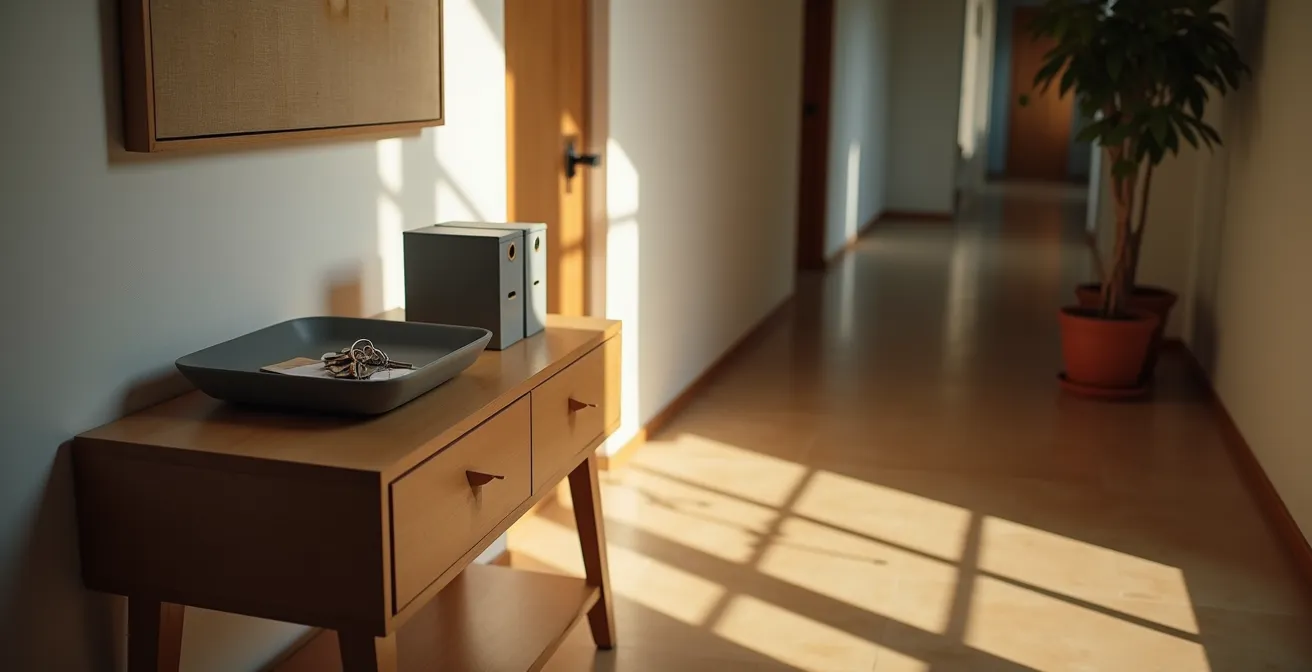
As you can see, a well-designed processing zone is minimal and functional. It provides a clear, structured pathway for incoming items, preventing them from ever becoming clutter. This isn’t about adding more furniture; it’s about creating a simple, repeatable workflow that becomes second nature. Involving the whole family, perhaps with a 10-minute daily reset, transforms this from a personal chore into a shared household habit that maintains a low-stimulus environment for everyone.
Closed Cabinets or Open Shelves: Which Is Better for a Calm Mind?
The choice between closed cabinets and open shelves is more than an aesthetic one; it’s a strategic decision in managing your daily cognitive load. Each option has a distinct psychological impact, especially for a mind already prone to feeling overwhelmed. The best choice depends on your capacity for visual curation and your primary goal: hiding chaos or displaying order.
Open shelving demands constant vigilance. Every item is visible, and if not perfectly arranged, it contributes to visual clutter. For a cluttered mind, this can be counterproductive, as the shelves become another source of visual “noise” that the brain must process. However, for those who find curation calming, beautifully organized open shelves can serve as a visual anchor of peace and order. This approach requires a minimalist mindset, where only essential or beautiful items are displayed.
Closed cabinets, on the other hand, offer an immediate solution to visual clutter. By simply closing a door, you create a calm, uniform surface that gives your brain a place to rest. This is the principle of “out of sight, out of mind” put into practice. For busy parents and executives, closed storage is often the more liberating choice because it provides a quick way to restore a sense of order without needing to perfectly arrange every single item inside. It contains the chaos, allowing the exterior of your space to remain a low-stimulus environment.
The following table summarizes the cognitive trade-offs:
| Storage Type | Pro (For a Calm Mind) | Con (For a Calm Mind) |
|---|---|---|
| Closed Cabinets | Instantly reduces visual noise; hides imperfection; requires less daily maintenance. | Can hide accumulating clutter, delaying the decision-making process. |
| Open Shelves | Encourages ownership of fewer, more intentional items; can be visually pleasing. | Requires constant curation; any disorganization adds to cognitive load. |
Ultimately, the most calming solution is the one that requires the least amount of ongoing mental effort from you. For most people struggling with mental fog, closed cabinets provide a more sustainable path to a visually serene home.
The Fear-Based Mistake That Keeps You Holding onto Junk for 10 Years
Often, the biggest obstacle to decluttering isn’t a lack of time or energy, but a deep-seated fear. It’s the fear of needing something “someday,” the fear of wasting money, or the fear of letting go of an identity tied to an object. This fear keeps us tethered to possessions we don’t use, need, or even like. It’s the reason a broken appliance sits in the garage for a decade or clothes that haven’t fit in years still occupy valuable closet space. This isn’t a personal failing; it’s a common psychological trap rooted in anxiety and a perceived loss of control.
This connection between our environment and our mental state is profound. As clinical psychologist Dr. Michael Carollo of Columbia University notes:
When our living environment becomes unmanageable for a period of time, it can be a symptom of depression or anxiety.
– Dr. Michael Carollo, PsyD, Columbia University Clinical Psychologist
The act of holding onto junk is often a misguided attempt to maintain control in a world that feels uncertain. The “what if” scenarios our brains create are powerful, but they come at the cost of our present-day peace of mind. A 2020 study from DePaul University found that the act of decluttering itself directly combats this fear. By making conscious decisions about what to keep and what to discard, individuals regain a sense of agency and control over their immediate environment, which in turn reduces feelings of fear and psychological reactance.
Letting go is not an act of lack, but an act of liberation. It’s choosing your current mental well-being over a hypothetical future need. It’s a declaration that your peace of mind today is more valuable than an object you might, but probably won’t, need tomorrow. Breaking this cycle requires acknowledging the fear and then acting in spite of it, one small decision at a time.
Where to Start: The Junk Drawer or the Garage for Momentum?
When facing a cluttered home, the question of where to begin can be paralyzing. The thought of tackling a massive project like the garage or basement can be so overwhelming that it leads to inaction. The secret to building momentum is not to start with the biggest mess, but with the area that will deliver the biggest psychological win. This means choosing a small, highly visible space that you interact with daily.
Why? Because every time you see that newly organized space—be it your kitchen counter, your desk, or a single clean drawer—your brain gets a hit of dopamine. It’s a tangible reward that proves change is possible. This small success builds confidence and creates the energy needed to tackle larger projects. Research in the Journal of Environmental Psychology supports this, showing that participants experienced a 50% increase in happiness after decluttering their space, a feeling that fuels further action.
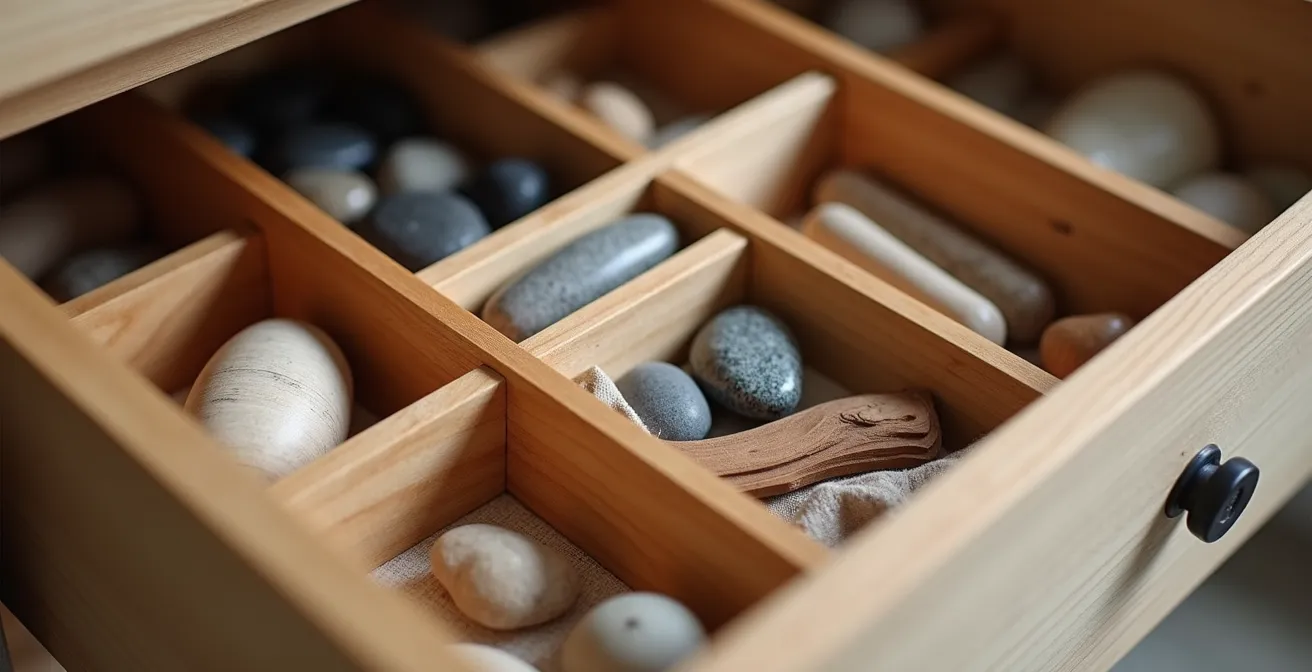
The junk drawer is often a perfect starting point. It’s contained, manageable within a short timeframe, and its transformation from a chaotic mess to an organized resource is incredibly satisfying. Completing one such area fully before moving to the next is key. This “snowball” method of starting small and building on successes is far more effective than attempting to clean the entire house at once and burning out. The goal is not perfection overnight, but consistent, momentum-building progress.
Your Action Plan: Gaining Decluttering Momentum
- Identify High-Visibility Hotspots: List 3 small but constantly visible cluttered areas (e.g., kitchen counter, coffee table, entryway console).
- Select Your First Target: Choose the easiest one from your list. Commit to decluttering only this single area.
- Time-Block the Task: Set a timer for 30-60 minutes. This creates a focused, low-pressure window for action.
- Execute the Four-Box Method: As you clear the area, sort every item into one of four categories: Keep, Donate/Sell, Trash/Recycle, or Relocate (belongs in another room).
- Complete the Cycle: Do not move on until the trash is out, donations are boxed, and relocated items are put away. Admire your work to lock in the psychological win.
How to Organize Your Pantry so You Never Order Takeout on Tuesday?
The “what’s for dinner?” question at the end of a long day is a major source of decision fatigue for busy families and professionals. When you open a cluttered pantry, you’re not just looking at food; you’re facing a wall of disorganized information that your tired brain must process. This moment of overwhelm is often what tips the scale in favor of ordering expensive and often unhealthy takeout. A strategically organized pantry, however, can make meal preparation the path of least resistance.
The solution is to think like a professional chef and implement a simplified FIFO (First In, First Out) system. This means organizing items so that older products are used before newer ones, reducing food waste. But the real power comes from creating “zones.” Group like items together: pastas and grains in one area, canned goods in another, snacks in their own bin. This turns a chaotic shelf into a logical map your brain can read instantly.
Taking this a step further, create “meal kit zones.” If you frequently make tacos, store the shells, seasoning packets, and canned beans together. This simple act reduces the decision-making time for a weeknight dinner from a 15-minute scavenger hunt to a 2-minute grab-and-go. Using clear containers is also a game-changer. Being able to see exactly how much rice or pasta you have left eliminates guesswork and prevents you from buying duplicates. This level of organization has a ripple effect on your entire well-being; in fact, studies show that individuals in decluttered environments report a 23% improvement in overall well-being.
An organized pantry isn’t about aesthetics; it’s a functional system designed to conserve your most precious resource at the end of the day: your mental energy. It makes the right choice—a home-cooked meal—the easy choice.
Key Takeaways
- Clutter is a cognitive drain, not just a physical mess. It actively consumes your brain’s limited processing power and increases stress.
- Effective change comes from implementing simple systems (like the “touch it once” rule) rather than relying on infrequent, exhausting cleaning marathons.
- Start with a small, high-visibility area. The psychological win from one clean drawer provides the momentum needed to tackle larger projects.
Why Open Shelving Increases Cortisol Levels in Cluttered Minds?
The trend of open shelving in kitchens and living rooms, popularized by minimalist design, can be a hidden source of stress for those not naturally inclined to meticulous organization. While visually appealing in a magazine, in a real, lived-in home, open shelves display every item, turning them into a constant visual to-do list. Your brain can’t help but notice the slightly misaligned stack of plates or the mismatched mugs, adding to your subconscious cognitive load.
This isn’t just a matter of preference; it has a measurable biological effect. A landmark 2009 UCLA CELF study demonstrated that women show unhealthy cortisol patterns in cluttered homes, while men’s cortisol levels were largely unaffected. The researchers noted that women often associate a tidy home with a successful family and life, so the visual evidence of clutter can trigger feelings of failure and a physiological stress response. Open shelving, if not perfectly curated, essentially puts this potential stressor on permanent display.
The psychological impact is significant. According to the Journal of Environmental Psychology, people who describe their homes as cluttered are 77% more likely to experience symptoms of anxiety and depression. For a mind that is already feeling overwhelmed, the pressure to maintain perfectly styled open shelves can be the tipping point. It forces a level of daily curation that many busy individuals simply do not have the bandwidth for. In this context, the visual peace offered by a closed cabinet door is a far more effective strategy for creating a genuinely calming environment.
How to Arrange Furniture in Small Spaces to Prevent Stagnant Airflow
Decluttering your visual field extends beyond just objects; it includes the very arrangement of your space. In small rooms, poor furniture placement can create a sense of stagnation, both physically and mentally. Blocked pathways and cramped layouts restrict not only airflow but also your “cognitive flow.” Your brain perceives these physical barriers as obstacles, subtly increasing tension and making a space feel smaller and more stressful than it is.
The goal is to create clear, unobstructed sightlines and pathways. Studies on environmental psychology show that the ability to see from one end of a room to another, or from the doorway to a window, has a calming effect on the nervous system. It creates a sense of openness and reduces the subconscious feeling of being trapped. People living in spaces with these clear visual paths report better sleep quality and reduced anxiety levels. This is about creating a feeling of “visual breathability.”
To achieve this, apply the “Line of Sight Test.” Stand at the main doorway of a room and identify the primary visual path to the furthest point, usually a window. Any furniture blocking that direct line of sight should be moved or replaced. Choosing furniture with legs, like a sofa or console table that is raised off the ground, also contributes to this effect by allowing light and air to move freely, making the room feel larger and more dynamic. A few simple rules can transform a cramped room into a serene and flowing space:
- Prioritize the Path: Ensure a minimum of a 3-foot pathway through the main traffic areas of a room.
- Pull from the Walls: Pulling furniture even a few inches away from the walls can create a greater sense of space.
- Elevate Furniture: Opt for pieces with legs to create an illusion of more floor space and light.
- Use Mirrors Strategically: Place a large mirror opposite a window to bounce light and visually double the space.
By arranging your furniture to enhance flow and light, you are doing more than decorating. You are designing an environment that actively supports your mental well-being, reducing cognitive load and creating a true sanctuary where your mind can finally rest.
The journey to a less stressful life begins with the intentional design of your personal space. Start today, not by attempting a massive overhaul, but by making one conscious decision to reclaim a piece of your visual field and reduce your cognitive load.