

High-performance self-care isn’t about adding more to your day; it’s about strategic micro-interventions with measurable ROI.
- Cookie-cutter wellness plans fail because they ignore the bio-individuality and intense cognitive load specific to leadership roles.
- Targeted breaks, precise nutrition, and adaptogenic protocols directly combat decision fatigue and dysregulated cortisol.
Recommendation: Focus on systemizing small, data-backed habits for energy regulation, not on finding extra hours for generic “wellness.”
For the high-stress professional, the concept of “self-care” often feels like another unproductive item on an already overflowing agenda. Standard advice—yoga retreats, hour-long meditations, digital detox weekends—is not only impractical but fundamentally misunderstands the executive environment. The challenge isn’t a lack of desire for well-being; it’s the absence of an efficient, scalable system that integrates seamlessly into a day packed with back-to-back meetings and high-stakes decisions. The pervasive feeling is that time invested in self-care is time stolen from productivity, creating a paradox where the actions needed to sustain performance are seen as a threat to it.
This leads to a reliance on sheer willpower and caffeine, a strategy with a notoriously short half-life. The conventional wellness industry offers solutions that are a poor fit for a world that measures time in minutes and outcomes in quarterly reports. But what if the entire premise is flawed? What if effective self-care for leaders isn’t about lengthy escapes but about precision-engineered, high-ROI “micro-interventions”? Instead of adding another block to your calendar, the key is to optimize the interstitial moments that already exist within your workday.
This guide deconstructs the 15-minute self-care routine from a performance coaching perspective. We will dismantle why generic plans fail, providing a data-driven framework to manage cognitive load, regulate cortisol, and optimize energy. We will explore how to strategically integrate micro-rest, solve the sedentary slump, and leverage nutrition and adaptogens to eliminate brain fog. The objective is not to add more to your plate, but to make every moment work smarter for your physical and mental capital.
This article provides a systematic approach to building a sustainable and effective self-care protocol. Below is a summary of the key systems we will engineer to reclaim your energy and focus.
Summary: How to Build a 15-Minute Self-Care Routine for Busy Executives
- Why Cookie-Cutter Wellness Plans Fail to Reduce Stress for 70% of Leaders?
- How to Integrate Micro-Rest Breaks During an 8-Hour Workday Without Losing Focus?
- Morning Priming vs Evening Decompression: Which Yields Better ROI for Focus?
- The Hidden Cost of Skipping Breaks That Leads to Burnout Within 6 Months
- Solving the Sedentary Slump: 3 Ways to boost Circulation Before 2 PM
- Why High Cortisol Specifically Targets Abdominal Fat Storage?
- Why Your “Healthy” Oatmeal Breakfast Is Causing Mid-Morning Hunger?
- How to Banish Brain Fog Using Nootropic Adaptogens and Fasting
Why Cookie-Cutter Wellness Plans Fail to Reduce Stress for 70% of Leaders?
The fundamental flaw in mainstream wellness advice is its one-size-fits-all approach. These “cookie-cutter” plans ignore the unique stressors and physiological demands of executive roles. Leadership is characterized by relentless decision-making, constant context-switching, and the management of complex human dynamics. The resulting cognitive load is immense. A generic suggestion to “meditate for 20 minutes” fails because it doesn’t address the root cause of the overload; it simply adds another task to an executive’s schedule.
Furthermore, these plans rarely account for bio-individuality. An effective routine must be tailored to a person’s chronotype, metabolic response, and specific stress triggers. Forcing a “night owl” into a 5 AM journaling session is counterproductive, just as recommending a high-carb breakfast to someone with insulin sensitivity will sabotage their morning focus. This lack of personalization is a primary reason for failure and abandonment. The reality is that executive stress isn’t a monolith; it’s a complex interplay of psychological pressure and physiological response.
The data confirms this disconnect. A recent Vistage survey revealed that 71% of CEOs report experiencing burnout at least occasionally, with 32% experiencing it frequently or daily. This epidemic persists despite the widespread availability of wellness resources, proving that current solutions are not hitting the mark. Executives are stuck in a cycle where the very structure of their role—spending an average of 17 hours a week in meetings—leaves no time for the deep strategic thinking they are paid for, let alone for ineffective wellness routines. True solutions must be integrated, not additive, targeting the specific points of failure in an executive’s day.
How to Integrate Micro-Rest Breaks During an 8-Hour Workday Without Losing Focus?
The key to sustainable energy management is not long breaks, but frequent, strategic “micro-interventions.” The goal is to dissipate cognitive residue—the lingering thoughts from a previous task—before moving to the next. A relentless, back-to-back schedule without these resets guarantees diminished focus and poor decision quality by mid-afternoon. Integrating micro-breaks requires a shift in mindset: view these moments not as lost time, but as an active tool for performance enhancement.
One highly effective method is sensory stacking. This involves using a quick, powerful sensory input to trigger a state change. For example, using a peppermint or citrus essential oil can create an immediate neurological alert, cutting through mental fog. The physical act of holding a diffuser or applying a roll-on provides a tactile anchor, pulling your focus into the present moment and away from the previous meeting’s lingering stress.
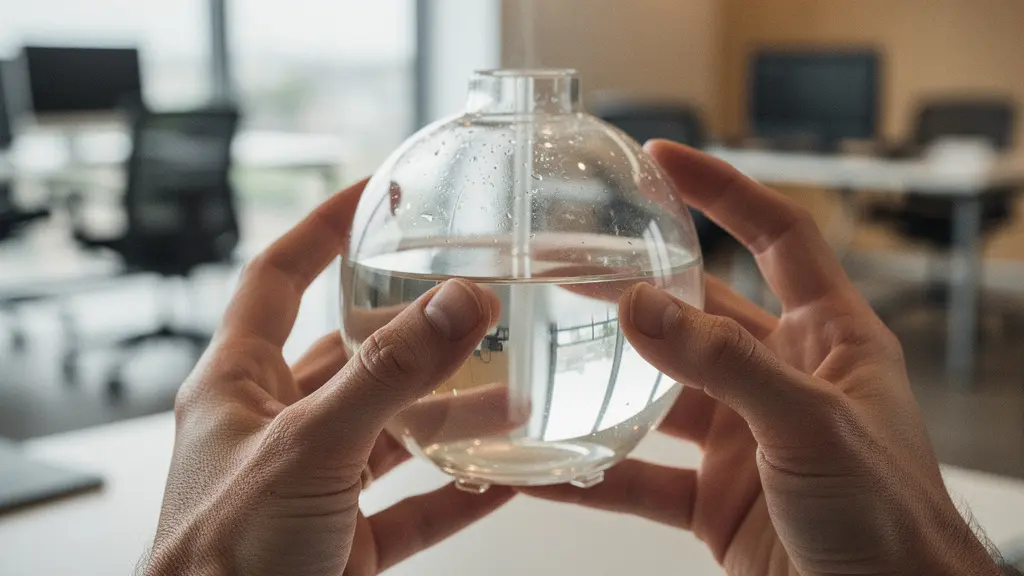
As this image illustrates, the technique is discreet and can be done at your desk in seconds. These interventions are about efficiency. They are designed to fit into the transitional periods you already have, such as the 90 seconds between ending a Zoom call and starting the next task. Here are a few protocols to implement:
- The 60-Second Walk: Between meetings, stand up and walk briskly around your office or to a window. This changes your physical state and resets your mental context.
- The 10-Second Posture Check: At your desk, consciously pull your shoulders back and down, elongating your spine. This counters the physical slump of sitting and improves breathing.
- The 5-Second Eye Palm: Before a video call, rub your hands together to generate warmth and gently press your palms over your closed eyes. This reduces visual strain from screen time.
- The Single Intentional Breath: Before opening a new document, take one deep diaphragmatic breath and state your intention for the task (e.g., “Clarity and focus”).
Morning Priming vs Evening Decompression: Which Yields Better ROI for Focus?
The debate between prioritizing a morning or evening routine is common, but the answer depends entirely on an executive’s chronotype and performance goals. A “one-size-fits-all” mandate is inefficient. The question isn’t which is better, but which routine provides the highest Return on Investment (ROI) for your specific biological wiring. A morning “priming” routine is designed for proactive focus, setting the cognitive and physiological stage for a day of strategic decision-making. An evening “decompression” routine is about reactive recovery, clearing cognitive debt and optimizing sleep to ensure peak performance the next day.
For “Lion” chronotypes (natural early risers), a morning routine between 5:00 and 6:30 AM delivers the best results. Activities like meditation, journaling, and light exercise during this window can optimize the natural morning cortisol peak, leading to up to 10 hours of enhanced performance. Conversely, “Wolf” chronotypes (night owls) gain more from an evening routine. Forcing a Wolf into a 5 AM workout is a recipe for fatigue. Their peak ROI comes from a decompression protocol between 8:00 and 10:00 PM, focusing on a digital detox, gratitude practices, and gentle stretching to lower cortisol and improve sleep quality.
The following analysis breaks down the strategic value of each approach, helping you architect a routine based on your individual needs. This data-driven perspective, based on an analysis of high-performing CEO habits, moves beyond generic advice to provide an actionable framework.
| Factor | Morning Priming | Evening Decompression |
|---|---|---|
| Best For | Lions chronotype (early risers) | Wolves chronotype (night owls) |
| Peak Benefit Time | 5-6:30 AM | 8-10 PM |
| Focus Impact | Proactive focus for strategic decisions | Reactive recovery for next-day performance |
| Key Activities | Meditation, journaling, light exercise | Digital detox, gratitude practice, stretching |
| Productivity Boost | 10 hours of optimized performance | Improved sleep quality & cortisol reset |
Ultimately, organizations with leaders who follow defined, personalized routines demonstrate superior long-term success. The key is not to do everything, but to do what works for your biology with absolute consistency. Choose one—priming or decompression—and execute it flawlessly for 30 days before considering adding the other.
The Hidden Cost of Skipping Breaks That Leads to Burnout Within 6 Months
For many executives, skipping breaks feels like a necessary sacrifice for productivity. This is a critical miscalculation. The refusal to pause doesn’t create more time; it accumulates cognitive debt, a state of mental exhaustion that directly degrades the quality of your primary output: decisions. Each decision, no matter how small, depletes a finite pool of mental energy. Without periodic resets, you fall into a state of decision fatigue, where your brain defaults to the easiest option, not the best one. This leads to risk aversion, procrastination on complex issues, and a marked decline in strategic thinking.
This isn’t a theoretical concept; it’s a measurable phenomenon. The cost of this accumulated fatigue is severe and manifests within months, not years. The initial symptoms include persistent brain fog, increased irritability, and a reliance on stimulants like caffeine to power through the day. This exhaustion is rampant in the modern workforce. A comprehensive study revealed that 82% of knowledge workers experience some level of exhaustion. Left unchecked, this state rapidly escalates into full-blown burnout, characterized by cynicism, detachment, and a complete loss of professional efficacy.
Case Study: The Tangible Cost of Decision Fatigue
The impact of skipping breaks was starkly illustrated in a research study on judicial rulings. The study found that the percentage of favorable rulings judges made dropped steadily from approximately 65% at the beginning of a session to nearly zero by the end of it. However, after a food break, the rate of favorable rulings immediately returned to around 65%. This demonstrates that even highly trained professionals make vastly different—and often harsher—decisions when they are mentally depleted. For an executive, the “unfavorable ruling” could be a rejected proposal, a missed opportunity, or a poor strategic call, all directly attributable to the failure to take a break.
The message is unequivocal: breaks are not a luxury. They are a non-negotiable component of a high-performance cognitive workflow. Skipping them is not a sign of dedication but an inefficient strategy that directly leads to a catastrophic decline in performance within two fiscal quarters.
Solving the Sedentary Slump: 3 Ways to boost Circulation Before 2 PM
The “sedentary slump” that hits most professionals after lunch is not just a feeling of tiredness; it’s a physiological event. Hours of sitting lead to poor circulation and lymphatic stagnation, reducing the flow of oxygen to the brain and causing physical and mental lethargy. Combating this requires proactive, targeted movement, not a post-work gym session that comes too late. The goal is to stimulate blood flow and lymphatic drainage *during* the workday. Here are three efficient protocols to implement before 2 PM.
First, leverage conference calls as opportunities for movement. Instead of staying seated, stand up and perform simple, repetitive exercises. This “active listening” approach boosts circulation without distracting from the call’s content. Second, integrate under-the-desk movements that can be done discreetly while working. These small actions prevent blood from pooling in the lower extremities. Third, build in quick, targeted stretches that release tension in the neck and shoulders, common problem areas for desk workers.
Many top performers have integrated these principles into their daily operations. Their routines underscore that consistent movement is a cornerstone of sustained energy, not an afterthought.
Tim Ferriss adopts a ‘slow morning’ routine beginning with meditation, then proceeding with journaling as well as light exercise. Such a strategy aids him in staying focused and clear. Richard Branson credits his energy to regular physical activity. Whether it’s kite surfing or tennis, he prioritizes movement as a key to his success.
– Corewell Fit, Healthy Lifestyle Habits for Busy Professionals
Here is a simple protocol to execute at your desk:
- 60-Second Calf Raises: While on a conference call, stand and lift your heels off the ground 20 times. This acts as a “second heart,” pumping blood from your lower legs.
- Under-Desk Ankle Rotations: While seated, circle each ankle 10 times clockwise and 10 times counter-clockwise.
- Seated Glute Squeezes: To activate the largest muscles in your body, contract your glutes for 5 seconds and release. Repeat 10 times.
Why High Cortisol Specifically Targets Abdominal Fat Storage?
For high-stress professionals, the accumulation of abdominal fat is often a frustrating and persistent issue, even with a disciplined diet and exercise regimen. This is not a failure of willpower; it is a direct and predictable biological consequence of chronic stress. The primary mechanism is the hormone cortisol. In an acute stress situation (a “fight or flight” response), cortisol is beneficial, mobilizing glucose for immediate energy. However, in the chronic, low-grade stress environment of executive life, cortisol levels remain persistently elevated.
This chronically high cortisol sends a specific signal to the body. It promotes the storage of visceral fat—the deep, metabolically active fat that surrounds the abdominal organs. The body interprets constant stress as a sign of impending famine or danger, so it prioritizes storing the most readily accessible energy source (fat) in a central location (the abdomen). This is because visceral fat cells have a higher concentration of cortisol receptors than fat cells elsewhere in the body, making them particularly sensitive to stress signals. This process also drives cravings for high-sugar, high-fat foods, creating a vicious cycle of stress, poor eating, and further fat storage.
The health implications extend far beyond aesthetics. Chronic burnout and the associated high cortisol are linked to a host of severe medical conditions. This connection underscores the critical importance of stress management as a health imperative, not a lifestyle choice.
Burnout is connected to many health risks, including type 2 diabetes, chronic fatigue, debilitating headaches, cardiovascular disease, gastrointestinal issues, and death before the age of 45.
– UK Workplace Health Research, 2024 Workplace Burnout Health Impact Study
Therefore, any effective self-care routine for an executive must have cortisol regulation as a primary objective. Without addressing the hormonal root cause, efforts to reduce abdominal fat through diet and exercise alone will yield minimal and frustrating results. The focus must be on systemic stress reduction through targeted breaks, proper sleep, and strategic nutrition.
Why Your “Healthy” Oatmeal Breakfast Is Causing Mid-Morning Hunger?
Many executives start their day with what is marketed as a “healthy” breakfast, such as instant oatmeal or a fruit smoothie, only to find themselves hungry, irritable, and battling brain fog by 10:30 AM. This mid-morning energy crash is often the first domino to fall in a day of poor productivity. The culprit is not a lack of calories, but an improperly structured meal that triggers a rapid blood sugar spike followed by a steep crash. Most commercial oatmeals are highly processed, causing them to be digested as quickly as simple sugar.
This spike-and-crash cycle has a direct impact on cognitive function and mood. The initial glucose rush provides a brief burst of energy, but the subsequent drop leaves the brain starved for fuel, leading to a desperate craving for more sugar or caffeine. This metabolic rollercoaster is the enemy of sustained focus. An effective breakfast for an executive must be engineered for stable, long-lasting energy. The key is to combine three elements: protein, healthy fats, and fiber-rich complex carbohydrates. This combination slows down digestion, prevents sharp glucose spikes, and promotes satiety for hours.
Instead of eliminating oatmeal, the solution is to modify it. Switching from instant oatmeal to steel-cut oats provides more fiber. More importantly, adding a source of protein (like protein powder or Greek yogurt) and fat (like nut butter or chia seeds) transforms the meal from a fast-burning fuel into a slow-release energy source. An analysis of breakfast types and their energy impact provides a clear guide for making better choices.
| Breakfast Type | Initial Energy | 2-Hour Impact | Recommended Modification |
|---|---|---|---|
| Instant Oatmeal | Quick spike | Energy crash & hunger | Add protein powder + chia seeds |
| Steel-Cut Oats | Gradual rise | Sustained energy | Add nut butter for extra satiety |
| Protein-Forward (eggs/avocado) | Stable | No crash | Add complex carbs for balance |
| Overnight Oats | Moderate rise | Steady energy | Include Greek yogurt for protein |
A simple tip to ensure compliance on busy mornings is meal prep. Pre-slicing fruits and vegetables or making large batches of steel-cut oats or egg muffins at the start of the week removes decision fatigue from your morning routine, making the optimal choice the easiest choice.
Key Takeaways
- Effective self-care is not about time, but about the ROI of targeted micro-interventions.
- Personalization is paramount; cookie-cutter wellness plans fail by ignoring bio-individuality and chronotypes.
- Systematic management of cortisol and blood sugar is more critical for executive performance than generic stress-reduction techniques.
How to Banish Brain Fog Using Nootropic Adaptogens and Fasting
For an executive, brain fog is not a minor inconvenience; it is a direct threat to performance. It impairs clarity, slows decision-making, and stifles creativity. While sleep and nutrition are foundational, advanced protocols involving nootropic adaptogens and intermittent fasting can provide a significant edge in cognitive enhancement. Adaptogens are natural substances that help the body’s resistance to physical and emotional stress. They work by modulating the hypothalamic-pituitary-adrenal (HPA) axis, the body’s core stress response system. When used strategically, they can enhance focus, reduce anxiety, and regulate cortisol.
Combining adaptogens with a simple overnight fast can amplify their effects. A 12-14 hour fast (e.g., from 7 PM to 7 AM or 9 AM) gives the digestive system a rest and encourages the body to produce ketones, a clean and efficient fuel source for the brain. This can lead to a state of remarkable mental clarity upon waking. Timing the intake of specific adaptogens can then sustain this clarity throughout the workday.
For example, Rhodiola Rosea is excellent for combating acute mental fatigue in the morning. Lion’s Mane mushroom supports Nerve Growth Factor (NGF) for long-term cognitive health and is best taken in the afternoon for sustained clarity. Ashwagandha is ideal for the evening, as it helps modulate cortisol and reduce anxiety, promoting restorative sleep. This “stacking” approach creates a synergistic effect for all-day cognitive support. For those sensitive to stimulants, combining these with L-theanine can promote calm concentration without the jittery side effects of caffeine.
Your Action Plan: The Executive Adaptogen Protocol
- Morning Focus: Supplement with Rhodiola Rosea (200-400mg) to enhance mental stamina and combat acute fatigue.
- Afternoon Clarity: Take Lion’s Mane (1000mg) to support Nerve Growth Factor (NGF) and maintain cognitive sharpness through the post-lunch slump.
- Evening Decompression: Use Ashwagandha (300-600mg) to modulate cortisol levels and reduce anxiety, preparing the body for restorative sleep.
- Fasting Window: Implement a 12-14 hour overnight fast (e.g., stop eating at 7 PM, resume at 7-9 AM) to promote ketone production for brain fuel.
- Synergistic Stacking: Combine with L-theanine (200mg) as needed to achieve a state of calm, focused concentration without stimulant-induced jitters.
It is crucial to approach adaptogens systematically. Start with one at a time to assess individual response before creating a personalized stack. This methodical approach ensures you are building a cognitive enhancement system that is both effective and sustainable.
Building a 15-minute self-care routine is an engineering problem, not a time-management one. By implementing these data-driven, high-ROI micro-interventions, you can systematically manage your internal state to sustain peak performance. The next logical step is to audit your current daily workflow and identify the precise moments where these protocols can be integrated for maximum impact.