

Squatting safely over 50 isn’t about avoiding the movement; it’s about mastering force redistribution to protect your joints while building strength.
- Knee pain during squats often stems from mobility limitations in the ankles and hips, not weakness in the knee itself.
- Simple modifications to stance, depth, and core engagement can shift stress from vulnerable joints to powerful muscle groups like the glutes.
Recommendation: Instead of stopping squats, learn to diagnose your movement pattern’s “energy leaks” and apply corrective strategies for a stronger, pain-free future.
The advice often given to adults over 50 experiencing knee pain is simple and disheartening: “Just stop squatting.” This well-intentioned but misguided counsel treats a foundational human movement as the enemy, ignoring its profound benefits for strength, balance, and independence. You may have been told to switch to machines or stick to partial movements, leaving you feeling that your body’s capabilities are inevitably declining. This approach fails to address the root cause of the discomfort, which is rarely the squat itself, but rather *how* the squat is being performed.
The truth is, your body is a remarkable system of interconnected levers and pulleys. Pain is a signal that this system is out of balance—that force is being misdirected. The common advice only addresses the symptom, not the underlying mechanical issue. But what if the key wasn’t to abandon the squat, but to re-engineer it? What if, instead of seeing pain as a stop sign, you could learn to see it as a diagnostic tool, pointing you toward specific areas that need attention? This is the essence of training for longevity.
This guide offers a different perspective. It’s built on the principle that protecting your knees is not about limitation, but about skillful execution. We will explore how to redistribute force away from your joints and onto your muscles, turning the squat from a source of pain into a powerful tool for building resilient strength. We will break down the biomechanics of a safe squat, provide actionable warm-ups to prepare your body, and teach you how to listen to your body’s signals to differentiate between productive effort and harmful strain. The goal is to empower you with the knowledge to move with confidence for decades to come.
This article provides a comprehensive roadmap to rebuilding your squat from the ground up, focusing on safety, joint health, and sustainable strength. Discover the principles and practical steps to make this fundamental exercise a cornerstone of your fitness journey.
Summary: How to Modify Your Squat to Protect Knees While Building Leg Strength
- Why “Motion Is Lotion” Works to Lubricate Stiff Joints
- How to Spend 10 Minutes Warming Up to Prevent Specialized Injuries
- Leg Press or Barbell Squat: Which Is Safer for a Bad Lower Back?
- The “No Pain No Gain” Mistake That Leads to Hip Replacements
- When to Rest vs. Active Recovery: The Timeline for Older Tissue
- Why Dragging Your Poles Ruins the Upper Body Workout Benefit
- The Arching Mistake That Shifts Load to Your Spine Instead of Abs
- How to Build Muscle Density Using Water Resistance After Knee Surgery
Why “Motion Is Lotion” Works to Lubricate Stiff Joints
The phrase “motion is lotion” is more than a catchy saying; it’s a fundamental principle of joint health. Your joints are lined with cartilage and lubricated by a substance called synovial fluid. This fluid is essential, acting like engine oil to reduce friction and nourish the cartilage. However, unlike a car engine, your body doesn’t have a pump. The only way to circulate this vital fluid is through movement. When you move a joint through its range of motion, you compress and release the cartilage, creating a sponge-like effect that draws in fresh, nutrient-rich synovial fluid. This is why joints can feel stiff after long periods of inactivity, like waking up in the morning.
This principle is especially critical when considering a complex movement like the squat, which involves the entire lower body kinetic chain: the ankles, knees, and hips working in concert. If one joint in this chain is stiff or has limited mobility, it forces other joints to compensate, leading to stress and potential injury. For example, stiff ankles that can’t bend sufficiently will force the knees to travel excessively forward or the lower back to round to achieve depth—both are classic “energy leaks” that put undue strain on vulnerable tissues.
The effectiveness of this kinetic chain is supported by scientific observation. Research on deep squats highlights that the mobility of lower joints, such as the ankles, directly determines the available range of motion in the knees and hips. A restriction in one area creates a bottleneck for the entire movement. Therefore, preparing for squats isn’t just about the knees; it’s about ensuring the entire system is well-lubricated and mobile, allowing for a smooth, balanced distribution of force. Thinking of movement as a way to lubricate and prepare this entire chain is the first step toward a safer, stronger squat.
How to Spend 10 Minutes Warming Up to Prevent Specialized Injuries
A proper warm-up is non-negotiable, especially for mature bodies. It’s not about breaking a sweat; it’s a targeted 10-minute investment in joint health that prepares your specific kinetic chain for the demands of squatting. The goal is to improve mobility where it’s needed (ankles and hips) and activate the muscles that provide stability (core and glutes). This “joint-by-joint” approach systematically addresses the common culprits of knee pain before you even add weight.
Start with your ankles. Limited ankle dorsiflexion is a primary cause of poor squat mechanics. Spend 2-3 minutes on simple mobility drills. A great one is the half-kneeling ankle rock: get into a lunge position with your front foot about a hand’s-length from a wall, and gently rock forward, trying to touch your knee to the wall without your heel lifting. This directly improves the specific range of motion needed for a deep squat. You can test your mobility by placing your big toe five inches from a wall; if you can’t touch your knee to the wall without your heel lifting, this is a critical area for you to work on.
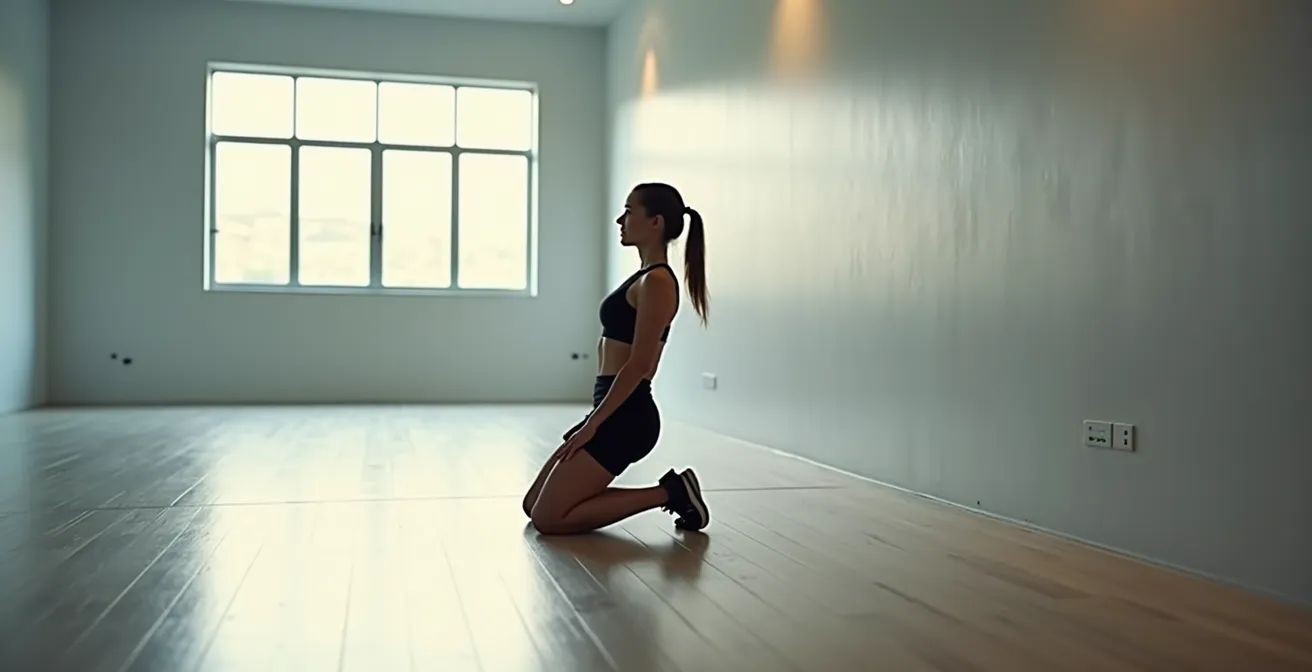
Next, focus on the hips for 3-4 minutes. Your hips are designed for a wide range of motion. Exercises like leg swings (forward/backward and side-to-side), cat-cow stretches, and bodyweight hip bridges “wake up” the hip flexors and, more importantly, activate the gluteal muscles. Finally, spend the last 3-4 minutes on core activation. Planks and bird-dog exercises teach your body to brace and create a rigid torso, which is essential for protecting your spine and transferring power efficiently from your lower body. This short, focused routine ensures your joints are lubricated and your primary moving muscles are ready to work.
Leg Press or Barbell Squat: Which Is Safer for a Bad Lower Back?
When lower back pain is a concern, many are quick to abandon the free-weight squat for the leg press machine, assuming its back support makes it inherently safer. This is a common misconception. While the leg press does support the spine, it can also encourage a dangerous movement pattern: posterior pelvic tilt, or “butt wink,” where the lower back rounds and lifts off the pad at the bottom of the movement. This flexion under load can place significant stress on the lumbar discs. The barbell squat, when performed correctly, trains the entire body—including the core muscles responsible for stabilizing the spine—to work as an integrated unit, offering superior functional benefits.
The key is not to abandon the squat, but to modify it. As a physical therapist at the Duke Center for Living, Cynthia Harrell, notes, the movement can be perfectly safe even for those with joint concerns if approached correctly.
Squatting is well tolerated by people with osteoarthritis of the knees if done correctly.
– Cynthia Harrell, Physical therapist at Duke Center for Living
Intelligent modifications can dramatically improve the safety and effectiveness of the squat, allowing you to build strength while protecting your back and knees. These adjustments are tools for force redistribution, shifting the workload away from sensitive areas and onto the powerful muscles of the hips and legs. The following table, based on an analysis of squat modifications for pain-free movement, outlines several effective strategies.
| Modification | Benefits | Best For |
|---|---|---|
| Wider Stance (20-30° toe-out) | More hip dominant movement, takes stress off knees, optimal knee alignment limiting tibial rotation | Knee pain, lower back issues |
| Box Squat | Controls depth, provides safety, maintains vertical shin | Limited mobility, form practice |
| Goblet Squat | Promotes upright torso, engages core naturally | Beginners, back pain |
| Elevated Heels | Reduces ankle mobility demands, allows better position | Limited ankle flexibility |
By experimenting with these variations, you can find the version of the squat that best fits your unique biomechanics, turning it into a safe and powerful tool for longevity.
The “No Pain No Gain” Mistake That Leads to Hip Replacements
The “no pain, no gain” mantra is perhaps the most dangerous piece of advice in fitness, especially for the aging athlete. Pushing through sharp, stabbing, or persistent joint pain is not a sign of toughness; it’s a signal of tissue damage. It’s crucial to distinguish between the productive discomfort of muscle fatigue and the destructive signal of joint or tendon pain. Muscle burn during a set is normal and part of the strengthening process. Pain within the joint itself—a sharp pinch in the hip or a grinding sensation in the knee—is an urgent warning sign that your form or programming is flawed.
Ignoring these signals and consistently training to failure with poor mechanics is a direct path to chronic injury. Research and clinical experience show that when knee pain from squats is persistent, the issue is often a programming error. Pushing intensity too high, too soon, without allowing for tissue adaptation, is the real culprit. In these cases, no amount of foam rolling or stretching will fix the problem. The first and most effective intervention is simply to reduce the intensity (load or volume). This single adjustment can often allow for pain-free squatting while you work on correcting the underlying mechanical flaws.
Your body has a finite capacity to recover, and this capacity decreases with age. Treating pain as an enemy to be conquered, rather than a messenger to be understood, leads to accumulated micro-trauma that can result in conditions requiring surgical intervention like hip or knee replacements. The truly advanced athlete is not the one who can lift the most weight, but the one who can listen to their body and train intelligently for decades. Learn to recognize these critical warning signs and stop your workout immediately if they appear:
- Unexplained swelling around the knee joint
- Knee locking or catching during movement
- Buckling or giving way of the knee
- Sharp, stabbing pain (versus muscle fatigue)
- Symptoms persisting beyond 24 hours post-workout
When to Rest vs. Active Recovery: The Timeline for Older Tissue
Understanding the difference between complete rest and active recovery is key to long-term training success. For older tissue, which recovers more slowly, this distinction is even more critical. Complete rest is necessary in cases of acute injury or sharp, debilitating pain. It means ceasing activity to allow inflamed tissues to calm down. However, for general muscle soreness (Delayed Onset Muscle Soreness, or DOMS), prolonged inactivity can be counterproductive, leading to more stiffness.
This is where active recovery comes in. It involves low-intensity movement designed to increase blood flow to tired muscles, which helps flush out metabolic waste products and deliver fresh oxygen and nutrients. This process can reduce soreness and speed up recovery, allowing you to train again sooner and more effectively. For aging joints, active recovery is a form of “motion is lotion,” keeping the joints lubricated and mobile without subjecting them to high stress. Think of it as a gentle whisper to your body, encouraging it to heal, rather than a loud command to perform.

Excellent forms of active recovery include walking, gentle cycling, stretching, or light mobility work. Aquatic exercise, as shown above, is particularly beneficial as the buoyancy of water supports the body and reduces stress on the joints while still providing gentle resistance. Even a structured, low-intensity movement protocol can serve as a recovery tool. For instance, a rehabilitation approach might involve performing 3 sets of 10-20 repetitions of a bodyweight movement with deliberate rest periods to encourage blood flow without causing further muscle damage. The rule is simple: active recovery should leave you feeling better, not more tired.
Why Dragging Your Poles Ruins the Upper Body Workout Benefit
In an activity like Nordic walking, passively dragging your poles behind you completely negates the purpose of using them for an upper-body workout. It becomes a wasted motion, an “energy leak.” A remarkably similar and far more critical energy leak occurs in the squat when you fail to actively engage the most powerful muscles in your body: the glutes. Many people perform squats in a “knee-dominant” way, initiating the movement by bending their knees first and relying heavily on their quadriceps. While the quads are involved, this pattern places excessive shear force on the knee joint and misses the single greatest opportunity of the squat: to build a powerful posterior chain.
This missed opportunity is critical because, as emphasized by experts, the glutes are the engine of your body. Actively engaging them is what transforms a simple up-and-down movement into a potent tool for building functional strength.
Your glutes are the powerhouse of your body and building strong glutes enables you to move with power, drive and force.
– Ben Main, Les Mills Creative Consultant
To correct this, you must learn to initiate the squat by pushing your hips back first, as if sitting down into a chair that’s slightly too far behind you. This “hip hinge” pattern automatically loads the glutes and hamstrings. Throughout the movement, think about actively “spreading the floor” with your feet. This cue helps engage your external hip rotators and glutes, creating stability in the pelvis and preventing the knees from collapsing inward—another common and dangerous energy leak. By shifting the focus from simply bending your knees to actively using your hips, you redistribute the force to the muscles best equipped to handle it, protecting your knees and unlocking the true power of the squat.
The Arching Mistake That Shifts Load to Your Spine Instead of Abs
One of the most common and dangerous form errors in the squat is excessive arching of the lower back, a condition known as hyperextension. This often happens when people over-emphasize keeping their “chest up” without properly engaging their core. When the lumbar spine arches, it can no longer effectively transfer force between the hips and the upper body. Instead, the vertebrae and surrounding small muscles are subjected to immense compressive and shear forces, putting you at risk for disc injuries and chronic lower back pain. This is a critical energy leak that shifts the load away from your abdominal muscles and directly onto your spine.
The solution is to learn how to create a “braced,” neutral spine. This doesn’t mean your back should be perfectly flat, but that it should maintain its natural, gentle curve without any change throughout the entire movement. To achieve this, you must engage your entire core—not just the “six-pack” abs in the front, but the obliques on the sides and the deep stabilizing muscles as well. A powerful cue is to imagine you are about to be punched in the stomach; that automatic, 360-degree tightening is the feeling you want to maintain. This creates an “internal weightlifting belt” that protects your spine.
Developing this proprioceptive awareness of your core takes practice. You can build this skill progressively, starting with foundational exercises and gradually applying the feeling to the squat. The goal is to make a braced spine second nature. To get started, you can try holding a simple wall squat. Initial protocols often recommend this isometric hold as a way to build endurance and awareness in the core and leg muscles in a supported position.
Your Action Plan: Building Core Stability for Squats
- Establish a Baseline: Start with dead bug or bird-dog exercises to learn how to keep your spine stable while your limbs are moving.
- Practice Bracing: Practice 360-degree bracing by taking a deep breath and then tightening your core as if preparing for an impact.
- Apply to Movement: Apply that same braced-spine feeling to unweighted, bodyweight squats, focusing on form over depth.
- Facilitate Hip Loading: Use tools like suspension trainers to assist your squat, allowing you to feel the proper hip hinge pattern with a stable spine.
- Integrate Load: Add a light weight in a goblet squat position; holding the weight in front of you naturally encourages core engagement and an upright torso.
Key Takeaways
- Knee pain is a symptom, not a diagnosis. It often points to mobility issues in your ankles and hips, which can be corrected.
- Intelligent modification is superior to avoidance. Adjusting your stance, depth, and tempo can transform the squat into a safe, joint-friendly exercise.
- Your core is your natural weightlifting belt. Learning to brace your spine is the most important skill for protecting your lower back during loaded movements.
How to Build Muscle Density Using Water Resistance After Knee Surgery
For individuals recovering from knee surgery or those with severe arthritis, even modified land-based exercises can be too painful or risky. This is where aquatic therapy emerges as a uniquely powerful tool for rebuilding strength without compromising joint integrity. Water possesses three key properties that make it an ideal rehabilitation environment: buoyancy, viscosity, and hydrostatic pressure. Buoyancy counteracts gravity, dramatically reducing the load on your joints. This allows you to perform movements like squats through a greater range of motion with significantly less pain.
Viscosity, or the natural “drag” of water, provides a safe and accommodating form of resistance. Unlike weights, which provide a constant load, water resistance is proportional to the speed and surface area of your movement. If you move slowly, the resistance is light; if you push harder and faster, the resistance increases. This allows you to precisely control the intensity of the exercise, ensuring you are always working within a safe and productive range. This viscous resistance also helps improve joint stability and strengthen the surrounding musculature.
Finally, hydrostatic pressure—the pressure exerted by the water on your body—can help reduce swelling and alleviate pain. This effect is why your legs can feel lighter and less achy after being in a pool. Studies on post-operative aquatic rehabilitation confirm that these properties work together to improve mobilization and muscle strengthening in a low-impact setting. For someone looking to regain muscle density after knee surgery, a progressive water-based protocol is one of the safest and most effective methods available:
- Begin with gentle squats in chest-deep water for maximum buoyancy.
- Add hamstring stretches and lunges in the water to improve flexibility.
- Use ankle fins for added resistance during knee extension exercises.
- Progress to walking on an underwater treadmill at a slow, controlled pace.
- Gradually increase water resistance by adjusting your movement speed or using aquatic resistance tools.
Just as water provides a uniquely supportive environment for healing, applying the principles of intelligent movement modification—like redistributing force, fixing energy leaks, and respecting your body’s signals—creates a sustainable path to building and maintaining strength for life.
To put these principles into practice, the next logical step is to perform a self-assessment of your own movement patterns and begin incorporating the appropriate modifications and corrective exercises into your routine.