

For driven professionals, the constant pressure to optimize every minute makes true relaxation feel impossible. This guide reveals a counterintuitive truth: the most powerful way to reduce anxiety isn’t more efficiency, but embracing ‘purposefully unproductive play.’ By learning to enjoy activities you’re bad at, you can rewire your brain’s reward system away from constant achievement and towards genuine, restorative joy, effectively building a sustainable defense against burnout.
Does your calendar look like a game of Tetris, with every single block filled? Do you feel a pang of guilt when you spend an hour doing something with no clear goal or ROI? For those in high-stakes careers, this relentless drive for productivity is both a superpower and a curse. You’ve optimized your work, your fitness, even your sleep. But in the process, you may have forgotten a fundamental human skill: how to play.
The standard advice—”get a hobby” or “take a break”—often falls flat. For a mind wired for achievement, a hobby can quickly become another project to master, another metric to track. A break feels like wasted time that could be spent getting ahead. This mindset, while effective in the boardroom, is a direct path to burnout. The constant pursuit of external validation depletes our internal resources, leaving us anxious, exhausted, and disconnected from any sense of spontaneous joy.
But what if the solution wasn’t to find another activity to be good at, but to deliberately choose one you’re terrible at? What if the real key to mental restoration lies not in accomplishment, but in the radical act of ‘purposefully unproductive play’? This isn’t about adding another task to your to-do list. It’s about giving yourself permission to engage in something purely for the sake of the process, not the outcome. It is about embracing joyful incompetence to heal a brain addicted to perfection.
This article will guide you through the psychology of adult play, showing you how to dismantle the mental barriers that block fun. We will explore how to choose activities that genuinely recharge you, protect your joy from the pressure to perform, and build small, sustainable rituals of play into your demanding life. It’s time to give yourself permission to play again.
To help you navigate this journey from productivity to playfulness, we’ve structured this guide to address the core challenges and strategies you’ll encounter. Below is a summary of the key areas we will explore.
Summary: Relearning “Play”: The Counterintuitive Method to Reduce Anxiety in Your High-Stakes Career
- Why Doing Something “For No Reason” Is Essential for Mental Health?
- How to Choose a Hobby That You Are Bad At (and Why That’s Good)?
- Woodworking or Watching TV: Which Truly recharges Dopamine?
- The Mistake of Turning Your Hobby into a Side Hustle That Kills the Joy
- When to Block “Blank Time” in Your Calendar for Spontaneity
- The Hidden Cost of Skipping Breaks That Leads to Burnout Within 6 Months
- How to Design a 2-Minute Trigger Routine to Enter Flow State Instantly
- How to Align Your Career with Your Core Values After 40
Why Doing Something “For No Reason” Is Essential for Mental Health?
In a world that worships productivity, doing something “for no reason” feels like an act of rebellion. But from a neurological standpoint, it’s a vital act of self-preservation. When your brain is constantly in goal-oriented mode—hitting targets, closing deals, optimizing workflows—it operates on a tight leash of cortisol and adrenaline. This is effective for short sprints but devastating as a marathon. Purposefully unproductive play is the antidote. It’s the act of telling your nervous system, “We are safe. We are not being evaluated. We can explore.”
This is not just a vague wellness concept; it has a tangible impact on brain structure and chemistry. Engaging in low-stakes, process-oriented activities helps regulate the amygdala, the brain’s alarm center. As research on therapeutic interventions for anxiety shows, effective treatments can decrease excessive neural reactivity, essentially calming the part of your brain that is on constant high alert. Play does this naturally, creating new neural pathways that associate unstructured time with safety and pleasure, not guilt.
The cost of ignoring this need for unstructured play is steep. High-achievers are particularly vulnerable to burnout, a condition that goes far beyond simple tiredness. It’s a state of profound emotional and physical exhaustion. The financial impact is also significant, as research from the American Journal of Preventive Medicine reveals that the average annual cost per executive burnout is $20,683 in healthcare expenses. Investing in play isn’t an indulgence; it’s a critical strategy for mental and financial well-being.
Think of it as mental cross-training. You wouldn’t train the same muscle group every day at the gym and expect it to grow stronger; it needs rest and variety. Similarly, the “achievement muscle” in your brain needs a break. Doing something for no reason—painting badly, learning three chords on a guitar, wandering through a park—is the essential, restorative work your mind needs to stay resilient, creative, and healthy.
How to Choose a Hobby That You Are Bad At (and Why That’s Good)?
Here’s a permission slip: you are officially allowed, and in fact encouraged, to be bad at your hobby. For a high-achiever, this concept is revolutionary. Your entire life has been geared towards competence and mastery. The thought of being a clumsy, fumbling beginner can trigger anxiety. But this is precisely where the magic lies. Choosing a hobby where you have no natural talent and no pressure to excel is the fastest way to short-circuit the achievement-driven part of your brain.
This practice is about finding joyful incompetence. When you are learning to throw a pot and the clay collapses, or trying to paint and the colors turn to mud, you are not failing. You are succeeding at the real goal: detaching your self-worth from your output. This process builds powerful mental resilience. As neuroscientist Andrew Huberman has noted, low-stakes play is particularly effective for building neuroplasticity, which is the brain’s incredible ability to adapt and form new connections. Being a beginner forces your brain to work in new, unfamiliar ways, making it more flexible and robust.
This close-up view of hands working with imperfect clay captures the essence of this process. It is not about the finished, perfect vase; it is about the feeling of the clay, the focus of the moment, and the freedom to create something wobbly and beautifully flawed.
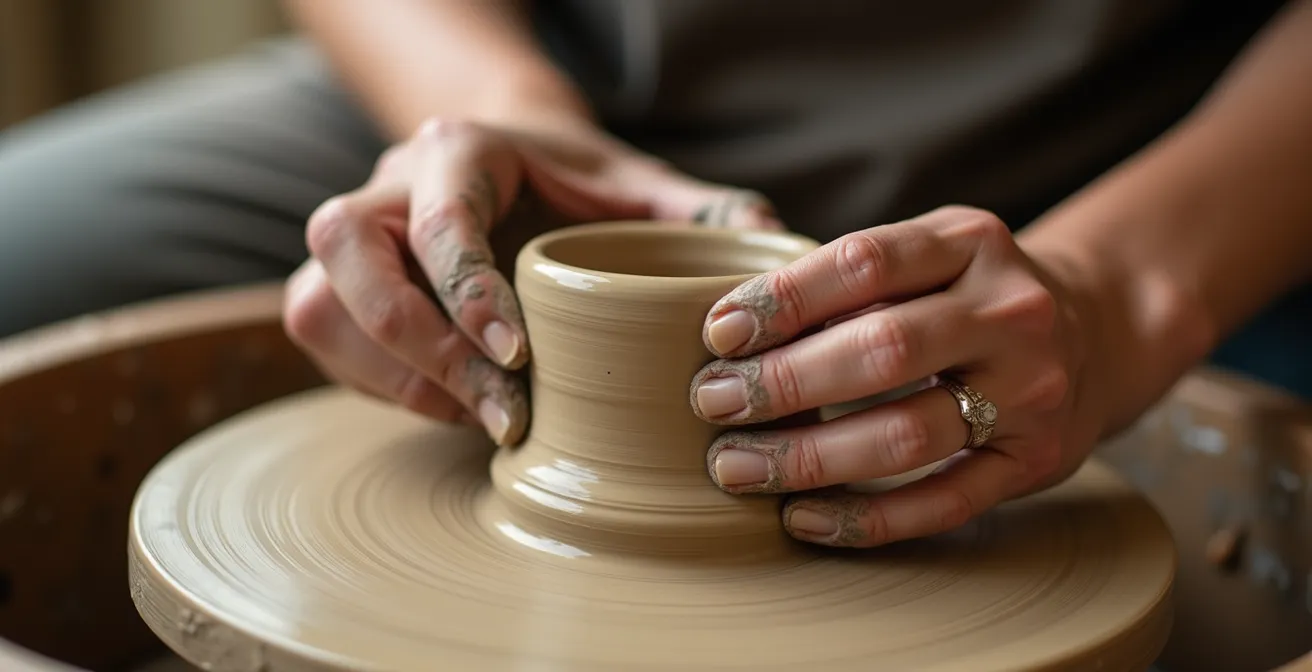
As you can see, the beauty is in the attempt, not the result. The goal is to find an activity that engages your senses and holds your attention without demanding perfection. So, how do you find your perfect “bad” hobby? Don’t overthink it. Instead of researching the “best” hobby for stress relief, think about what sparked your curiosity as a child. Was it building things? Exploring? Making jokes? These are clues to your natural “play archetype.”
Your Action Plan: Finding Your Play Archetype
- The Kinesthete: Do you need to move your body? Try activities that involve your hands and physical senses. Think woodworking, dancing, gardening, or even learning to bake bread.
- The Explorer: Is discovery your main driver? Choose hobbies based on exploration. This could be urban sketching in a new neighborhood, geocaching, or learning about a historical period just for fun.
- The Collector: Does organizing and categorizing soothe you? Lean into it. Consider collecting vinyl records, stamps, or interesting rocks. The joy is in the hunt and the arrangement.
- The Joker: Do you need more laughter? Engage in activities that are inherently silly and lighthearted. Join an improv comedy class, play goofy board games with friends, or learn a few magic tricks.
- The Test Drive: Before committing, test each archetype with a low-cost, low-stakes activity. Take a single pottery class, buy one old record, or watch one improv show. See what genuinely feels like fun, not work.
Woodworking or Watching TV: Which Truly recharges Dopamine?
After a grueling day, collapsing on the couch to binge-watch a series feels like the ultimate reward. It’s easy, it requires zero effort, and it provides a temporary escape. This is a form of passive recovery that delivers a quick, low-quality hit of dopamine. The problem? Your brain builds a tolerance. Over time, you need more and more of this passive consumption to feel the same level of distraction, and it does little to truly restore your mental energy. It’s the psychological equivalent of junk food: temporarily satisfying but ultimately unfulfilling.
Active recovery, on the other hand, is like a nourishing meal for your brain. Activities like woodworking, playing a musical instrument, or even engaging in certain types of video games require your participation. They engage your problem-solving skills, your senses, and your creativity. This generates a high-quality, sustained release of dopamine. More importantly, it also triggers a cascade of other beneficial neurochemicals like serotonin (mood regulation), endorphins (natural pain relief), and oxytocin (connection), especially if the activity is shared.
This doesn’t mean all screen time is detrimental. The key is engagement. For instance, a study found that playing “cozy” video games for 30 minutes daily can reduce anxiety levels. These games often focus on building, exploring, and nurturing rather than high-stakes competition, making them a form of active, restorative play. The distinction is about being a participant versus a passive spectator.
The following table, based on an analysis of the neurochemical impact of different activities, breaks down this crucial difference. It highlights why choosing your downtime activity wisely is critical for what we can call ‘dopamine hygiene’—the practice of seeking out rewards that genuinely restore you.
| Activity Type | Dopamine Quality | Additional Neurochemicals | Recovery Effectiveness |
|---|---|---|---|
| Woodworking/Active Play | High-quality, sustained release | Serotonin, Endorphins, Oxytocin | Deep psychological restoration |
| TV Watching/Passive | Low-quality, tolerance-building | Limited neurochemical diversity | Temporary distraction only |
| Video Games (Cozy) | Moderate quality, engagement-dependent | Variable based on game type | Can be restorative if mindful |
The Mistake of Turning Your Hobby into a Side Hustle That Kills the Joy
You’ve found it. An activity you genuinely love. You’re painting, knitting, or coding a small game, and for the first time in years, you feel a sense of flow without a deadline. Then, the high-achiever brain kicks in. “This is pretty good. I could probably sell this. I should start an Etsy shop. I need to build a personal brand around this.” Stop. This is the single fastest way to kill the joy you just discovered.
The moment a hobby is tied to performance metrics, deadlines, or financial gain, it ceases to be play. It becomes work. The pressure to optimize, market, and perform transforms a sanctuary of purposelessness into another source of stress. The activity is no longer an escape from the evaluation; it is the evaluation. This is the cardinal sin against play. You must fiercely protect your hobby’s “uselessness.”
To do this, you need to create a firewall between your play and your professional life. One of the most powerful ways to achieve this is by creating a ‘Play Contract’ with yourself. This isn’t a silly exercise; it’s a formal declaration to your own ambitious mind that this one area of your life is off-limits to optimization. It’s a pre-commitment to protect your joy at all costs.
When pursued with intention, play evolves into a long-term leadership method, complementing rather than competing with professional ambition. Over time, it becomes part of an executive’s operating rhythm, not an occasional escape.
This transformation from “escape” to “operating rhythm” is only possible when play remains sacred. By refusing to monetize it, you are making a powerful statement: your well-being is more valuable than another potential revenue stream. You are choosing long-term resilience over short-term gain.
When to Block “Blank Time” in Your Calendar for Spontaneity
For someone with a packed schedule, the idea of “spontaneity” can seem like a luxury you can’t afford. But what if you could schedule spontaneity? It sounds like a paradox, but it’s a practical strategy for reintroducing unstructured time into a structured life. It involves intentionally blocking out “Blank Time” in your calendar—a one or two-hour slot with no predetermined activity.
This is not a meeting with yourself to “ideate” or “strategize personal growth.” It is a commitment to do… nothing in particular. Or rather, to do whatever feels right in that moment. This block of time is an invitation to your own curiosity. Maybe you’ll use it to wander through a bookstore, listen to a new album from start to finish, or simply sit in a park and watch the world go by. The only rule is that you can’t use it for pre-planned work or chores.
This approach reframes recovery as a strategic practice. As one analysis of high-performance environments puts it, this is about “deliberate, even ritualised, engagement” in activities that function as brain-optimisation tools for mental reset. By scheduling the time, you give it the same importance as a client meeting, ensuring it doesn’t get pushed aside.
Case Study: The Spontaneity Toolkit
To make the most of “Blank Time,” it helps to have a ‘Spontaneity Toolkit’ ready. This removes the friction of having to decide what to do. One executive created a “curiosity jar” filled with 5-minute activity prompts on paper slips (e.g., “learn about a random historical event on Wikipedia,” “try to draw your coffee mug,” “find a new song”). When his blank time block began, he simply drew a slip and did what it said, no questions asked. This removed the paralysis of choice and made it easy to dive into a moment of spontaneous play, even on the most demanding days.
You can create your own toolkit by having a dedicated ‘play playlist’ on your phone, keeping juggling balls by your desk, or bookmarking a website that shows you a random street view somewhere in the world. The goal is to make spontaneity as accessible as possible, so when the opportunity arises, you can seize it without hesitation.
The Hidden Cost of Skipping Breaks That Leads to Burnout Within 6 Months
“I’ll just power through.” It’s the mantra of the high-achiever, the belief that skipping a lunch break or working late is a sign of dedication. In reality, it’s a high-interest loan taken out against your future well-being. Your brain and body are not machines; they operate in cycles of effort and recovery known as ultradian rhythms. Consistently ignoring the need for recovery doesn’t just lead to tiredness; it systematically paves the way for burnout.
Burnout is a clinical state of vital exhaustion, and it is reaching crisis levels. The scale of the problem is staggering, with some new research revealing that up to 82% of employees could be at risk of burnout by 2025. This isn’t just about feeling stressed. It’s a creeping erosion of your ability to function. The first six months of “powering through” are often the most critical, as the cumulative stress begins to cause lasting damage that is difficult to reverse.
One of the most insidious costs of burnout is the damage it does to your sense of self. It attacks the very competence that defines you. As the research team at Appreciation at Work explains, the consequences are deeply personal:
Burnout can erode self-belief. Leaders who once felt capable begin to doubt their effectiveness. This sense of reduced efficacy often accompanies feelings of mental fatigue and disconnection.
– Appreciation at Work Research Team, Executive Burnout: 7 Critical Signs and Strategies
This feeling of reduced efficacy is terrifying for someone used to excelling. It’s a sign that your internal resources are critically depleted. Breaks and play are not a luxury; they are the non-negotiable process of replenishing those resources. Skipping them is like trying to drive a car across the country without ever stopping for gas. Eventually, you will grind to a halt, and the damage will be far greater than the time “saved” by not stopping.
How to Design a 2-Minute Trigger Routine to Enter Flow State Instantly
You’ve scheduled your “Blank Time,” and you have your “bad” hobby ready. But how do you switch from the high-alert, analytical mindset of your workday to a relaxed, playful state? The transition itself can be a source of friction. The answer lies in creating a “trigger routine”—a short, repeatable ritual that signals to your brain that it’s time to shift gears. Athletes use pre-performance routines to get in the zone, and you can apply the same principle to play.
This routine shouldn’t be complicated. In fact, it must be simple enough to execute in just two minutes. Its purpose is to create a somatic and environmental shift, physically and mentally separating you from your work. The routine acts as a bridge. As seen in athletics, pre-performance routines are essential for reducing anxiety and enhancing focus. Visualizing success is a common tool for athletes, and you can adapt it by visualizing the feeling of enjoyment and letting go of the outcome of your play.
The goal is to create a powerful Pavlovian response. After repeating the routine a few times, your brain will begin to anticipate the feeling of play, making the transition smoother and faster. Below is a sample protocol you can adapt. The key is consistency.
The 2-Minute Somatic Reset Protocol
- Step 1: Digital Shutdown (15 seconds)
Close all work tabs, mute notifications, and turn your monitor off. This is a clear, physical signal that the work session is over. - Step 2: Full-Body Shake-Out (20 seconds)
Stand up and literally shake the stress out of your body. Focus on your hands, arms, and shoulders, releasing the physical tension of typing and thinking. - Step 3: Lion’s Breath (30 seconds)
Execute three “lion’s breath” exercises. Inhale deeply through your nose. On the exhale, open your mouth wide, stick your tongue out towards your chin, and make a forceful “ha” sound. It feels silly, and that’s the point. It’s a powerful release. - Step 4: Auditory Cue (10 seconds)
Put on a designated “play playlist” or a specific nature sound. The music acts as an immediate environmental cue. - Step 5: Connect with Your Object (45 seconds)
Pick up your play object—your guitar, sketchbook, puzzle box, or knitting needles. Simply hold it for a moment. Feel its texture and weight. Take 10 slow breaths, focusing only on the object in your hands. - Step 6: The Smallest First Step
Begin with the absolute simplest action possible: play one chord, draw one line, place one puzzle piece. Do not think about the final product. Just begin.
Key Takeaways
- True mental restoration comes from ‘purposefully unproductive play,’ not more goal-oriented tasks.
- Choosing a hobby you are bad at (joyful incompetence) is a powerful strategy to build neuroplasticity and detach self-worth from outcomes.
- Active play (like woodworking) provides high-quality, restorative dopamine, while passive consumption (like watching TV) offers only temporary distraction.
- You must protect your hobby from monetization by creating a ‘Play Contract’ to preserve its restorative power.
- Scheduling ‘Blank Time’ and using a 2-minute ‘Somatic Reset’ routine are practical ways to integrate play into a demanding life.
How to Align Your Career with Your Core Values After 40
As you pass the age of 40, the relentless climb up the career ladder can start to feel hollow if it’s not aligned with your core values. The burnout you experience isn’t just from overwork; it’s from a growing disconnect between who you are and what you do every day. Re-learning to play is not just an antidote to stress; it’s a powerful diagnostic tool. The activities you are drawn to in your “purposeless” time are direct clues to your deeply held values: creativity, community, exploration, or problem-solving for its own sake.
Play acts as a mirror, reflecting the parts of yourself that have been suppressed by your professional persona. If you find yourself drawn to coaching a kids’ sports team, it might signal a core value of mentorship. If you spend your blank time learning a new language, perhaps a value of connection and discovery is calling to you. This is a “Play History Audit.” By observing your own play, you gather data on what truly energizes you, data you can use to realign your career.
This realignment doesn’t necessarily mean a dramatic career change. It can be about finding ways to integrate your values into your current role. If you value community, you might take the lead on organizing team-building events. If you value creativity, you can volunteer for projects that require innovative thinking. The pressure to perform can manifest differently across demographics, with research showing that 59% of women report experiencing burnout compared to 46% of men, highlighting the varied social and workplace pressures that can create this values-disconnect.
By giving yourself permission to play, you are not escaping your career; you are gathering the intelligence needed to reshape it into something more sustainable and fulfilling. Play becomes the bridge between your professional ambition and your authentic self, ensuring the next phase of your career is driven by purpose, not just pressure.
Frequently Asked Questions about The Psychology of Adult Play
How do I explain scheduling ‘Blank Time’ to my team or family without sounding lazy?
Frame it with confidence as a “strategic recovery session” or “deep thinking time.” You can explain that, just like professional athletes need structured rest to perform at their peak, you need dedicated time to decompress and recharge your creative and problem-solving abilities. You’re not being lazy; you’re being strategic about maintaining long-term performance.
Can play and hobbies actually improve my career performance?
Absolutely. Engaging in play, especially in activities outside your area of expertise, builds cognitive flexibility, resilience, and creative problem-solving skills. It trains your brain to approach problems from new angles. The stress reduction and mental restoration from true play also lead to better focus, improved mood, and greater capacity to handle pressure at work.
What if I try a hobby and I genuinely hate it?
That’s fantastic! You’ve just learned something valuable about yourself. The goal of ‘purposefully unproductive play’ isn’t to force yourself to like something. It’s to experiment without pressure. Simply drop the activity without guilt and try something else. The “failure” is a success because you engaged in the process of exploration, which is the whole point.