

Feeling ‘tired but wired’ is a sign your nervous system is stuck in fight-or-flight mode; true recovery in under 20 minutes requires deliberately using physiological levers, not just passive rest.
- Non-Sleep Deep Rest (NSDR) protocols are more restorative than napping because they replenish dopamine without the grogginess of a full sleep cycle.
- Manipulating light (dimming, changing color) and temperature (cold exposure, warm showers) are the fastest ways to signal a “rest and digest” state to your brain.
Recommendation: Instead of scrolling on your phone, try a 15-second ice water facial dip followed by a 10-minute guided NSDR session to force a complete nervous system downshift.
You feel it in your bones: a profound exhaustion. Yet, when you finally get a moment to rest, your mind races. Your heart flutters, your thoughts loop, and a sense of unease hums just beneath the surface. This is the paradox of being “tired but wired”—a classic sign of a nervous system stuck in sympathetic dominance, the body’s ‘fight-or-flight’ state. You’re running on empty, but the engine won’t shut off. For many exhausted parents and driven professionals, the default advice to “just relax” or “meditate” feels impossible, sometimes even increasing the anxiety.
Conventional wisdom tells us to unwind with a book or a show, but this often provides distraction, not true physiological recovery. The common solutions fail because they don’t address the root cause: your body is still receiving signals of high alert. But what if the key wasn’t to quiet your mind, but to change the physical signals your mind is receiving? The secret to rapid, deep recovery lies not in mental effort, but in using your body’s own built-in mechanisms. These are powerful, non-negotiable physiological levers that can force a “downshift” from high-alert to a state of profound rest and digestion.
This guide moves beyond generic advice. We will explore the specific, science-backed protocols that use light, temperature, and breath to manually trigger your parasympathetic nervous system. You will learn not just *what* to do, but *why* these techniques work on a neurobiological level, allowing you to achieve a state of deep restoration in 20 minutes or less—a practical toolkit for anyone who needs to recharge, not just disengage.
For those who prefer a guided experience, the following video from Dr. Andrew Huberman provides a complete Non-Sleep Deep Rest protocol that perfectly complements the principles discussed in this article. It’s an ideal way to put these concepts into immediate practice.
To help you navigate these powerful techniques, this article is structured to provide actionable insights into each physiological lever. The following summary outlines the key areas we will cover, from understanding the power of deep rest protocols to implementing specific changes in your environment for immediate effect.
Summary: A Practical Guide to Rapid Nervous System Recovery
- Why NSDR Recovers Energy Faster Than a 90-Minute Nap?
- How to Create a Low-Stimulation Sanctuary in a Small Apartment?
- Passive Rest or Active Recovery: Which Is Best for Mental Exhaustion?
- The Dopamine Trap: Why Phone Scrolling Increases Fatigue Instead of Reducing It
- When to Dim the Lights: The Perfect Timeline for a 10 PM Bedtime
- Why Your Bathroom Light Is Waking You Up More Than Espresso?
- How to Use Ice Water Facial Dips to Lower Heart Rate in 30 Seconds?
- How to Increase Deep Sleep Percentage for Better Muscle Recovery
Why NSDR Recovers Energy Faster Than a 90-Minute Nap?
When you’re mentally drained, a nap seems like the obvious solution. However, a full 90-minute nap can often lead to sleep inertia or grogginess, while a short nap may not be restorative enough. Non-Sleep Deep Rest (NSDR) offers a superior alternative by guiding the brain into a state similar to the cusp of sleep without fully crossing over. This process is profoundly restorative because it actively replenishes neurochemicals without the metabolic cost of a full sleep cycle. It’s a deliberate state of deep relaxation that provides mental and physical recovery.
The key lies in its effect on dopamine, the neurotransmitter of motivation and drive. Unlike passive rest, which can sometimes lead to rumination, NSDR is a structured practice that focuses awareness. This focused rest is powerfully regenerative. In fact, research has shown that a single hour of NSDR can lead to a 65% increase in baseline dopamine levels. This is a crucial distinction: NSDR doesn’t just pause the drain on your energy; it actively refills the tank, leaving you feeling refreshed and focused, not groggy.
Case Study: The Cognitive Boost of a Daily 13-Minute Practice
The benefits of NSDR are not just subjective feelings of restfulness; they are measurable. Researchers at Stanford found that a daily 13-minute NSDR practice led to significant improvements in cognitive function over 8 weeks. Participants demonstrated increased attention, better working memory, and enhanced recognition memory. Furthermore, they showed reduced anxiety in response to psychosocial stressors, proving that even a short, consistent practice can build powerful resilience in the nervous system.
This protocol provides a direct pathway to this restorative state. It’s a sequence designed to systematically shut down the body’s stress response and activate the parasympathetic “rest-and-digest” system, making it an incredibly efficient tool for your 20-minute recovery window.
How to Create a Low-Stimulation Sanctuary in a Small Apartment?
Your environment sends constant signals to your nervous system. In a small or cluttered space, these signals are often of high alert: bright lights, hard surfaces, and ambient noise. Creating a “low-stimulation sanctuary” isn’t about expensive renovations; it’s about intentional sensory gating—consciously controlling the inputs your brain has to process. The goal is to create a corner that signals safety, calm, and rest to your body on a primal level. This can be achieved even in a tiny apartment by focusing on specific sensory elements.
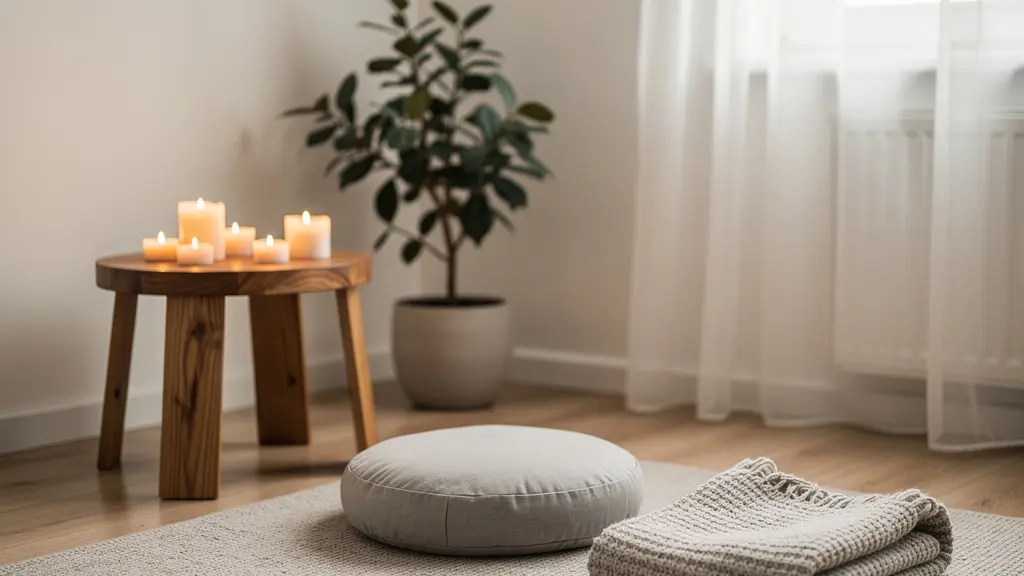
As seen in the space above, the core principles involve soft, natural textures, warm and dimmable lighting, and the removal of all digital screens. A soft rug, a meditation cushion, a weighted blanket, and a simple plant can transform a corner. The key is to reduce the cognitive load imposed by your surroundings. When your nervous system isn’t busy processing sharp angles, blue light, and sudden noises, it has the bandwidth to downshift into a parasympathetic state.
To optimize your small space for parasympathetic activation, you can introduce specific sensory tools. The following table breaks down key elements, their physiological effect, and how to implement them without clutter, as detailed in a recent analysis of nervous system regulation techniques.
| Sensory Element | Parasympathetic Effect | Implementation in Small Space |
|---|---|---|
| 40Hz Binaural Beats | Reduces anxiety, increases HRV | Use noise-cancelling headphones or small speaker |
| Weighted Blanket (10% body weight) | Deep pressure therapy activates vagus nerve | Fold and store in ottoman when not in use |
| Essential Oil Diffusion (Lavender/Ylang-ylang) | Triggers olfactory-vagal pathway | Small ultrasonic diffuser on shelf |
| Warm Color Temperature (2700K) | Signals circadian wind-down | Replace bulbs with warm LED alternatives |
| Natural Textures | Reduces cognitive load through tactile grounding | Add cork mat, wool cushion, bamboo elements |
By strategically layering these elements, you create a powerful environmental cue for relaxation. Your sanctuary becomes a reliable trigger for your nervous system to begin its recovery process the moment you step into it.
Passive Rest or Active Recovery: Which Is Best for Mental Exhaustion?
When you’re mentally exhausted, the choice between passive rest (like lying on the couch) and active recovery (like gentle stretching or breathing exercises) can be confusing. For the “tired but wired” individual, purely passive rest can backfire, allowing the anxious mind to spin out of control. Conversely, purely active recovery might feel like too much effort. The most effective approach for a quick, 20-minute reset is a combination of both, known as the Parasympathetic Sandwich Protocol. This method uses active techniques to initiate the relaxation response, then transitions into passive rest to deepen it.
The protocol begins with a few minutes of deliberate diaphragmatic breathing. This is a powerful active recovery technique because it directly stimulates the vagus nerve, which acts as the primary brake for the sympathetic nervous system. By manually slowing your breath, you are sending a direct physiological signal of safety to your brain. Once your heart rate begins to lower and your body feels calmer, you transition into passive rest, like an NSDR body scan. At this point, your body is primed to relax deeply without the initial mental resistance.
Study: The Power of a Combined Approach on Heart Rate Variability
The effectiveness of this combined strategy is supported by science. Studies on individuals with high-stress jobs, such as shift workers, show that implementing both active recovery techniques (like breathing exercises) and periods of passive rest leads to significant improvements in Heart Rate Variability (HRV). An analysis published in Frontiers in Physiology found that this combined approach resulted in reduced sympathetic activation and enhanced parasympathetic recovery compared to using passive rest alone. Higher HRV is a key indicator of a resilient, well-regulated nervous system.
This 20-minute protocol structures your rest for maximum efficiency:
- Minutes 1-5 (Active Recovery): Begin with diaphragmatic breathing. Place a hand on your belly and ensure it rises with each inhale. Breathe in for 4 counts, hold for 4, and exhale slowly for 6-8 counts. This initiates the vagal brake.
- Minutes 6-15 (Passive Rest): Transition to a body scan or NSDR. Let your breathing return to its natural rhythm while you mentally release tension from your feet up to your head.
- Minutes 16-20 (Gentle Re-activation): Slowly bring awareness back to your body. Introduce micro-movements like rotating your ankles, stretching your fingers, and gentle neck rolls before opening your eyes.
The Dopamine Trap: Why Phone Scrolling Increases Fatigue Instead of Reducing It
In a moment of exhaustion, reaching for your phone feels like a harmless way to “zone out.” But this habit is a significant contributor to the “tired but wired” state. Scrolling through social media or news feeds creates a dopamine trap. Each new post, notification, or video provides a small, unpredictable hit of dopamine. This isn’t the restorative, baseline dopamine that NSDR helps replenish; it’s a spiky, addictive cycle of seeking and reward that keeps your nervous system in an alert, expectant state. It mimics the pattern of a slot machine, training your brain to crave more stimulation.
This constant, low-grade stimulation prevents the nervous system from ever truly downshifting. Instead of allowing for recovery, phone scrolling increases your cognitive load and perpetuates a state of circadian mismatch, where your brain is receiving “awake and alert” signals even when your body is depleted. This is why you can scroll for an hour and feel more drained and mentally scattered than when you started. The cycle of micro-rewards leaves your nervous system agitated, not rested.

As visualized above, the chaotic, unpredictable stimulation from digital devices contrasts sharply with the calm, predictable rewards found in nature or deep rest. Breaking this cycle requires a conscious choice to opt out of cheap dopamine in favor of activities that genuinely restore your nervous system. This means replacing the 20 minutes of scrolling with a 20-minute NSDR protocol, a walk outside, or one of the other physiological resets discussed in this article. The goal is to move from a state of seeking external validation to one of internal restoration.
The link between screen time and nervous system dysregulation is well-documented. This constant state of alert contributes to a background level of anxiety and prevents the deep recovery necessary to combat chronic fatigue, ultimately making you feel more exhausted in the long run.
When to Dim the Lights: The Perfect Timeline for a 10 PM Bedtime
Light is the single most powerful signal for regulating your body’s internal clock, or circadian rhythm. For millennia, the setting sun signaled to our bodies to begin producing melatonin, the hormone of sleep. Today, our homes are flooded with bright, blue-spectrum light long after sunset, creating a profound circadian mismatch that suppresses melatonin and keeps us alert. To prepare for a 10 PM bedtime, you must manage your light exposure with a deliberate, timed approach, effectively creating an “artificial sunset” indoors.
The process isn’t just about turning off the main lights right before bed; it’s a gradual reduction in both the intensity (lux) and the color temperature of your lighting. Bright, overhead lights, especially those with a cool, white hue, are the biggest offenders. Starting your wind-down routine two hours before your desired bedtime gives your brain ample time to receive the “night is coming” signal and initiate the cascade of hormones necessary for sleep.
The “Mini Jet-Lag” Effect of Evening Light
The impact of evening light is not trivial. Clinical studies have demonstrated that exposure to bright light after 8 PM can delay the onset of melatonin release by up to 90 minutes. This exposure can also cause a measurable spike in cortisol, the stress hormone that should be at its lowest at night. This combination effectively creates a ‘mini jet-lag’ effect, disrupting your natural sleep-wake cycle and directly contributing to patterns of chronic fatigue and difficulty falling asleep.
Follow this timeline to optimize your light environment for melatonin production, aiming for a 10 PM bedtime:
- 8:00 PM: Switch from bright overhead lights to table or floor lamps. The goal is to reduce the overall light intensity (lux) in your living space to under 100 lux.
- 8:30 PM: Close all curtains and blinds to eliminate light pollution from streetlights or neighboring houses.
- 9:00 PM: Begin your “light spectrum shift.” Replace any white light bulbs in the rooms you’ll be in (especially the bathroom and bedroom) with warm, red-spectrum bulbs (2700K or lower).
- 9:30 PM: Start a “light fast.” Use only minimal, indirect lighting. Candles or salt lamps, which are typically under 10 lux, are ideal at this stage.
- 9:45 PM: Complete darkness is the goal. Use only a red LED nightlight for essential navigation if needed, as the red spectrum does not interfere with melatonin.
- 10:00 PM: Your bedroom should be in total darkness for sleep, ideally under 1 lux. This is darker than the light from a full moon.
Why Your Bathroom Light Is Waking You Up More Than Espresso?
A middle-of-the-night trip to the bathroom can completely derail your sleep, and the primary culprit is your light fixture. Most modern bathrooms are equipped with bright, cool-white LED lights. While great for daytime grooming, this light is a powerful biological stimulant at night. The intensity of a typical bathroom vanity light can be over 500 lux. This is a catastrophic level of light exposure when your brain is in sleep mode, as it sends an unambiguous “daytime” signal to your internal clock.
The biological mechanism at play is the immediate and near-total suppression of melatonin. Your brain is exquisitely sensitive to light, especially light in the blue spectrum, which is abundant in cool-white LEDs. Even a few seconds of exposure to this intense light is enough to halt melatonin production, making it significantly harder to fall back asleep. It’s the physiological equivalent of drinking a shot of espresso—it wakes you up, elevates alertness, and disrupts the delicate architecture of your sleep for the rest of the night.
Understanding the relative impact of different light sources is key to protecting your sleep. As this table shows, the difference between a standard LED and a sleep-friendly alternative is staggering. The data highlights how common light sources compare in their ability to suppress melatonin.
| Light Source | Typical Lux Level | Melatonin Impact | Alternative Solution |
|---|---|---|---|
| Bathroom LED (cool white) | 500-1000 lux | Complete suppression within minutes | Red spectrum bulb (<5 lux) |
| Phone screen at 12 inches | 40-60 lux | 50% reduction in production | Blue light filter + minimum brightness |
| Moonlight | <1 lux | No measurable impact | Natural baseline reference |
| Candle at 1 meter | 1-2 lux | Minimal to no impact | Safe nighttime navigation option |
| Red LED nightlight | 0.5-2 lux | No suppression (wrong spectrum) | Ideal bathroom solution |
The solution is simple and effective: replace your main bathroom bulb with a dim, red-spectrum bulb, or install a plug-in red LED nightlight. This provides just enough light for safe navigation without triggering the melatonin-suppressing response. Protecting your eyes from bright, blue light at night is one of the most impactful changes you can make to improve your sleep quality and overall recovery.
How to Use Ice Water Facial Dips to Lower Heart Rate in 30 Seconds?
When you need to slam the brakes on an acute stress response—racing heart, shallow breathing, spiraling thoughts—one of the fastest and most powerful physiological levers you can pull is the mammalian dive reflex. This is a primal, involuntary response hardwired into our nervous system that is activated by cold water on the face while holding your breath. It’s a circuit-breaker that immediately shifts your body from a sympathetic (fight-or-flight) to a parasympathetic (rest-and-digest) state.
The mechanism is fascinating. The cold receptors on your face send a powerful signal to the brain, which then activates the vagus nerve. This causes two things to happen almost instantly: bradycardia (a slowing of the heart rate) and the redirection of blood flow from your extremities to your core organs. This reflex evolved to conserve oxygen when submerged in cold water, but we can co-opt it as a rapid tool for anxiety reduction. The effect is not subtle; you can often feel your heart rate drop within 15-30 seconds.

This technique requires no special equipment, just a bowl, water, and ice. It is a potent tool for moments of overwhelm, providing an immediate physical reset that interrupts anxious thought loops. The key is to follow the protocol precisely, as holding your breath during the immersion is critical for full activation of the reflex.
Here is the clinical protocol for activating the mammalian dive reflex safely and effectively:
- Step 1: Fill a large bowl with cold water (around 10-15°C or 50-60°F) and add ice cubes if available to ensure it’s sufficiently cold.
- Step 2: Take a moment to measure your baseline pulse. Find it on your neck or wrist and count the beats for 15 seconds, then multiply by 4 to get your beats per minute (BPM).
- Step 3: Take a deep breath and hold it.
- Step 4: Lean forward and submerge your face in the water, ensuring the area from your forehead to your chin is covered, for 15-30 seconds.
- Step 5: It is crucial to keep your breath held during the entire immersion period to trigger the full reflex.
- Step 6: Lift your face from the water, exhale slowly, and immediately measure your pulse again for 15 seconds.
- Step 7: You should observe a noticeable reduction in your heart rate, typically a drop of 10-20 BPM.
Key takeaways
- True rest for a “tired but wired” system comes from physiological resets, not just mental distraction.
- Non-Sleep Deep Rest (NSDR) is more effective than napping for quick energy recovery as it boosts baseline dopamine.
- Your environment is a tool: use dim, warm light and cold water exposure to manually signal “rest” to your brain.
How to Increase Deep Sleep Percentage for Better Muscle Recovery
While falling asleep is the first battle, the quality of that sleep determines how restorative it truly is. For physical and mental recovery, the most crucial phase is deep sleep (also known as N3 or slow-wave sleep). This is when your body releases growth hormone, repairs tissues, and consolidates memories. A low percentage of deep sleep is a common reason for waking up feeling unrefreshed. Increasing this percentage isn’t a matter of chance; it’s a direct result of how well you manage your nervous system throughout the day and in the hours leading up to bed.
A key metric for this is your Heart Rate Variability (HRV), which measures the variation in time between your heartbeats. A high HRV indicates a resilient, adaptable nervous system dominated by parasympathetic activity. A low HRV signals a system under chronic stress. Importantly, high HRV during the day is a strong predictor of increased deep sleep and REM sleep percentages at night. Therefore, every technique in this article—from NSDR to cold water dips—that boosts your parasympathetic tone during the day is directly contributing to better sleep quality at night.
One of the most potent physiological levers for increasing deep sleep is temperature manipulation. Your body’s core temperature needs to drop by about 1-2 degrees Celsius to initiate and maintain deep sleep. You can facilitate this process by taking a warm shower or bath 90 minutes before bed. This brings blood to the surface of your skin, and when you get out, the rapid cooling of your body mimics the natural temperature drop required for sleep, signaling your brain that it’s time for deep rest.
Your Action Plan for Deeper Sleep: Temperature Manipulation Protocol
- 90 minutes before bed: Take a warm (not scalding) shower or bath (40-42°C / 104-108°F) for 10-15 minutes to raise your surface body temperature.
- Post-shower: Allow your body to cool down naturally in a room-temperature environment. Avoid bundling up in heavy robes or blankets immediately.
- 60 minutes before bed: Ensure your bedroom is cool. The ideal temperature for sleep is between 18-20°C (65-68°F).
- 30 minutes before bed: Perform 5-10 minutes of slow, diaphragmatic breathwork to further activate your parasympathetic system and lower your heart rate.
- At bedtime: Start with minimal bedding. It’s better to feel slightly cool when you first get into bed than to be too warm. Have an extra blanket nearby in case you need it later in the night.
By consistently applying these physiological levers, you move from being a victim of your exhaustion to an active participant in your own recovery. Start with one technique—the ice water dip for acute stress or the light-dimming timeline for better sleep—and build from there. You have the tools to downshift your nervous system and achieve the deep rest you need.