

Mastering a specific pressure point in your hand can reliably shut down a tension headache in under 5 minutes, without any medication.
- This technique works by using the “Gate Control Theory” of pain to block headache signals from reaching your brain.
- Success depends on precise location (the Hegu point), correct technique (static vs. circular motion), and optimal duration (about 60 seconds).
Recommendation: Practice finding the point and applying firm pressure for one minute as a daily micro-break to build the skill before you urgently need it.
The familiar, dull throb begins behind your eyes. The screen in front of you seems to pulse with every beat, and the deadline on your calendar looms large. For many office workers, this is the daily reality of tension headaches, often met with another cup of coffee or a hopeful squint. You may have heard about “pressure points” as a potential remedy, a piece of folk wisdom passed down without much explanation. It’s often presented as a vague, almost magical trick: just press somewhere on your hand and hope for the best.
But what if you could approach this not as a folk remedy, but as a repeatable, reliable skill? What if the power to alleviate your own pain wasn’t in a pill bottle, but literally in your own hands? The true key to unlocking this potential isn’t just knowing where to press, but understanding why it works and how to apply the technique with precision for maximum, near-instant effect. This moves you from passively hoping for relief to actively taking control of your body’s response to stress and pain.
This guide is designed to empower you with that skill. We will explore the science behind how pressure can intercept pain signals before they reach your brain. You’ll learn to locate the exact point with confidence, master the different application techniques for different types of tension, and understand the crucial timing that makes the difference between a half-hearted attempt and profound relief. This is your practical instruction manual for turning your hand into one of the most effective self-care tools you own.
In this article, you will discover the precise steps and scientific principles to effectively manage your tension headaches. The following sections provide a clear roadmap from understanding the mechanism to mastering the application.
Summary: Your Guide to Mastering Acupressure for Headaches
- Why Pressing a Thumb into Your Hand Relieves Pain in Your Head?
- How to Find the Hegu Point to Stop a Toothache?
- Static Hold or Circular Motion: Which Releases Knots Faster?
- The Dangerous Point You Must Avoid Pressing If You Are Pregnant
- How Long to Press a Point Before It Becomes Counter-Productive?
- How to Integrate Micro-Rest Breaks During an 8-Hour Workday Without Losing Focus?
- Why Mouth Breathing Reduces Oxygen Delivery to Your Brain?
- Which 3 Acupoints Boost Immunity During Flu Season?
Why Pressing a Thumb into Your Hand Relieves Pain in Your Head?
The notion that pressing a point on your hand can alleviate pain in your head seems almost magical, but it’s grounded in solid neuroscience. The primary mechanism at play is known as the Gate Control Theory of Pain. Imagine a “gate” in your spinal cord that controls which signals get through to your brain. Small nerve fibers transmit pain signals (like a tension headache), while larger nerve fibers transmit non-painful signals like touch and pressure.
When you apply firm pressure to a potent acupoint like Hegu (LI-4) in your hand, you activate those large nerve fibers. This intense pressure signal travels up to the spinal cord and essentially “distracts” the gatekeeper. The gate closes to the smaller, weaker pain signals from your headache, preventing them from reaching the brain where they would be processed as pain. According to an in-depth explanation of the Gate Control Theory in physical therapy, techniques like massage and acupressure are effective precisely because they leverage this neurological system.
This isn’t just a theory; it has practical, observable results. The stimulation of these specific points helps relax muscles and improve blood flow, further contributing to pain relief. The effectiveness is significant, as some studies have shown that up to 86% of patients found relief from various types of pain using therapies based on this principle. By learning to apply this pressure correctly, you are actively managing your body’s nervous system to your advantage.
How to Find the Hegu Point to Stop a Toothache?
The Hegu point, also known as Large Intestine 4 (LI-4), is one of the most powerful and accessible points in acupressure. While renowned for headache relief, its influence extends to facial pain, including toothaches. Locating it precisely is the first step to harnessing its power. Don’t just guess; the effectiveness lies in the accuracy.
Follow these steps to find the exact location of the LI-4 point on your hand:
- Position your hand with your fingers pointing up, as if waving, with the back of your hand facing you.
- Gently squeeze your thumb and index finger together. You will notice a fleshy mound or bulge that forms in the muscle between them.
- Relax your hand slightly and place the thumb of your other hand on the highest point of that muscular bulge. This spot is the LI-4 pressure point.
- When you apply pressure, it should feel firm. You might experience a slight ache or tenderness, which is a sign you’re on the right spot, but it should never be sharply painful.
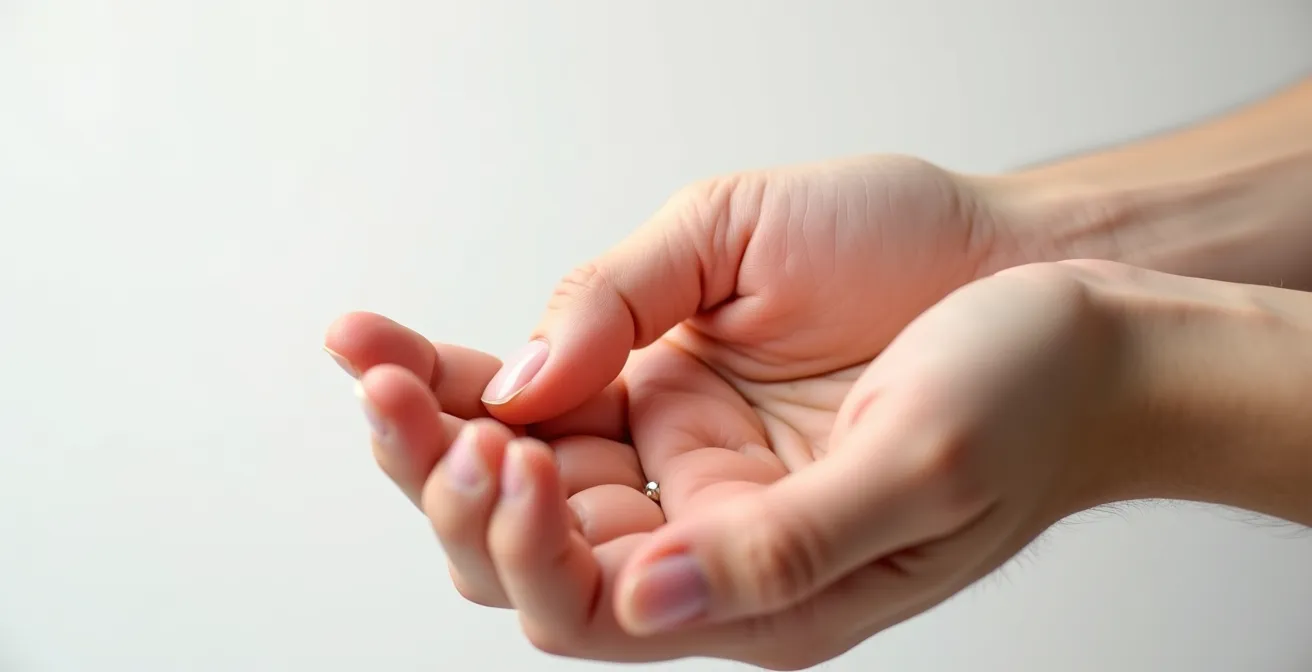
Once you’ve located the point, you’re ready to apply pressure. Remember that this point is bilateral, meaning it exists on both hands. It’s often recommended to work on the point on the hand opposite to the side of your headache or pain, but applying pressure to both sides is also effective. Consistent practice will make finding this point second nature.
Static Hold or Circular Motion: Which Releases Knots Faster?
As an authority in the field, acupuncturist Dr. Eileen Li notes in a CNBC Health Report, the goal of acupressure is to relax muscles and improve blood flow. The technique you use—a steady, static hold or a deep, circular motion—can be adapted to the specific type of tension you’re feeling. One is not universally “better” than the other; they are different tools for different jobs.
As an acupuncturist with 10 years of clinical experience, I’ve had thousands of patients come to me for help with tension headaches. In acupuncture treatment, pressure is placed on certain points of the body to relax muscles and improve blood flow.
– Dr. Eileen Li, CNBC Health Report
A static hold is ideal for targeting small, hard, and clearly defined knots of tension. This technique involves applying direct, sustained pressure to the point, often pushing gently toward the bone of the index finger to deepen the sensation. It’s like holding a key in a lock to release a specific mechanism. In contrast, a circular motion works best for more diffuse, widespread tension. By making small, deep circles with your thumb, you can address a slightly larger area and gently work through layers of muscle tightness.
The following table breaks down the best use cases for each technique, helping you create a more nuanced and effective self-care routine.
| Technique | Duration | Best For | Method |
|---|---|---|---|
| Static Hold | 60 seconds | Small, hard knots | Press down and gently push towards the bone of the index finger. |
| Circular Motion | 10 seconds each direction | Diffuse tension areas | Make small circles with your thumb in one direction and then the other. |
| Combined Method | 30 sec static + 20 sec circular | Stubborn chronic knots | Start with static pressure, then add small deep circles. |
The Dangerous Point You Must Avoid Pressing If You Are Pregnant
While the Hegu (LI-4) point is a powerful ally for most people, it comes with a critical warning: it is strongly contraindicated during pregnancy. Applying firm pressure to this point can induce uterine contractions and potentially lead to premature labor. This is not a myth but a well-established precaution in both traditional and modern medicine. As leading institutions like Memorial Sloan Kettering Cancer Center warn, medical professionals advise against pressing the Hegu point at any stage of pregnancy to avoid this risk.
However, this does not mean that pregnant women are left without options for natural headache and tension relief. There are several other potent and safe acupressure points that can be used instead. Focusing on these alternatives provides the benefits of acupressure without the associated risks.
Here are three safe and effective alternative points for headache relief during pregnancy:
- Gates of Consciousness (GB20): Located at the base of the skull, in the hollows on either side of the two large vertical neck muscles. Gently pressing these points helps relieve neck tension, improves blood circulation to the head, and promotes deep relaxation.
- Third Eye Point (Yin Tang): Found directly between the eyebrows, at the point where the bridge of the nose meets the forehead. Applying firm but gentle pressure here for one minute can ease stress, calm the mind, and reduce frontal headache pain.
- Temple Points (Tai Yang): Located in the soft depressions at the temples. Using your fingertips to apply a gentle circular massage to these points is a classic and safe way to ease the pain of tension headaches, especially those concentrated on the sides of the head.
How Long to Press a Point Before It Becomes Counter-Productive?
The effectiveness of acupressure hinges not only on location and technique but also on duration. There is a “sweet spot” for how long to apply pressure. Too little time, and you won’t fully activate the neurological gate. Too much time, and you can over-stimulate the area, causing bruising or creating more tension. The goal is a therapeutic dose of pressure, not a test of endurance. Research on the effects of massage and pressure therapies confirms their value; one study on chronic tension headaches found that regular sessions reduced the average number of headaches per week from almost seven to just two.
So, what is the optimal timing? While it varies slightly by point and individual sensitivity, a general and effective guideline for the Hegu (LI-4) point is to apply firm, steady pressure for about 60 seconds. For a more dynamic approach, you can pinch the point firmly for 10 seconds, then make small, deep circular motions for 10 seconds in each direction, repeating this cycle for about a minute. For particularly stubborn knots, a pulse method can be effective: apply pressure for 20-30 seconds, release for 10 seconds, and repeat this 3 to 5 times.
Ultimately, listening to your body is crucial. The pressure should create a sensation of a dull ache or fullness (known as “Deqi” in acupuncture), but it should not be sharp or unbearable. If the pain increases or feels “wrong,” it’s a sign to ease up or stop. Consistency is more important than intensity.
Action Plan: Your 5-Point Acupressure Technique Audit
- Location Check: Am I on the highest point of the muscle bulge between thumb and index finger? Re-find it by squeezing and relaxing.
- Pressure Check: Is the pressure firm and deep, but not causing sharp pain? Adjust to find the “dull ache” sensation.
- Technique Check: Am I using the right tool for the job? Static hold for a specific knot, or circular motion for diffuse tension?
- Duration Check: Am I holding the pressure for at least 30-60 seconds to effectively “close the gate” on pain signals? Use a timer.
- Breathing Check: Am I holding my breath? Pair the pressure with slow, deep nasal breaths to maximize relaxation and oxygen flow.
How to Integrate Micro-Rest Breaks During an 8-Hour Workday Without Losing Focus?
For a busy office worker, the idea of taking a break can feel like a threat to productivity. The key is not to stop working, but to integrate intelligent, restorative “micro-breaks” that enhance focus rather than disrupting it. Acupressure is perfectly suited for this, as it’s silent, discreet, and can be done right at your desk. You might wonder, “How often should I do this?” To be effective, experts recommend scheduling very short breaks every 30 to 60 minutes. This doesn’t have to be a major interruption; it can be as simple as a 60-second acupressure routine.
The beauty of using the Hegu (LI-4) point is its discretion. During a video call or while reading a document, you can easily press the point on the hand that’s below the desk or out of the camera’s view. No one needs to know you’re actively managing a budding headache. To build this into a habit, “stack” it with an existing routine. For example, practice your 60-second pressure hold immediately after finishing a phone call or just before you get up for a water break. This consistency builds the neural pathways that make the technique more effective when you need it most.
Furthermore, don’t underestimate the power of combining acupressure with other forms of micro-breaks. When you do have five minutes, getting up and stretching encourages blood flow to the entire body and brain. If possible, a brief walk, even just around the office, can decrease stress and provide a fresh dose of oxygen, which is a powerful tool against tension headaches. The goal is to create a toolkit of small, manageable actions that prevent tension from building to a critical point.
Why Mouth Breathing Reduces Oxygen Delivery to Your Brain?
While acupressure directly targets pain signals, your breathing pattern plays a fundamental, often overlooked role in preventing tension headaches. Many people, especially when stressed or concentrating, unconsciously switch to shallow mouth breathing. This habit is surprisingly detrimental to your brain’s oxygen supply and can be a major contributor to brain fog and tension.
The problem with mouth breathing is that it bypasses the sophisticated filtration and preparation system of your nasal passages. When you breathe through your nose, the air is warmed, humidified, and filtered. More importantly, your nasal sinuses produce nitric oxide (NO), a crucial gas that is carried to the lungs with each nasal breath. Nitric oxide is a vasodilator, meaning it helps relax and widen blood vessels, which can significantly improve the lungs’ ability to absorb oxygen—by some estimates, up to 10-15% more efficiently.
When you mouth breathe, you get less of this vital nitric oxide. This leads to less efficient oxygen uptake into your bloodstream and, consequently, reduced oxygen delivery to your brain. A brain that is even slightly deprived of oxygen is more prone to stress, fatigue, and tension headaches. Pairing your acupressure practice with conscious, slow, deep nasal breathing creates a powerful synergy. The acupressure closes the pain gate, while the nasal breathing ensures your brain is getting the oxygen it needs to function optimally and resist tension in the first place.
Key Takeaways
- The Hegu (LI-4) point works by using the “Gate Control Theory” to have non-painful pressure signals block headache pain signals from reaching the brain.
- Technique matters: use static holds for tight, specific knots and circular motions for general tension, typically applying pressure for about 60 seconds.
- Never press the LI-4 point during pregnancy as it can induce labor; use safe alternatives like points at the base of the skull (GB20) or between the eyebrows (Yin Tang).
Which 3 Acupoints Boost Immunity During Flu Season?
While Hegu (LI-4) is a champion for pain relief, the principles of acupressure extend far beyond managing headaches. By stimulating other key points on the body, you can support and strengthen your body’s overall resilience, including your immune system. This is particularly valuable during flu season or times of high stress. A 2024 study mentioned by Healthline found acupressure could increase relaxation and reduce stress, which are known factors in immune function. Here are three essential acupoints known as the “Immunity-Building Trinity.”
Mastering these points can add another layer to your self-care toolkit, helping you feel more robust and energized. Incorporating them into a weekly routine can be a proactive measure for maintaining wellness.
- Stomach 36 (ST36 – Zu San Li): Known as the “Leg Three Miles” point, this is one of the most vital points for energy and immune health. Locate it four finger-widths below your kneecap, just one finger-width to the outside of your shinbone. Pressing firmly here for 2-3 minutes is believed to invigorate the body’s defensive energy (Qi).
- Large Intestine 11 (LI11 – Qu Chi): Found at the outer end of the elbow crease when your arm is bent. This point is traditionally used to clear heat from the body, which can be beneficial at the onset of a fever or sore throat. Apply firm, circular pressure for 1-2 minutes on each arm.
- Lung 7 (LU7 – Lie Que): Located on the inside of the arm, about two finger-widths above the wrist crease. This point is directly connected to the Lung meridian, making it essential for supporting respiratory health and strengthening the body’s first line of defense against airborne pathogens.
Massage therapy can be beneficial to many types of patients, helping with blood pressure, sleep, relaxation, depression, and recovery time. Cardiac patients may benefit from massage to minimize pharmaceutical use.
– Physiopedia Contributors, Gate Control Theory of Pain
Start incorporating these simple, powerful techniques into your daily routine. Take control of your well-being and build your personal toolkit for pain and stress management, one pressure point at a time.