
Basalt’s superiority for thermotherapy is not magic; it is a direct result of its measurable geological properties.
- Its igneous formation creates a dense, non-porous structure that resists thermal shock, unlike fragile sedimentary rocks.
- Its high iron and magnesium content gives it a specific heat capacity that allows it to absorb, store, and radiate heat far more effectively than any other common stone type.
Recommendation: For predictable, safe, and effective treatments, professionals must prioritize stone selection based on material science, not aesthetics or price. True volcanic basalt is the only logical investment.
As a massage therapist or a dedicated practitioner, you have likely heard the claim that basalt stones are the superior choice for hot stone therapy. The market is saturated with assertions about their “natural energy” and smooth feel. However, these explanations often remain superficial, failing to address the fundamental question from a material science perspective: why basalt? Many practitioners, in an attempt to save costs, may turn to aesthetically pleasing but geologically unsound alternatives like river stones, only to find they crack under thermal stress or fail to hold a consistent temperature.
The common discourse focuses on the “what”—that basalt retains heat—but rarely delves into the “why.” This gap in understanding can lead to ineffective treatments and even dangerous equipment failures. The truth is, the efficacy of a hot stone set has less to do with ancient mysticism and more to do with fundamental geology and physics. The choice between a stone that delivers consistent, deep-penetrating heat and one that poses a safety risk is determined by its origin, mineral composition, and internal structure.
This article will deconstruct the properties of basalt from the ground up. We will abandon vague marketing terms and instead focus on the scientific principles that make this specific igneous rock the only suitable material for professional thermotherapy. We will analyze why other stone types fail, quantify basalt’s thermal performance, and provide a clear, evidence-based framework for selecting, using, and maintaining your most critical tools.
By understanding the material science, you can elevate your practice from one based on tradition to one grounded in predictable, repeatable, and superior therapeutic outcomes. The following sections break down the essential knowledge every serious practitioner needs to master.
Summary: Why Basalt Is the Only Stone Type Suitable for Sustained Heat Retention
- Why sedimentary Stones Crack Under Heat While Basalt Survives?
- How to Recharge the Energy of Basalt Stones After Every Client?
- Polished or Natural: Which Texture Offers Better Grip with Oil?
- The Microwave Mistake That Explodes Stones and Ruins equipment
- Which Size Stone Fits Perfectly in the Arch of the Foot?
- Why Heat Penetrates 3cm Deeper Than Manual Pressure Alone?
- How to Replace Endocrine-Disrupting Cleaners With Safe Alternatives Under $20?
- How to Unblock Meridian Channels to Restore Vitality
Why sedimentary Stones Crack Under Heat While Basalt Survives?
The fundamental difference between basalt and stones like sandstone or limestone lies in their geological formation. Basalt is an igneous rock, forged from the rapid cooling of magnesium- and iron-rich lava. This process creates a fine-grained, dense crystalline structure with minimal porosity. The interlocking crystals give the stone immense internal strength, allowing it to expand and contract uniformly when heated without developing fractures.
Sedimentary rocks, by contrast, are formed from the compression of sand, silt, and organic debris over millions of years. Their structure is layered and porous, often containing microscopic pockets of trapped water and air. When heated, this trapped moisture turns to steam, creating immense internal pressure. The rock’s weak, layered bonds cannot withstand this force, leading to cracking or, in some cases, explosive shattering. This phenomenon is a classic example of thermal shock failure.
Furthermore, basalt’s material properties are optimized for thermal applications. Its low porosity prevents it from absorbing water, which would otherwise lead to the same steam-pressure-induced failure seen in sedimentary rocks. From a physics standpoint, basalt exhibits consistent thermal performance. According to research on rock thermal properties, its conductivity allows for efficient heat absorption and slow, even release. This stability is why basalt can endure hundreds of heating and cooling cycles, while a sedimentary river stone may fail on its very first use.
How to Recharge the Energy of Basalt Stones After Every Client?
The concept of “recharging” stones is often cloaked in metaphysical language, but from a material science standpoint, it refers to two critical processes: thorough sanitization and a complete thermal reset. A stone that is not properly cleaned harbors bacteria, and a stone that is not fully cooled cannot perform optimally in the next session. True “recharging” is about restoring the stone to its baseline state of hygienic and thermal neutrality.
After each client, every stone must be individually cleaned and sanitized. Simply leaving them in warm water is insufficient and creates a breeding ground for pathogens. A professional protocol involves removing the stones from the warmer, washing them with an appropriate soap, and disinfecting them. Some protocols leverage natural antimicrobial agents to enhance this process. Proper cooling is equally important. Allowing the stones to return to ambient temperature ensures their crystalline structure fully “resets,” preventing the accumulation of thermal stress over time. This also guarantees that when you begin a new session, you are starting from a controlled, consistent baseline temperature for predictable heating.
This image of stones dissipating heat on a rack is not just about cooling; it symbolizes the essential step of allowing the material to return to equilibrium. This reset is what ensures consistent performance and longevity for your professional tools.
Action Plan: Professional Stone Sanitization and Thermal Reset
- Decommission and Isolate: Unplug the stone warmer and remove all stones. Never clean stones inside the warmer unit.
- Manual Decontamination: Wash each individual stone with warm water, an antibacterial soap, and a dedicated scrub brush until all oil and residue are visibly gone.
- Antimicrobial Soak: In a clean basin of water, add 5 or more drops of a natural antimicrobial agent like tea tree oil and submerge the stones.
- Complete Thermal Reset: Remove stones from the water, dry them, and place them on a clean, dry surface or rack. Allow them to cool completely to ambient room temperature to reset their thermal structure.
- Hygienic Storage: Once cool and dry, store the stones in a clean, closed container, ready for the next heating cycle.
Polished or Natural: Which Texture Offers Better Grip with Oil?
The texture of a basalt stone is a critical factor influencing its handling during a massage, especially when oil is introduced. A common misconception is that a glass-like, highly polished surface provides the best experience. However, from a practical and material standpoint, a naturally finished stone often offers superior performance. The key lies in the stone’s inherent micro-porosity.
As Master Massage Equipment notes in its product analysis, basalt has a unique surface characteristic. A statement from their analysis explains:
This grey-black and fairly lightweight stone has pores on its surface that become smaller and denser towards the center and a fine-grained, crystalline texture. All basalt is rich in iron and magnesium, making these stones very effective in massage treatments.
– Master Massage Equipment, Product analysis of basalt stone characteristics
This micro-porous texture creates a counter-intuitive effect. While the stone feels exceptionally smooth against a client’s oiled skin, it provides a subtle yet effective grip for the therapist’s hands. The tiny surface imperfections interact with the oil’s viscosity, preventing the stone from becoming uncontrollably slippery. A highly polished, non-porous stone, conversely, can create a hydroplaning effect with oil, making precise pressure application difficult and strenuous on the therapist’s hands.
This phenomenon is frequently observed by experienced practitioners who have worked with different stone finishes. A professional therapist reported this exact experience:
I was surprised that they were not glassy smooth when I got them, but when I put oil on them and then tried it out they were very smooth! Not sure how, but they are grippy to my hands, but smooth to my clients skin.
– Professional massage therapist, Synergy Stone
This testimony perfectly illustrates the ideal balance. The optimal basalt stone is one that has been tumbled and finished to be smooth enough for client comfort, but not so polished as to eliminate the natural texture that provides essential grip for the therapist.
The Microwave Mistake That Explodes Stones and Ruins equipment
Using a microwave to heat massage stones is arguably the most dangerous and misguided practice in thermotherapy. It demonstrates a fundamental misunderstanding of both microwave technology and rock geology. This is not a matter of preference; it is a matter of physics, and the consequences can range from ruined equipment to serious injury.
Microwaves work by agitating water molecules. As explained in laboratory studies on the topic, any rock containing even microscopic amounts of trapped moisture can become a miniature pressure bomb. The water inside turns to steam, and if the pressure builds faster than it can escape, the rock will fracture or explode. This risk is highest with porous sedimentary rocks, but it is not absent even in igneous rocks like basalt, which may have minute, invisible water inclusions or micro-fractures.
Case Study: The Physics of Microwave-Induced Rock Failure
In a laboratory context, it has been demonstrated that when water inside a rock’s pores is heated by a microwave, it rapidly converts to steam. This expansion creates immense internal pressure that the rock’s structure cannot contain, leading to cracking or violent explosion. This phenomenon, known as thermal shock, is exacerbated by the presence of different minerals within the rock that heat at different rates, creating additional internal stress points.
Furthermore, microwave radiation delivers intense, uneven energy. Specific minerals within the basalt can superheat, causing extreme thermal stress. The result is not the gentle, uniform heat achieved in a professional water heater, but a chaotic and damaging thermal assault. In fact, scientific studies on microwave-rock interaction demonstrate that a 3.2 kW microwave can cause basalt to reach destructive temperatures of 250-400°C in just 60 seconds, inducing crack formation. Heating stones in a microwave is an uncontrolled experiment with a high probability of failure. A professional water-based stone heater is the only acceptable method, as it provides slow, even, and controllable heat transfer.
Which Size Stone Fits Perfectly in the Arch of the Foot?
Selecting the correct stone size and shape is essential for effective and ergonomic application, particularly for the complex topography of the foot. The arch, with its intricate network of muscles, ligaments, and fascia, requires a tool that can provide targeted, comfortable pressure without causing instability or discomfort. A generic, oversized stone is ill-suited for this task; it will fail to contour to the plantar surface and may apply pressure unevenly.
For the arch of the foot, the ideal tool is not a large, placement-style stone but a smaller, more specialized one. A “miniature pressure” or “toe” stone, typically long and narrow, is designed specifically for this purpose. Its shape allows it to nestle perfectly within the plantar arch, delivering sustained heat and targeted pressure to points like the Kidney 1 (Yongquan) acupressure point, located in the depression on the sole of the foot. This ergonomic fit ensures that the therapeutic benefit is maximized while the client remains comfortable.
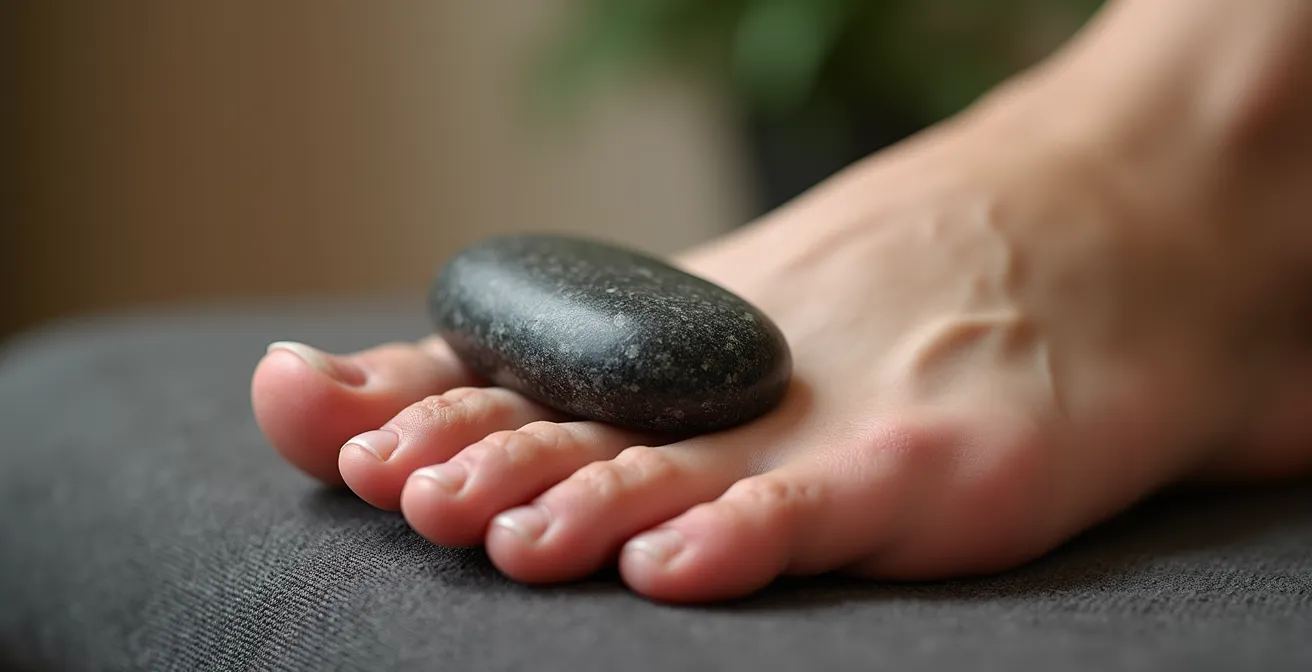
The table below outlines common stone sizes and their primary applications, highlighting why a specialized stone is superior for detailed work on the foot’s arch. While medium or small ovals are excellent for broader areas like the soles or for resting in the palm, they lack the precision needed for the arch itself.
| Stone Size | Dimensions | Best Application |
|---|---|---|
| Medium Oval | 2.5″ x 1.5″ x 0.5″ | Palm rest and calf placement |
| Small Oval | 1.5″ x 1″ x 0.5″ | Forehead, crown, soles of feet |
| Miniature Pressure | 3″ x 1″ x 0.39″ | Targeted arch pressure points |
Why Heat Penetrates 3cm Deeper Than Manual Pressure Alone?
The therapeutic effectiveness of hot stone massage hinges on a core principle of physics: heat transfer. Basalt’s ability to deliver sustained heat deep into muscle tissue is not a mystical property but a direct result of its high specific heat capacity and thermal conductivity. This allows it to achieve a level of physiological response that manual pressure alone cannot replicate.
Specific heat capacity is the measure of a material’s ability to absorb and store thermal energy. Basalt, rich in iron and magnesium, excels in this area. Geothermal property studies reveal that basalt possesses a specific heat capacity of around 840 J/kg·K, allowing a standard set of stones to store a tremendous amount of thermal energy. When placed on the body, the stone doesn’t just feel hot; it actively radiates this stored energy into the tissue. This process, known as conduction, transfers heat from the stone to the skin, and then progressively deeper into the muscle layers.
This deep, sustained heat triggers a powerful physiological response known as vasodilation. As High Stone Wholistic Wellness explains in its analysis of thermotherapy:
Heat helps dilate blood vessels, increasing blood flow to the targeted area. Enhanced blood circulation brings more oxygen and nutrients to the muscles, accelerating healing and reducing pain.
– High Stone Wholistic Wellness, Analysis of thermotherapy benefits in massage
This vasodilation allows the therapist’s manual work to be far more effective. The muscles are already in a relaxed, pliable state, and the increased blood flow helps to flush out metabolic waste. The heat effectively “preps” the tissue, allowing manual pressure to work on deeper layers without the resistance and discomfort that might otherwise be present. It is this combination of sustained thermal radiation and subsequent manual manipulation that defines the unique efficacy of the treatment.
How to Replace Endocrine-Disrupting Cleaners With Safe Alternatives Under $20?
The sanitization of your basalt stones is a non-negotiable step for client safety, but the choice of cleaning agent is critically important. Many conventional commercial cleaners contain harsh chemicals, synthetic fragrances, and compounds that can act as endocrine disruptors. These substances not only risk irritating a client’s skin but can also degrade the natural surface of the stones over time and contribute to an unhealthy indoor air environment in your treatment room.
Fortunately, effective, safe, and affordable alternatives are readily available. The most effective solutions leverage the natural antimicrobial and antibacterial properties of plant-derived ingredients. These cleaners avoid harsh chemicals like ammonia or chloride, opting instead for compounds that are both effective and biocompatible. A key ingredient in many of these formulations is tea tree oil (Melaleuca alternifolia), renowned for its powerful natural cleansing properties.
Transitioning to these alternatives is simple and cost-effective. A single bottle of a high-quality, plant-based concentrate or a pre-mixed solution typically costs well under $20 and can last for dozens of cleaning cycles. These products prove that you do not need to compromise on safety or environmental responsibility to achieve professional-grade hygiene.
Case Study: ECOS Plant-Derived, EPA Safer Choice Certified Cleaner
The company ECOS has developed a 100% vegan cleaning formula that is EPA Safer Choice certified, confirming its favorable health and environmental profile. Their bathroom cleaner utilizes plant-derived ingredients, including tea tree oil, to effectively clean surfaces. It is formulated without ammonia, chloride, or synthetic fragrances, relying on the natural antibacterial properties and earthy aroma of tea tree oil to provide effective cleaning without harsh fumes or residues.
By opting for cleaners based on ingredients like tea tree oil, you not only protect your clients and your stones but also align your practice with principles of health and wellness that extend beyond the massage table itself.
Key takeaways
- Basalt’s superiority is due to its igneous formation, providing structural integrity under heat that sedimentary rocks lack.
- Effective thermotherapy relies on basalt’s high specific heat capacity, a measurable physical property stemming from its dense, iron-rich mineralogy.
- Safety is paramount: never use a microwave, and always use professional-grade, plant-based cleaners to sanitize stones after every use.
How to Unblock Meridian Channels to Restore Vitality
While concepts like “meridian channels” and “vitality” originate in Traditional Chinese Medicine, their effects can be understood through the lens of modern physiology. From a Western perspective, “unblocking channels” is analogous to improving circulatory and lymphatic flow, reducing neuromuscular tension, and promoting homeostasis. The sustained, deep-penetrating heat from basalt stones is a powerful catalyst for these physiological processes.
According to professional massage therapy guidelines, stones are typically heated to a controlled temperature of 130-145°F (54-63°C) and used throughout a 60-90 minute session. This prolonged application of heat induces significant vasodilation, as discussed earlier. The widening of blood vessels dramatically increases blood flow, delivering oxygen and nutrients to tissues while simultaneously facilitating the removal of metabolic byproducts like lactic acid. This enhanced circulation is a key mechanism for restoring “vitality” to stagnant, tight, or ischemic tissues.
The benefits extend beyond simple circulation. The combination of heat and pressure has a profound effect on the nervous system, helping to down-regulate the sympathetic (“fight or flight”) response and promote a parasympathetic (“rest and digest”) state. This systemic relaxation can lead to a cascade of benefits that align with the goals of “unblocking energy.” As the Healing Mountain Massage School notes:
Hot stone massage promotes many of the same benefits as Swedish massage, including pain management, increased range of motion, strengthened immunity, reduced spasms and cramps, reduced post-surgery adhesions, scarring and swelling, helps relieve migraine pain, and promotes tissue regeneration.
– Healing Mountain Massage School, Clinical benefits of hot stone therapy
Whether you frame it as unblocking Qi or enhancing physiological function, the outcome is the same: the targeted application of thermal energy via basalt stones initiates a cascade of therapeutic effects that reduce pain, improve mobility, and restore the body’s natural state of balance and well-being.
By grounding your practice in the material science of your tools, you move beyond generic treatments and into the realm of precise, predictable, and powerful thermotherapy. Choosing genuine, high-density volcanic basalt is the first and most critical step in delivering the highest standard of care to your clients. Evaluate your equipment today and ensure it is built on the solid foundation of geological science.