
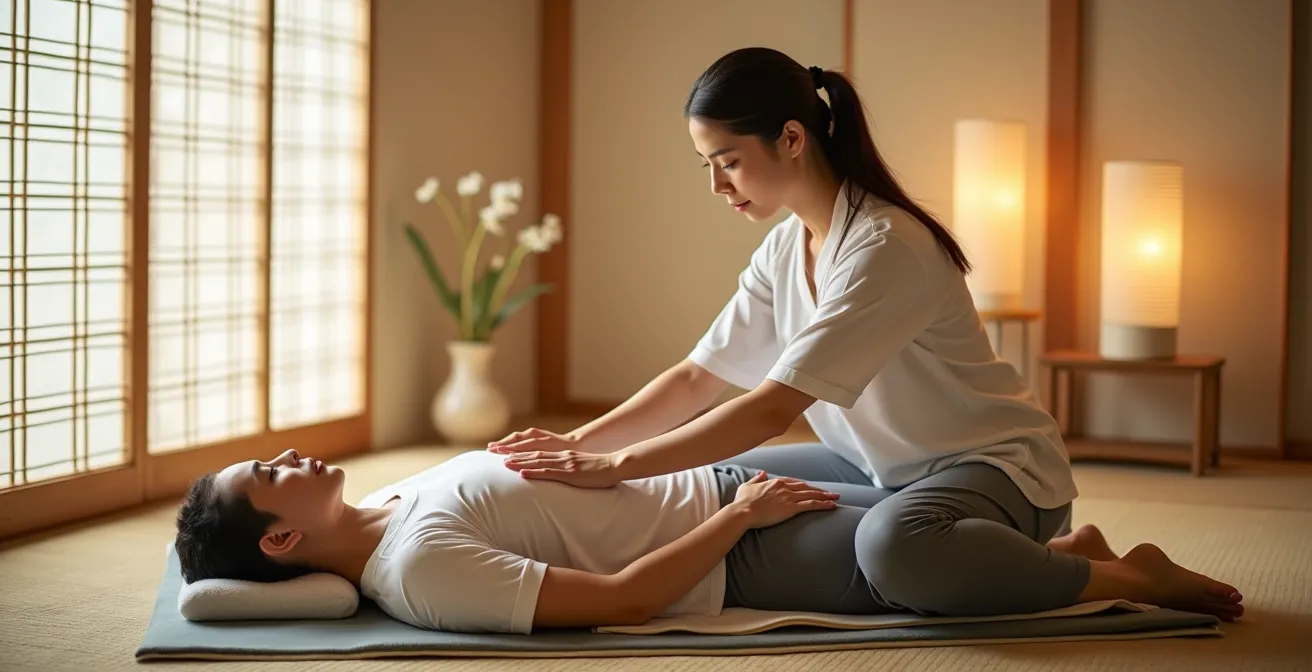
Many believe Shiatsu is simply “massage without oil,” a choice based on personal comfort. This is a fundamental misunderstanding. The absence of oil is a strict therapeutic requirement, enabling the practitioner to make direct contact with the fascial network, accurately diagnose energetic imbalances through palpation, and apply the sustained, perpendicular pressure necessary for profound structural change—techniques that are impossible with oil-based methods.
For those who are modest, dislike the sensation of massage oil, or seek effective therapy without disrobing, the world of bodywork can seem limited. The conventional image is one of draped tables, scented oils, and gliding strokes. This approach, while relaxing, often only addresses the most superficial layers of muscle tension. It is a common assumption that any oil-free alternative must be a compromise, sacrificing depth for convenience.
This perspective overlooks a discipline built on an entirely different foundation. While many therapies focus on muscular manipulation, they neglect the deeper, more pervasive web of connective tissue—the fascia—where chronic pain and postural issues often originate. The preference for remaining clothed is often seen as a barrier to “deep tissue” work, forcing a choice between comfort and efficacy.
But what if the most precise and profound work required no oil at all? What if remaining clothed was not a limitation, but an advantage? Shiatsu is not a modification of Western massage; it is a complete diagnostic and therapeutic system from Japan. Its principles dictate that the absence of oil is essential. It allows for a level of perception and a type of pressure that oil makes impossible, targeting the root causes of dysfunction with disciplined specificity.
This guide will illuminate the core principles of Shiatsu, demonstrating why its oil-free, floor-based approach is not a matter of preference but a cornerstone of its effectiveness. We will explore how body weight surpasses muscular force, how the body’s story is read through the abdomen, and why true healing often lies not in the muscles, but in the tissues that hold them.
Summary: Why Shiatsu Is the Superior Choice for Those Who Dislike Massage Oil
- Why Using Body Weight Is More Effective Than Muscular Force?
- How to Read the Abdomen to Assess Overall Health Status?
- Floor Mat or Massage Table: Which Allows for Better Stretching Angles?
- The “Good Pain” Mistake: When Pressure Crossing the Line into Injury
- Where to Start: The Head or the Feet for Grounding Excessive Thinking?
- Why Stretching Muscles Won’t Fix Pain Located in the Connective Tissue?
- Mat Work or Reformer Machine: Which Fixes Posture Faster?
- How to Recognize the Signs of Stagnant Qi Before It Becomes Illness
Why Using Body Weight Is More Effective Than Muscular Force?
In conventional massage, pressure is generated by the practitioner’s muscular effort. This force is often fast, fatiguing, and limited in its depth. Shiatsu operates on a different principle: the application of steady, perpendicular pressure derived from the practitioner’s own body weight. This is not a matter of pushing harder, but of leaning with focused intent. This method allows for a pressure that is both profoundly deep and deeply respectful of the body’s limits.
When a practitioner uses their own muscle, the force is active and can trigger a defensive tensing in the recipient. The use of relaxed body weight, however, feels stable and non-invasive. The body does not perceive it as an attack and is more willing to release long-held tension. This sustained pressure has a direct effect on the fascial system, the connective tissue that envelops every muscle and organ.
The distinction is not merely philosophical; it is mechanical. A 2023 study on fascial response revealed that sustained body weight squeezed hyaluronic acid toward the edges of fascial planes. This action creates greater lubrication and allows previously “stuck” layers to slide freely against one another. It is a structural reset that cannot be achieved with the quick, gliding strokes of an oil-based massage.
By using their entire body—palms, thumbs, elbows, knees—and leveraging gravity, the Shiatsu practitioner can maintain this vital, sustained pressure for minutes at a time without fatigue. This transforms the treatment from a series of muscular actions into a quiet, powerful dialogue with the body’s deepest structures.
How to Read the Abdomen to Assess Overall Health Status?
In Japanese therapeutic traditions, the abdomen, or Hara, is considered the body’s energetic and physical center. It is far more than a collection of digestive organs; it is a microcosm of one’s entire state of health. A skilled Shiatsu practitioner does not begin a treatment with a preconceived routine. They begin by listening, and the Hara is where the body speaks most clearly. This process of abdominal palpation is known as Hara diagnosis.
Through gentle, mindful touch, the practitioner assesses various zones of the abdomen that correspond to the body’s meridians and their associated organs. This is not a forceful prodding but a sensitive inquiry. The practitioner is feeling for subtle variations in temperature, tension, resilience, or emptiness. These qualities provide a real-time map of the body’s energetic state, revealing where Ki (or Qi) is deficient, excessive, or stagnant.
The abdomen contains vital information about the functioning of internal organs, energy pathways (meridians), and the flow of vital energy throughout your body.
– Daniel Adler Clinic, What is Hara Diagnosis?
The assessment follows a structured sequence to build a comprehensive picture of the individual’s condition. The key steps involve:
- Beginning with gentle palpation to assess temperature variations across different abdominal zones.
- Identifying areas of hardness, softness, or tenderness that signal potential imbalances in specific organs or disruptions in the flow of energy.
- Assessing vital information about the functioning of internal organs and the flow of vital energy (Ki) through careful touch.
- Noting these diagnostic signs to create a treatment strategy tailored to the individual’s immediate needs.
- Connecting certain areas of discomfort in the abdomen to specific emotional states or stressors, as the Hara is also a center of emotional holding.
This diagnostic palpation is only possible on bare skin or through a thin layer of clothing. The presence of oil would obscure these subtle signals, rendering this essential diagnostic tool useless. The information gathered from the Hara guides the entire session, ensuring the treatment is not generic but a precise response to the client’s unique condition.
Floor Mat or Massage Table: Which Allows for Better Stretching Angles?
The traditional setting for Shiatsu is not an elevated table but a firm, comfortable mat (futon) on the floor. This is not an arbitrary choice of decor; it is a fundamental component of the therapy’s effectiveness, particularly regarding stretching. Working on the floor grants the practitioner unparalleled freedom of movement and leverage that a massage table simply cannot provide.
On a table, both practitioner and client are in a fixed, elevated position. The practitioner’s movement is restricted to the space around the table, and they must rely primarily on arm and upper body strength. On a floor mat, the practitioner can use their entire body, including their knees and feet, to stabilize the client while applying pressure and facilitating deep, multi-dimensional stretches. They can move around the client in a 360-degree range, changing angles and leverage points with fluid efficiency.
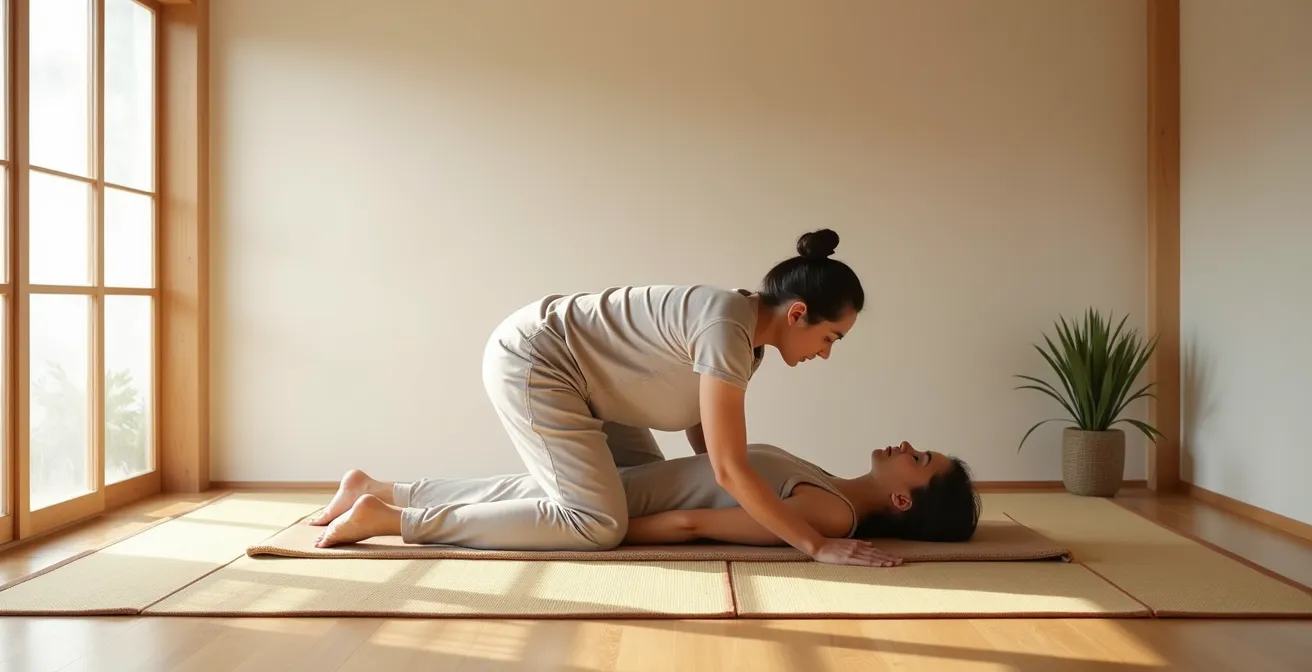
This grounded position allows for powerful rotational and traction-based movements that are impossible on a table. For example, a practitioner can stabilize a client’s shoulder with one knee while gently rotating the hip to release deep tension in the lower back and pelvis. The floor provides a solid, unmoving base, allowing the practitioner’s body weight to be channeled directly into the stretch, ensuring stability and safety.
The differences are stark when compared directly. The floor mat is not just an alternative; it is a superior tool for the structural work central to Shiatsu.
| Aspect | Floor Mat | Massage Table |
|---|---|---|
| Practitioner Body Mechanics | Practitioner’s whole body weight is involved, not just the hands | Limited use of body weight, more reliance on arm strength |
| Stretching Angles | 360° access, three-dimensional stretches possible | Limited to table height, restricted angles |
| Stability for Deep Work | Solid ground provides stable base for leverage | Table may shift with deep pressure |
| Client Positioning | Easy transitions between prone, supine, side-lying, seated | Transitions more difficult, limited positions |
| Traditional Practice | Traditionally performed on futon mat placed on floor | Modern adaptation for accessibility |
The “Good Pain” Mistake: When Pressure Crossing the Line into Injury
There is a common misconception in bodywork that for a treatment to be effective, it must be painful. This “no pain, no gain” philosophy often leads clients to endure uncomfortable or even harmful pressure, believing it is a necessary part of the healing process. In authentic Shiatsu, this is a dangerous error. The goal is to create release, not to overwhelm the body’s defenses. A key concept is “itami kimochi ii,” the Japanese term for a sensation that is on the edge of pain but feels positive and releasing—a “good ache,” not a sharp pain.
If the pressure is too intense, the recipient’s body will instinctively tense up, holding its breath and resisting the treatment. This is a counterproductive response that prevents true release. A skilled practitioner is trained to be exquisitely sensitive to this boundary. They feel for the moment the tissue begins to resist and hold their pressure there, waiting for it to yield. Sharp, electric, or burning sensations are clear signals that the pressure is excessive and potentially causing injury to nerves or tissue.
The absence of oil is a critical safety feature in this regard. Oil allows a practitioner’s hands or tools to slide quickly over the skin. This can cause them to slip past a point of tension or, worse, to apply deep pressure too quickly before the underlying tissue has had a chance to adapt. Without oil, the practitioner has direct tactile feedback. They can feel the texture and resistance of each layer of tissue, applying pressure with control and precision.
While Shiatsu is generally not painful, it is normal to experience some muscle soreness, similar to what one might feel after a new workout. This is known as Delayed Onset Muscle Soreness (DOMS) and typically resolves within 24 to 48 hours. This is a sign that the body is adapting and reorganizing, not a sign of injury. True therapeutic pressure is always a respectful dialogue, and as massage therapy experts confirm that even very gentle pressure has a beneficial effect on the nervous system.
Where to Start: The Head or the Feet for Grounding Excessive Thinking?
In our modern lives, many of us live predominantly in our heads. Constant mental activity, worry, and overthinking can lead to a state where our energy, or Ki, becomes “stuck” in the upper body. This manifests as tension headaches, neck and shoulder pain, jaw clenching, and a feeling of being disconnected from our bodies. In such cases, applying direct pressure to the head might seem logical, but it can sometimes intensify the feeling of congestion. The most effective strategy is often to work from the opposite end: the feet.
The principle of grounding is central to many Eastern practices. It involves drawing excess energy downward, away from the overactive mind, and reconnecting it to the earth. In Shiatsu, the feet are a powerful gateway for this process. They contain numerous potent acupressure points (tsubos), most notably the point known as Kidney 1 (or Yongquan), located on the sole of the foot. The name Yongquan translates to “Gushing Spring,” and stimulating this point is like opening a drain for excess mental energy.
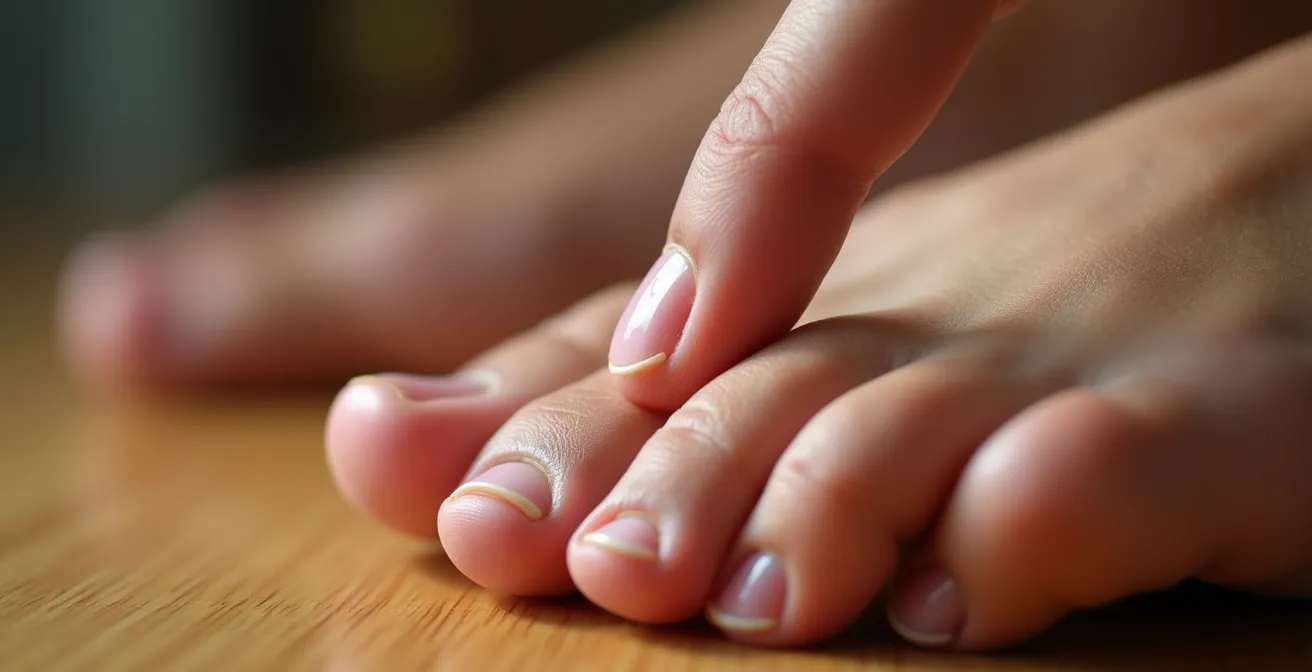
By starting a session with focused work on the feet, a practitioner can anchor the client’s awareness in their physical body. This sends a powerful signal to the nervous system to shift out of a “fight or flight” state and into a “rest and digest” mode. As the mind quiets, the tension held in the neck and shoulders begins to release naturally, without the need for forceful manipulation. The feet provide the foundation, and only when that foundation is stable can the work on the upper body be truly effective.
You can perform a simple self-shiatsu technique to experience this grounding effect firsthand, especially when feeling stressed or before sleep.
Your Grounding Action Plan: Self-Shiatsu for Mental Overactivity
- Sit comfortably with your feet flat on the floor, bringing one foot to rest on the opposite thigh.
- Locate the Kidney 1 point (Yongquan) in the depression on the sole, about one-third of the way down from the base of your toes.
- Apply firm, steady pressure with your thumb into this point for 30-60 seconds. The sensation should be strong but not sharply painful.
- Close your eyes and focus on breathing deeply into your abdomen while maintaining the pressure, visualizing excess energy draining from your head down through your legs and out your feet.
- Release and repeat on the other foot. This simple audit of your energy can be done several times throughout the day to restore calm and clarity.
Why Stretching Muscles Won’t Fix Pain Located in the Connective Tissue?
When we feel stiff or sore, our first instinct is to stretch the muscle. We pull on our hamstring or twist our torso, feeling a temporary sense of relief. However, for many chronic pain conditions, this relief is fleeting. The tightness returns because the problem does not lie solely in the muscle fibers themselves, but in the fascia—the dense web of connective tissue that surrounds and permeates every muscle, bone, and organ.
Fascia should be supple and hydrated, allowing muscles to glide smoothly over one another. Due to injury, repetitive strain, poor posture, or emotional stress, this tissue can become dehydrated, thickened, and “stuck.” These areas of binding are known as fascial adhesions. A simple muscular stretch, which is an elastic and temporary lengthening, is often insufficient to break down these tough, cross-linked fibers. It is like pulling on a knotted rope; you might stretch the unknotted parts, but the knot itself remains tight.
Fixing fascial restrictions requires a different approach. It demands sustained, direct pressure that sinks through the superficial muscle to engage the deeper connective tissue. This is a primary reason why Shiatsu is performed without oil. Oil-based strokes would simply slide over these adhesions. The oil-free, stationary pressure of Shiatsu allows the practitioner to “hook” into a fascial restriction and hold it. This sustained pressure encourages a thixotropic effect: the dense, gel-like ground substance of the fascia begins to “melt” and become more fluid, allowing the fibers to release and realign.
By applying sustained pressure and stretching techniques, massage therapists can release adhesions and fascial restrictions, allowing the fascia to regain its natural elasticity and glide freely.
– Seattle Clinical Massage School, Unlocking the Secrets of Fascia
This explains why someone might stretch their hamstrings daily yet never gain flexibility. The restriction may not be in the muscle but in the fascial sheath around it, or even further up the chain in the fascia of the lower back. Shiatsu addresses the entire fascial line, treating the root cause of the restriction rather than just its most obvious symptom.
Mat Work or Reformer Machine: Which Fixes Posture Faster?
Poor posture is a complex issue. It is often seen as a problem of weak muscles—a weak core, weak back extensors—that need to be strengthened. Modalities like Pilates, particularly on a Reformer machine, are excellent for this. They build the active holding capacity of postural muscles, teaching the body how to maintain proper alignment. However, this is only half of the equation. If the body’s structure is being pulled out of alignment by tight, restricted fascia, no amount of muscle strengthening will create lasting change.
Imagine trying to hold a tent pole straight while one of the guy ropes is pulled far too tight. You can expend enormous energy resisting the pull (muscular strengthening), but the moment you relax, the pole will be yanked out of line again. The only lasting solution is to release the tension on the tight rope. In the body, this “tight rope” is restricted fascia. Shiatsu mat work excels at this first, crucial step: releasing the passive pull on alignment.
By using sustained pressure and deep stretches on a floor mat, Shiatsu releases the fascial adhesions that are distorting the body’s structural integrity. This provides an immediate proprioceptive reset. Proprioception is the body’s sense of its position in space. When fascia is released, the nervous system receives new, more accurate information about joint position, and the body can find its natural alignment with much less effort. The posture improves not because muscles are stronger, but because the resistance has been removed.
Comparing the two approaches reveals their complementary nature. One releases the brakes (Shiatsu), while the other strengthens the engine (Reformer). For the fastest, most lasting results, a combined approach is ideal: release the fascial restrictions first, then reinforce the new, better alignment with targeted strengthening.
| Method | Primary Action | Postural Impact | Timeline |
|---|---|---|---|
| Shiatsu Mat Work | Releases fascial restrictions | Removes passive pull on alignment | Immediate proprioceptive reset |
| Reformer Machine | Strengthens postural muscles | Builds active holding capacity | Progressive over weeks |
| Combined Approach | Release then reinforce | Address root cause then stabilize | Fastest lasting results |
Key Takeaways
- Shiatsu’s oil-free nature is a therapeutic necessity for engaging fascia and performing accurate diagnosis, not a simple comfort preference.
- Using sustained body weight is superior to muscular force for achieving deep, non-resistant release in the body’s connective tissues.
- The floor mat is a superior tool to a massage table, providing the stability and 360-degree access required for Shiatsu’s unique three-dimensional stretches.
How to Recognize the Signs of Stagnant Qi Before It Becomes Illness
In the framework of Eastern medicine, illness does not appear overnight. It is often preceded by a period of imbalance where the body’s vital energy, or Ki (Qi), is not flowing smoothly. This condition is known as Ki Stagnation. It is a pre-clinical state that may not be detectable by conventional medical tests but manifests in a variety of subtle yet distinct physical and emotional signs. Recognizing these signs early is a key to preventative health, allowing one to address the imbalance before it consolidates into a more serious condition.
Ki Stagnation is often compared to a traffic jam. The energy is there, but it is blocked and cannot move freely. A primary emotional sign is irritability or frustration that seems disproportionate to the situation. Physically, it often manifests as pain that is not fixed but moves around the body, or a feeling of distention and pressure. One of the most classic signs is frequent, unconscious sighing—the body’s instinctive attempt to move the stuck energy.
Other common indicators include tension headaches, a sensation of a lump in the throat (called “plum pit qi”), and digestive difficulties. Because the smooth flow of Ki is also responsible for warming the body, individuals with Ki stagnation often experience cold hands and feet even in a warm room. As recent systematic reviews indicate that massage therapy can be highly effective for stress and anxiety, which are both causes and symptoms of Ki Stagnation.
Learning to recognize these signals in yourself is an empowering act of self-awareness. It allows you to take action—through practices like Shiatsu, exercise, or breathing techniques—to restore flow. The following checklist can serve as a guide for self-assessment.
Your Action Plan: Checklist for Identifying Qi Stagnation
- Review emotional state: Do you experience frequent, disproportionate irritability or bouts of frustration?
- Monitor physical sensations: Is there a persistent feeling of a lump in your throat or frequent tension headaches?
- Assess pain patterns: Do you have aches and pains that seem to move from one place to another rather than staying in a fixed location?
- Check body temperature: Are your hands and feet often cold, even when the rest of your body is warm?
- Observe automatic habits: Do you find yourself sighing frequently without realizing it, or experiencing regular colds, flu, or digestive difficulties? Answering yes to several of these points may indicate a pattern of stagnant Ki.
The principles of Shiatsu offer a path to profound well-being that begins with respecting the body’s inherent wisdom. To truly understand these concepts, they must be experienced. Consider seeking out a qualified, certified Shiatsu practitioner to begin your own journey into the art of oil-free, structurally intelligent therapy.