
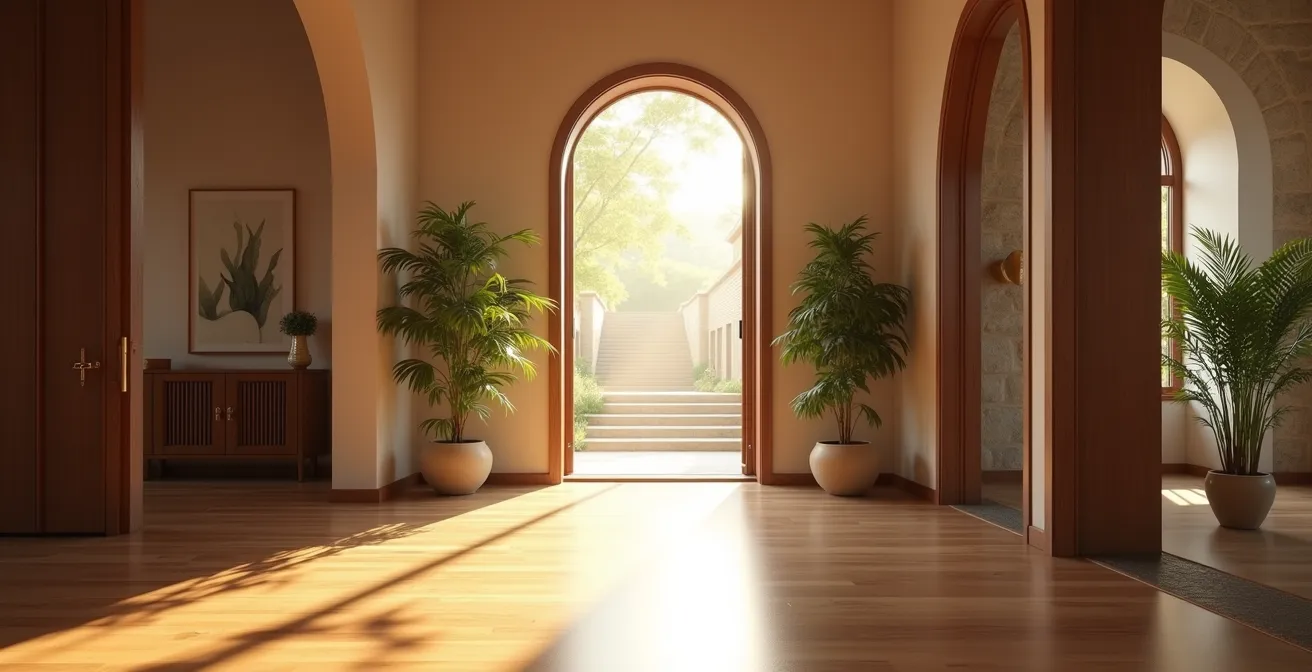
Applying the Bagua map to a new home is not about decorating; it’s about consciously directing the invisible rivers of energy (Qi) that will shape your new life.
- Your front door acts as the “Mouth of Qi,” determining the quality of all energy and opportunities that enter.
- The placement of your bed directly impacts your subconscious security and quality of rest, which is the foundation of your personal energy.
- Clutter, from jumbled shelves to poorly arranged furniture, creates stagnant energy that can lead to stress and blocked progress.
Recommendation: Begin by clearing and activating your front entrance. This single act sets the energetic tone for your entire home and is the most powerful first step you can take.
Moving into a new house is a profound opportunity—a blank canvas on which to paint your future. Many new homeowners focus on the tangible: paint colors, furniture, and unpacking boxes. They might hear about Feng Shui and the Bagua map, treating it as a mystical decorating guide for placing a lucky bamboo in a specific corner. This approach, however, misses the fundamental power of this ancient practice. It’s like knowing the notes of a song but not understanding the melody.
The common advice to simply overlay a nine-square grid on your floor plan is an oversimplification. The true art of applying the Bagua is not a static placement of objects. It is the dynamic and intentional cultivation of an energetic foundation for your new life. It’s about understanding the invisible “rivers of Qi”—the life force energy—that flow through your home and how they influence everything from your career opportunities to your peace of mind. Thinking of your home as a living, breathing entity is the first step toward genuine transformation.
This guide will shift your perspective. Instead of just telling you *what* to place where, we will explore *why* these principles work. You will learn to see your home not as a collection of rooms, but as an ecosystem of energy. We will uncover how to ensure Qi flows smoothly, how to protect yourself from negative influences, and how to create a space that actively supports your goals for prosperity and well-being. By understanding the flow, you become the conscious architect of your home’s energy, not just its decorator.
To help you navigate this process, this article is structured to build your understanding from the ground up, starting with the most critical areas of your new home. Follow along to create a space that feels as good as it looks.
Summary: How to Apply the Bagua Map to a New House to Invite Prosperity
- Why Your Front Door Determines the Quality of Opportunities Entering Your Life?
- How to Place Your Bed to Reduce Subconscious Anxiety While Sleeping?
- Mirrors or Paintings: Which Expands Qi in a Cramped Hallway?
- The Sharp Corner Mistake That Directs Aggressive Energy at Your Sofa
- When to Apply Feng Shui Cures: Before or After Renovation?
- Why Owning Fewer Things Gives You Back 5 Hours a Week?
- Why Open Shelving Increases Cortisol Levels in Cluttered Minds?
- How to Arrange Furniture in Small Spaces to Prevent Stagnant Airflow
Why Your Front Door Determines the Quality of Opportunities Entering Your Life?
In Feng Shui, the front door is known as the “Mouth of Qi.” It is the primary portal through which all energy—and by extension, all opportunities, wealth, and relationships—enters your home and your life. The condition and energy of this entrance set the tone for everything that follows. A cluttered, dark, or neglected entryway invites stagnant or chaotic energy, while a bright, clear, and welcoming entrance ushers in fresh, positive Qi. For a new homeowner, establishing this positive flow from day one is the most impactful action you can take.
Think of it as the first impression your home makes on the universe. If the path is blocked, difficult to find, or uninviting, beneficial energy will struggle to find its way in. This is not just a metaphor; it’s a principle of energetic attraction. The energy you cultivate at your front door directly influences the quality of opportunities that come knocking. The current era, known as Period 9 in Feng Shui, is particularly potent for new beginnings. In fact, the #9 Star of Current Prosperity brings fame and fortune opportunities for the next 20 years, making it an auspicious time to consciously activate your home’s potential.
To welcome this prosperous energy, perform a simple ritual upon moving in. First, ensure the path to your door is clear and the door itself is clean and in good repair. A squeaky hinge or a broken lock can create energetic friction. Then, focus on the threshold. You can perform a simple clearing by wiping it with salt water with the intention of washing away any lingering energy from previous occupants. Finally, place a vibrant, healthy plant with rounded leaves near the entrance to soften the energy and signal life and growth. This simple sequence establishes a powerful energetic foundation for your new life.
How to Place Your Bed to Reduce Subconscious Anxiety While Sleeping?
You spend roughly a third of your life in bed, a time when your body and mind are in their most passive and receptive state. During sleep, your subconscious mind is highly active, processing the day’s events and remaining alert to the surrounding environment. This is why the placement of your bed is arguably the most critical Feng Shui adjustment you can make for your personal well-being. Improper placement can lead to a persistent, low-grade feeling of anxiety, poor sleep, and depleted personal energy.
The most important principle for bed placement is the “Command Position.” This means positioning your bed so that you can see the door to the room without being directly in line with it. This placement satisfies a primal, subconscious need for security. When you can’t see who or what might be entering your space, your nervous system remains on high alert, even during sleep. This prevents you from achieving the deep, restorative rest necessary for health and vitality. Conversely, sleeping directly in line with the door (the “coffin position”) exposes you to a fast-moving channel of Qi, which is disruptive and unsettling.
The ideal setup is to place your bed diagonally opposite the door, with a solid wall behind your headboard for support. This provides a sense of stability and protection, allowing your subconscious to fully relax.
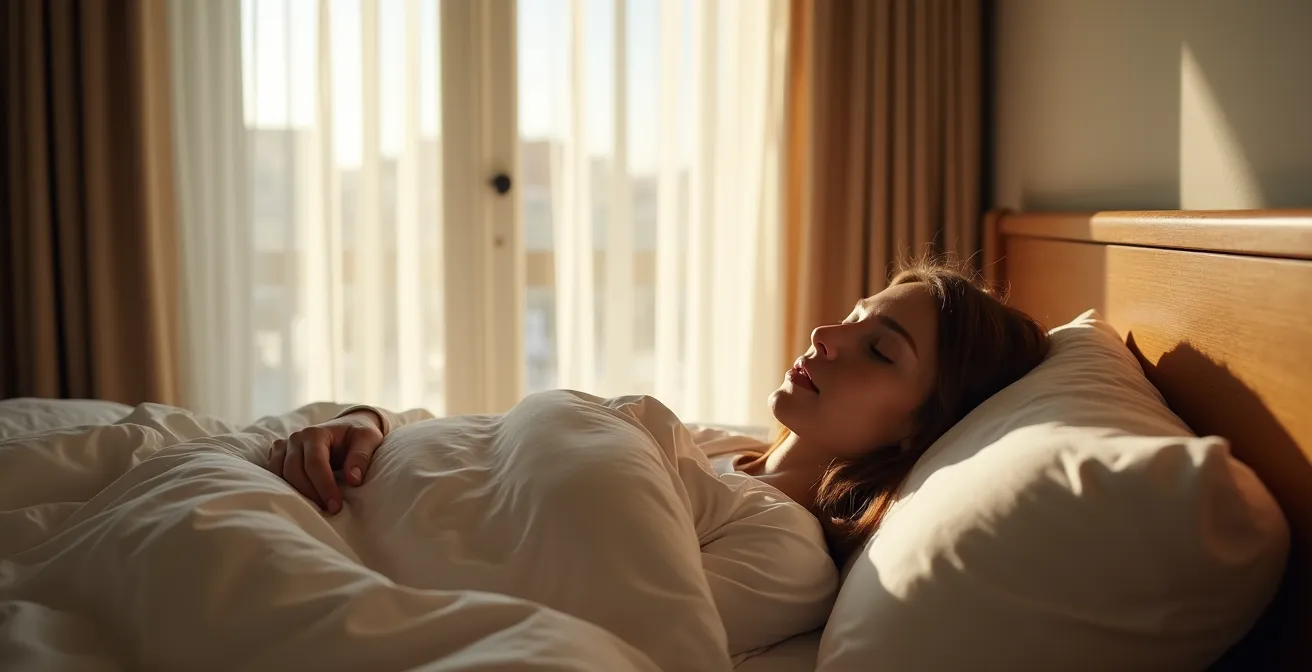
As the illustration shows, this layout creates a feeling of serene control. The solid headboard acts as a “mountain” of support, while the clear view of the entrance eliminates subconscious surprises. The results of this simple change can be profound, fostering a sense of peace that extends into your waking hours. As one client shared after adjusting their bedroom layout:
“Since the consultation, I’ve seen much improvement all around, but mostly….relationship with my husband improved, and so did our finances.”
– Feng Shui Consultation Client, Ms. Feng Shui
Mirrors or Paintings: Which Expands Qi in a Cramped Hallway?
Hallways and entryways are the arteries of your home, responsible for circulating Qi from the front door to all other rooms. In many modern homes, these spaces can be narrow, dark, or cramped, leading to Qi stagnation. When energy cannot flow freely, it becomes stuck, contributing to a feeling of being “stuck” in life. Two common tools to address this are mirrors and paintings, but they serve very different energetic functions. Choosing the right one depends on the specific problem you need to solve.
A mirror’s primary function is to reflect and double whatever is in front of it. This makes it a powerful but tricky tool. Placed correctly, a mirror can make a space feel larger and brighter by reflecting natural light or a beautiful view, effectively accelerating the flow of Qi. However, if it reflects clutter, a sharp corner, or the front door (pushing energy back out), it will amplify that negative energy. A painting, on the other hand, introduces new energy into a space. It acts as a window, creating a sense of depth and inviting the mind to travel. A landscape painting can bring in the energy of nature, while an abstract piece can introduce vibrant, uplifting color.
This principle of using the Bagua map can also be applied to a single room or even a wall. By understanding the energy of each sector, you can choose artwork that corresponds to your goals for that area. For instance, a picture of a mountain in the Knowledge and Self-Cultivation area of a hallway can add a sense of stability and wisdom.
To make the best choice for your narrow space, this comparison can help guide your decision, based on analysis from Feng Shui experts like the International Feng Shui Guild.
| Aspect | Mirror | Painting |
|---|---|---|
| Energy Function | Reflects and doubles existing energy | Introduces new energy |
| Best Use Case | When reflecting light or a beautiful view | When facing a blank wall needing energy |
| Space Perception | Creates illusion of doubled space | Creates depth through perspective |
| Caution | Avoid reflecting clutter or sharp corners | Choose images with positive symbolism |
The Sharp Corner Mistake That Directs Aggressive Energy at Your Sofa
In the language of Feng Shui, sharp corners from walls, pillars, or large pieces of furniture create something called “Sha Qi” or “poison arrows.” This is a fast-moving, aggressive form of energy that, when pointed at a place where you spend significant time—like your sofa, desk, or bed—can feel like a constant, subtle attack on your personal energy field. Over time, this can manifest as unexplained discomfort, arguments, or a feeling of being on edge in your own home.
New homeowners are often so focused on arranging furniture for aesthetics or television viewing angles that they overlook these invisible energetic threats. A common mistake is placing a sofa directly in the path of a sharp corner from an adjoining wall or a large, square coffee table. While you may not consciously notice it, your body’s energy field registers the “cutting” nature of the Sha Qi, preventing you from fully relaxing. This is especially true in open-plan living spaces where architectural features are more exposed.
Fortunately, mitigating the effects of poison arrows is straightforward. The goal is to soften or redirect the aggressive energy before it reaches you. You don’t need to completely rearrange your room. A simple and beautiful solution is to place a tall, leafy plant with rounded leaves in front of the sharp corner. The plant’s living energy and soft shapes will absorb and disperse the Sha Qi.
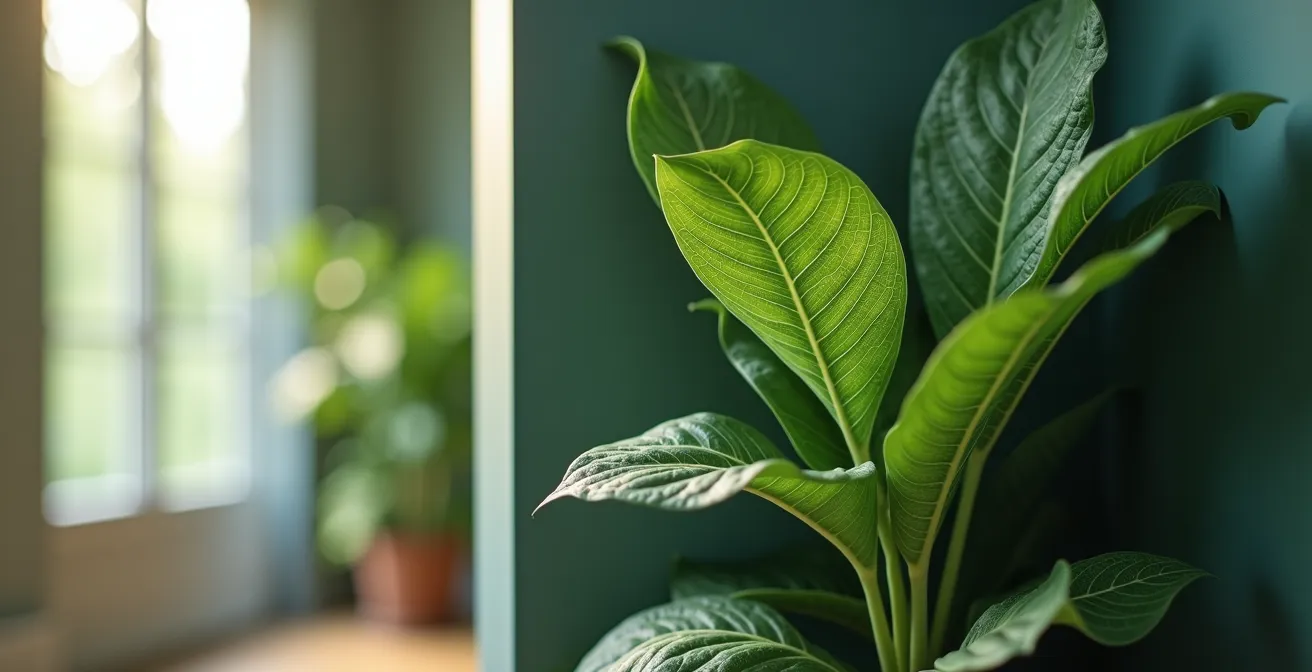
As this image details, the organic texture of the plant leaves effectively breaks up the harsh line of the corner. Other solutions include hanging a faceted crystal to refract the energy or draping a soft fabric over the corner. The key is to consciously identify these “arrows” and place a buffer between them and your personal space, transforming an aggressive feature into a harmonious one.
When to Apply Feng Shui Cures: Before or After Renovation?
For new homeowners, one of the most pressing questions is timing: when is the best moment to apply Feng Shui principles? Should you wait until you’ve lived in the space, or integrate them during a pre-move-in renovation? The answer depends on the type of “cure” or adjustment being made. It’s crucial to differentiate between structural changes and decorative enhancements.
Structural Feng Shui addresses the “bones” of the house: the location of the front door, the layout of the kitchen, the position of staircases, or the shape of the floor plan itself. These elements have the most profound and lasting impact on the home’s energetic foundation. If you are planning a renovation, this is the golden opportunity to consult the Bagua map. Making changes like moving a doorway to avoid a direct alignment with a back door, or reconfiguring a kitchen so the stove (Fire element) isn’t directly opposite the sink (Water element), is far easier and more cost-effective *before* you’ve moved in. These are foundational fixes that set a permanent, positive energy pattern.
Decorative cures, on the other hand, are adjustments made to the surface layer of your home. This includes adding specific colors, placing symbolic objects (like crystals or statues), hanging artwork, or arranging furniture. These are powerful and can be applied at any time to fine-tune the energy of a space or address a specific life goal (e.g., enhancing the Relationship corner). These adjustments are best made *after* you have settled in and have a feel for the home’s natural energy flow. You can also use decorative cures like mirrors to energetically “complete” a missing corner in an L-shaped floor plan, a common issue in modern architecture. The key is to prioritize the deep, structural work first during renovation, and then layer the decorative elements once you inhabit the space.
Why Owning Fewer Things Gives You Back 5 Hours a Week?
While the Bagua map guides the placement of things, one of the most potent Feng Shui principles involves the intentional *removal* of things. Every object in your home holds energy and requires a portion of your attention—to clean, to maintain, to organize, or simply to be processed by your brain. An excess of possessions, or clutter, creates a constant, low-level drain on your personal Qi and your time. It’s estimated that we spend a significant amount of time managing our “stuff,” and reducing this burden can free up hours each week for more meaningful pursuits.
From a Feng Shui perspective, clutter is more than just a physical mess; it is a manifestation of stagnant energy. It blocks the smooth flow of Qi through your home, leading to feelings of lethargy, confusion, and being stuck in the past. Owning fewer things isn’t about stark, joyless minimalism. It’s about conscious curation. It’s about ensuring that every item in your home is either useful, beautiful, or deeply meaningful. This practice creates physical and energetic space, allowing fresh opportunities and inspiration to enter your life.
This philosophy is deeply connected to the core of Feng Shui, which seeks to create harmony. As the International Feng Shui Guild explains, creating positive energy is a holistic process.
“Balancing the five elements, looking at poison arrows or traffic flows through the space, clearing clutter, and more are all part of creating positive Feng Shui. Looking at the overall bagua in conjunction with aligning your goals and passions can bring about specific cures or enhancements that support your growth and change.”
– International Feng Shui Guild, The Feng Shui Bagua Guide
Your Action Plan: Applying Intentional Minimalism with the Bagua
- Identify a Focus Area: Using the Bagua map, determine which of the nine life areas (e.g., Wealth, Health, Relationships) needs the most attention in your life right now.
- Perform a Total Clear-Out: Go to the corresponding physical area of your home and remove every single item from that space. Clean the area thoroughly.
- Select a Power Object: Choose one single, powerful, and meaningful object that represents your clear intention for this life area. This could be a thriving plant for the Wealth corner or a pair of cranes for the Relationship corner.
- Practice Mindful Placement: Place this single object back into the space with intention. You can create a small daily ritual, like touching the object and reaffirming your goal, to keep the energy active.
- Evaluate and Maintain: Only allow items back into this area that strongly support your intention. Anything that is broken, unused, or brings up negative feelings should be permanently removed.
Why Open Shelving Increases Cortisol Levels in Cluttered Minds?
Open shelving is a popular trend in modern interior design, praised for its airy and accessible feel. However, from a Feng Shui and a psychological perspective, it can be a double-edged sword. While beautifully styled shelves can enhance a room’s energy, disorganized or overstuffed open shelves act as a source of constant visual clutter. This “visual noise” is not just an aesthetic issue; it can have a tangible impact on your mental state by subtly increasing stress levels.
Your brain is wired to constantly scan and process your environment. When your eyes land on a chaotic collection of items, your mind has to work to make sense of the disorder. This continuous, low-level cognitive load can trigger a stress response, contributing to elevated levels of cortisol, the stress hormone. You may not consciously feel stressed just by looking at a messy shelf, but your body is reacting. A 2021 study published in Building and Environment found that subjects exposed to spaces organized by Feng Shui principles experienced significantly higher levels of comfort and more positive emotions than those in disorganized spaces.
This doesn’t mean you must abandon open shelving. The key is to transform it from a source of chaos into a beacon of intention. By organizing your shelves according to the principles of the Bagua, you can turn a potential stressor into a powerful tool for supporting your goals. The vertical dimension of a shelving unit can be seen as a microcosm of the Bagua, representing different life aspirations.
This table offers a simple framework for organizing your shelves to create a display that is not only visually pleasing but also energetically supportive, based on established principles.
| Shelf Level | Bagua Area | Items to Display | Energy Purpose |
|---|---|---|---|
| Top Shelf | Fame/Aspirations | Awards, achievements, vision boards | Future goals and recognition |
| Middle Shelf | Family/Health | Family photos, plants, wellness items | Daily life support |
| Bottom Shelf | Knowledge | Books, learning materials, wisdom objects | Foundation and growth |
Key Takeaways
- The Bagua is a tool for managing energy flow (Qi), not just a decorating template.
- Your front door, bed position, and pathways are the three most critical areas to address first in a new home.
- Clutter, including visual clutter on open shelves, creates stagnant energy and subconscious stress.
How to Arrange Furniture in Small Spaces to Prevent Stagnant Airflow
Applying Feng Shui in a small apartment or compact house presents a unique challenge: how do you create a sense of spaciousness and flow when square footage is limited? The primary risk in small spaces is Qi stagnation. When furniture is too large, pushed against every wall, or blocks natural pathways, it creates energetic dams. The life force energy cannot circulate, leading to a feeling of being cramped, restricted, and lethargic. The goal is not to have less furniture, but to arrange it smartly to guide the “rivers of Qi” through your home.
Imagine gentle streams of energy flowing from your doors and windows. Your furniture should act as the “riverbanks,” guiding this flow smoothly rather than blocking it. A common mistake is to place a large sofa or bookshelf directly in the path between a door and a window, effectively damming the primary energy current. Instead, create clear pathways that allow you to move through the space with ease. A practical guideline is the “Knee Rule”: ensure there are at least 18 inches (45cm) of space for minor pathways, allowing energy to meander freely.
In small spaces, creating flow under and around furniture is key. Opt for “furniture on legs”—sofas, consoles, and chairs that are raised off the floor. This simple choice allows light and air (and Qi) to circulate underneath, preventing energy from becoming trapped and heavy. Instead of using large, solid pieces as room dividers, use “soft zoning” techniques like area rugs or strategic lighting to define different functional zones without creating hard physical barriers. This maintains an open feel while still creating distinct areas for living, dining, or working. By following these principles, you can make even the smallest space feel open, harmonious, and full of life.
Now that you have the foundational tools to shape the energy of your new home, the next step is to begin the practice. Start with one room—perhaps your bedroom or living area—and apply these principles. Observe how the feeling of the space changes. This journey is about cultivating a mindful relationship with your environment, transforming your house into a true sanctuary that nurtures and supports your prosperity in every sense of the word.