
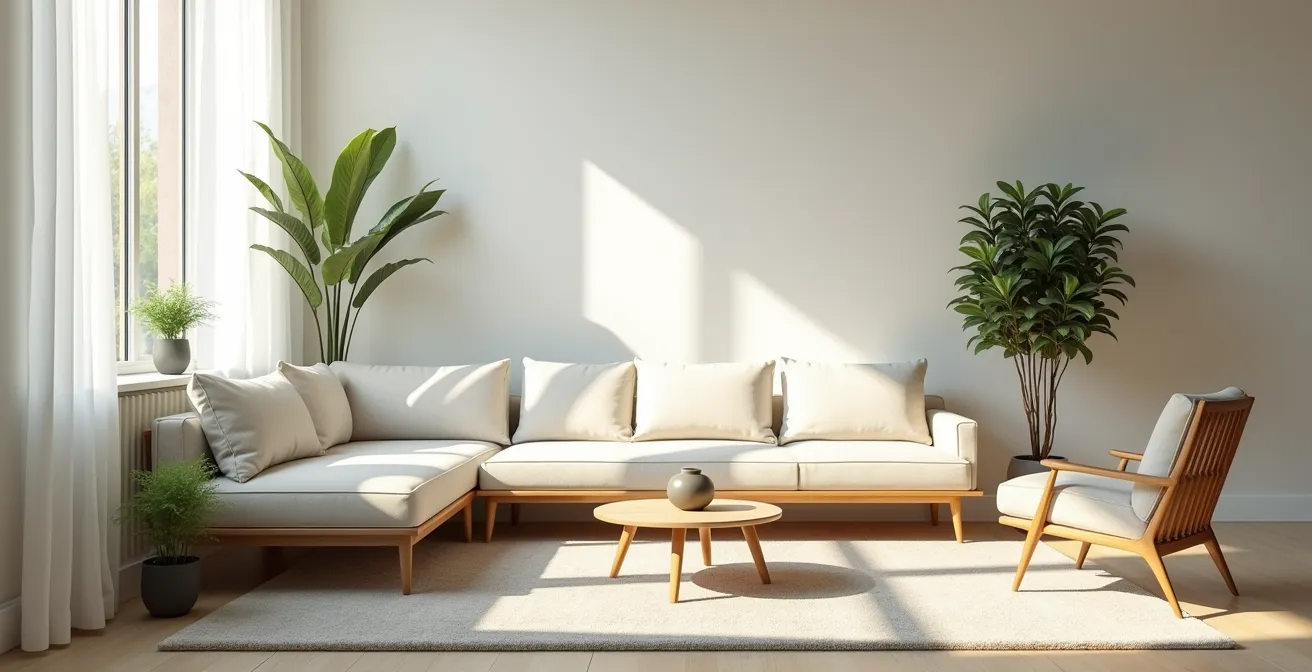
That stuffy, suffocating feeling in your small apartment isn’t just about a lack of space; it’s a problem of stagnant air trapping pollutants. The solution isn’t just opening a window, but redesigning your layout based on residential aerodynamics. By strategically creating clearance, directing airflow with furniture, and managing humidity, you can turn your home from a static box into a dynamic, self-ventilating system that actively promotes healthier air and a sense of spaciousness.
If you live in a studio or a small apartment, you know the feeling. It’s a sense of stuffiness that clings to the air, no matter how much you tidy up. You wake up with a dull headache, notice dust bunnies colonizing unreachable corners, and feel a general sense of lethargy. The common advice is predictable: get multi-functional furniture, don’t block vents, maybe buy an air purifier. While not wrong, these tips only treat the symptoms. They miss the fundamental cause: your furniture layout is choking your home.
The air in your room is a fluid, and your furniture dictates how it moves—or fails to. Stagnant air isn’t just unpleasant; it’s a reservoir for pollutants like Volatile Organic Compounds (VOCs) off-gassing from your sofa and paint. The key to a healthy, breathable small space isn’t about minimalist aesthetics or clever storage hacks alone. It’s about becoming a residential aerodynamicist, consciously engineering airflow pathways to ensure constant, gentle air exchange.
But what if the very idea of ventilation is more complex than we think? What if opening a window at the wrong time makes things worse? This guide moves beyond the platitudes. We will treat your room as a dynamic system, exploring how to use furniture placement not for decoration, but as a tool to control pressure zones, create convection currents, and eliminate the dead air spots that are making you feel suffocated. We’ll delve into the science of why stagnant air is a health risk, provide engineered solutions for creating breezes, and show how a focus on airflow inherently solves the dilemma between clear pathways and adequate storage.
This article provides a structured approach to transform your living space. Each section builds upon the last, guiding you from understanding the invisible threats in your air to implementing advanced strategies for a truly breathable and focused home environment.
Summary: How to Arrange Furniture in Small Spaces to Prevent Stagnant Airflow
- Why Poor Ventilation in Small Bedrooms Causes Morning Headaches?
- Why Poor Ventilation Increases Respiratory Infection Risk by 30% in Winter?
- The Furniture Mistake That Creates Unreachable Dust Bunnies
- How to Position Fans to Mimic a Cross-Breeze in Single-Window Rooms?
- Clear Pathways or More Storage: Which Makes a Room Feel Bigger?
- The Sharp Corner Mistake That Directs Aggressive Energy at Your Sofa
- When to Open Windows vs Use Dehumidifiers to Prevent Mold?
- How to Use Biophilic Design Elements to Boost Focus in Home Offices
Why Poor Ventilation in Small Bedrooms Causes Morning Headaches?
That dull, persistent headache you wake up with is often not from a bad pillow, but from the air you’ve been breathing all night. In a small, poorly ventilated bedroom, you are essentially marinating in a soup of accumulated pollutants. As you sleep with the door and windows closed, your own respiration increases carbon dioxide levels. But a more insidious threat is the off-gassing of Volatile Organic Compounds (VOCs) from everyday objects.
Your mattress, your new dresser, the paint on your walls, and even your sofa are constantly releasing these chemicals into the air. Without adequate airflow to disperse them, their concentration skyrockets overnight. In fact, research from the American Lung Association confirms that VOC levels are consistently higher indoors (up to ten times higher) than outdoors. These compounds are a major cause of headaches, eye irritation, and nausea. One study on furniture emissions found a new sofa could increase the Total VOC (TVOC) concentration in a room by 911 µg/m³, accounting for almost 230% of the provisional target value.
Visualizing this process helps understand its severity. Imagine your room as a sealed container where these invisible particles accumulate, reaching their highest concentration in the early morning, right as you’re about to wake up.
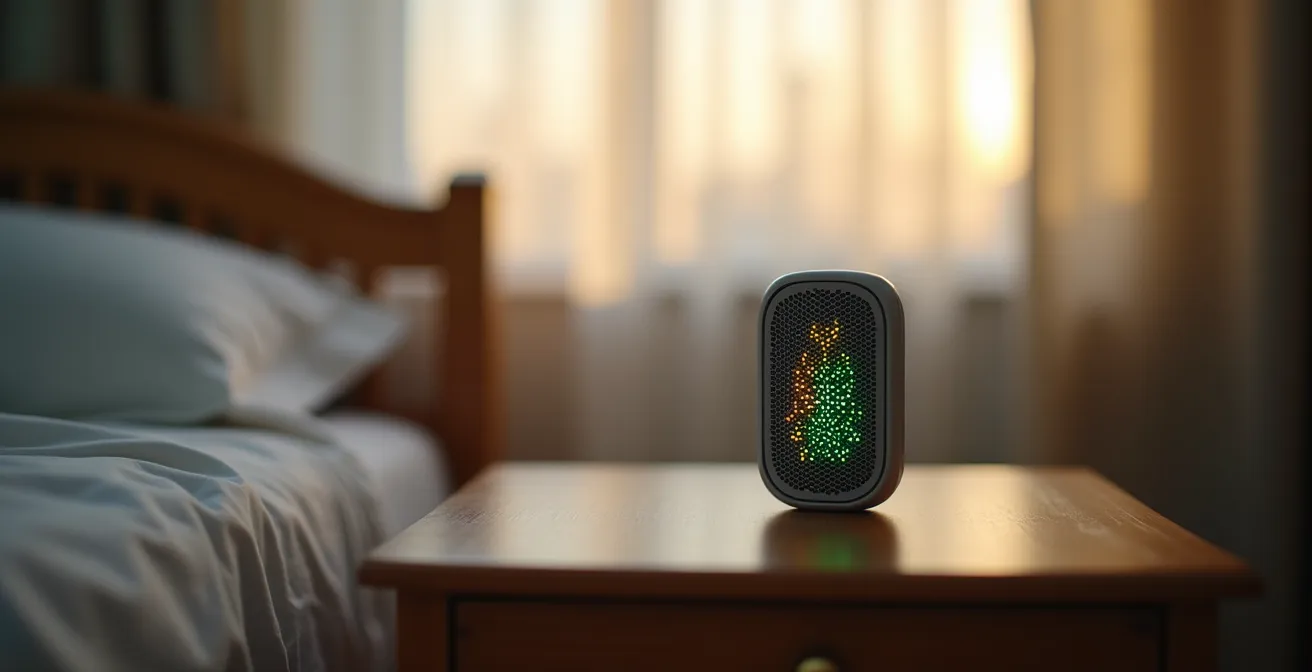
As the illustration suggests, the air becomes saturated with these compounds. Your body’s response to this overnight exposure is often that signature morning headache. It’s a clear signal that your room’s “exhale”—its ability to vent stale air and “inhale” fresh air—is compromised. The primary culprit is a layout that creates stagnant air, trapping these VOCs around you while you sleep. The solution begins with understanding that your health is directly tied to your home’s ability to breathe.
Why Poor Ventilation Increases Respiratory Infection Risk by 30% in Winter?
During winter, we seal our homes to stay warm, but this creates a perfect breeding ground for airborne illnesses. The lack of fresh air circulation means that virus-laden aerosols from a cough or sneeze linger for hours, dramatically increasing the chances of transmission between household members. Stagnant air allows particulate matter, like PM2.5, to accumulate. These microscopic particles can carry viruses deep into our lungs and weaken our respiratory defenses. Studies have quantified this risk, showing that even short-term exposure to higher PM2.5 levels is linked to more hospital visits. For example, research demonstrated that interquartile range increases in PM2.5 over 7 days were associated with 2.5% increased excess rates for certain types of pneumonia hospitalizations.
The intuitive response is to ventilate more. However, the solution is more nuanced, especially in winter. Over-ventilating with cold, dry outdoor air can be counterproductive. It drastically lowers indoor humidity, and viruses thrive in dry conditions. As Stanford chemist Richard Zare explains, a certain level of humidity is actually our ally.
I’m not against ventilation, but doing it five times per hour, particularly in the wintertime when the heat is on, means that you’re drying out the air and lowering the relative humidity. We have shown that low relative humidity makes viruses and droplets much more viable and they survive a lot longer.
– Richard Zare, Stanford University Research
This creates a critical balancing act. We need enough air exchange to disperse pollutants and viral loads, but not so much that we create an overly dry environment that helps viruses survive longer. This is where strategic furniture placement becomes a tool for micro-climate control. By ensuring gentle, consistent air movement throughout the room, rather than harsh, intermittent blasts of ventilation, you can help clear aerosols without completely stripping the air of beneficial humidity. It’s about creating a slow, steady “river” of air, not a “flood.”
The Furniture Mistake That Creates Unreachable Dust Bunnies
Those persistent dust bunnies in impossible-to-reach places are more than an aesthetic nuisance; they are a physical indicator of “dead air” zones in your home. These zones are created by the most common furniture layout mistake: pushing heavy pieces flat against the walls and using furniture with no ground clearance. This practice effectively creates dams and barriers, stopping airflow in its tracks and forming stagnant pockets where dust, allergens, and pollutants settle and accumulate.
This layout flaw has consequences beyond cleanliness. When a large sofa or entertainment center is placed directly in front of an air return vent, it obstructs the primary intake for your home’s circulatory system. This blockage forces your HVAC system to work up to 30% harder to pull in air, leading to higher energy bills and increased wear and tear. You’re essentially forcing your home’s “lungs” to breathe through a straw. The space behind and under your furniture is critical for maintaining what physicists call the boundary layer—the layer of air that clings to surfaces. Without circulation, this layer becomes thick and stagnant.
The solution is to think of your furniture not as static blocks, but as objects that should float within the room’s air volume. Adhering to a simple set of clearance rules can transform these dead zones into active airflow pathways. By ensuring every piece of furniture allows air to move around, over, and under it, you prevent the formation of stagnant pockets and create a healthier, self-cleaning environment.
Your 4-Inch Rule Audit for Eliminating Dead Air Zones
- Wall Clearance: Pull all major furniture pieces (sofas, bookcases, dressers) at least 4-6 inches away from the walls. This creates a crucial channel for air to circulate behind them, preventing moisture buildup and dust accumulation.
- Under-Furniture Flow Tunnels: When selecting new furniture, prioritize pieces with legs at least 4 inches high. This clearance creates “flow tunnels” underneath, allowing air and your vacuum cleaner to move freely, eliminating dust bunny breeding grounds.
- Corner Strategy: Instead of pushing a large chair or desk tightly into a corner, position it diagonally. This simple trick breaks up the 90-degree angle, eliminating a classic dead air pocket and encouraging circulation around both sides of the piece.
- Upholstery Breathing Room: Pay special attention to sofas and fabric chairs. Maintaining that 4-6 inch gap behind them is vital to prevent humidity from getting trapped in the upholstery, which can lead to musty odors and mold growth.
- Ventilation Vents Check: Perform a visual audit of all air supply and return vents. Ensure no furniture is blocking them. An unobstructed vent is the most critical component of your home’s entire air circulation system.
How to Position Fans to Mimic a Cross-Breeze in Single-Window Rooms?
In a room with only one window, creating a true cross-breeze is impossible. However, you can use principles of fluid dynamics to engineer an artificial one. The goal is to create a continuous, circular airflow pattern—a whole-room vortex—that systematically pulls stale air out and circulates fresh air in. This requires a strategic partnership between your fan, your window, and your furniture arrangement. Forget simply pointing a fan at yourself; you are now the architect of your room’s weather system.
The first step is to decide the fan’s role. To exhaust stale air, place a box fan in the window facing outwards. This creates a low-pressure zone inside the room, which will naturally draw fresher, cooler air in through the gaps around the fan and from other areas of your home. To bring fresh air in, place the fan in the window facing inwards. The real magic, however, comes from using furniture and walls as “bounce boards.” Position a powerful air circulator on the floor, facing the wall opposite the window. This creates a large-scale vortex, using the entire room’s volume to circulate air instead of just creating a narrow jet stream.
The final, crucial element is ensuring your furniture facilitates, rather than obstructs, these engineered breezes. Major furniture pieces should be positioned to channel, not block, the flow from the window or fan. For instance, place your sofa at a 90-degree angle to the window. This allows the incoming breeze to travel along the length of the room instead of hitting the back of the sofa and stopping. Maintaining specific, non-negotiable clearances around all furniture is the foundation of this entire system.
The following guidelines provide the specific measurements needed to create a layout that breathes. Think of these not as suggestions, but as the building codes for a healthy room.
| Furniture Type | Minimum Clearance | Optimal Clearance | Purpose |
|---|---|---|---|
| Sofas & Chairs | 18 inches | 24 inches | Prevent humidity buildup behind upholstery |
| HVAC Vents | 18 inches | 24-30 inches | Allow unobstructed air circulation |
| Beds | 4 inches | 10+ inches | Enable under-bed airflow |
| Major Walkways | 30 inches | 36-42 inches | Main traffic flow routes |
Clear Pathways or More Storage: Which Makes a Room Feel Bigger?
The classic small-space dilemma—sacrificing open space for a much-needed bookcase—is a false choice. The question is not *if* you should prioritize clear pathways, but *how* you can achieve them while integrating smart storage. From an airflow perspective, clear pathways are non-negotiable. They are the arteries of your home’s respiratory system, allowing air to move from room to room, carrying away stale pollutants and distributing fresh air. A blocked pathway is a blocked artery, leading to stagnant, unhealthy zones.
A room “feels bigger” not just because of visual tricks, but because it’s comfortable to be in. A stuffy, stagnant room feels oppressive and small, regardless of its actual dimensions. Therefore, an unobstructed 36-inch main pathway is the single most important rule for both perceived space and actual air quality. This primary “airflow pathway” allows for effective cross-ventilation throughout your entire home. The solution to the storage problem isn’t to encroach on this vital corridor, but to think vertically.
The strategy is to concentrate storage in high and low zones, leaving the human-level plane—from your waist to just above your head—as open as possible. This is where we live and breathe, and this is the zone that must be kept clear for air to circulate freely.
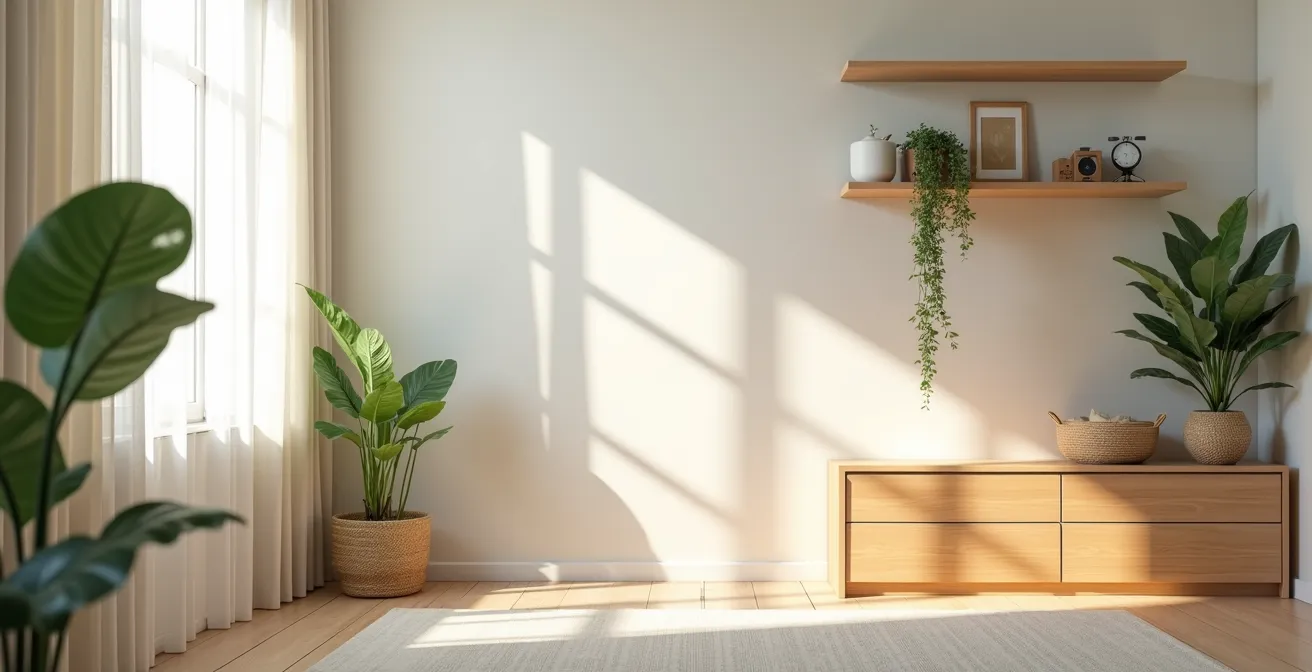
As seen in this example, tall, wall-mounted shelving placed above head height and low-slung credenzas or benches keep items organized without creating obstructive walls in the middle of the room. This approach maintains a clear line of sight and an unimpeded path for air. Even the classic advice to pull furniture away from the walls contributes to this. As Jack Cooper Design notes, floating your sofa even a few inches forward “makes the space feel airier and allows for better airflow and light.” It adds depth and reinforces the idea that the room has space to spare.
The Sharp Corner Mistake That Directs Aggressive Energy at Your Sofa
In Feng Shui, a sharp corner pointing at a place of rest, like a sofa or bed, is said to create “Sha Chi” or aggressive energy. From a fluid dynamics perspective, this ancient wisdom has a modern explanation: sharp corners accelerate airflow. As air moves around a 90-degree corner, it speeds up and can create a subtle but persistent draft. While this might sound beneficial, this jet of air can be uncomfortable, and it directs dust and allergens toward a single point—your seating area.
The goal is not to eliminate airflow, but to make it gentle and diffuse. You want a slow, meandering river, not a firehose. This is achieved by “softening” the sharp corners in your room’s layout and traffic patterns. Instead of forcing air to make abrupt turns, you encourage it to follow smooth, curved paths. This slows the air down and helps it to mix more effectively, preventing uncomfortable drafts and dust concentration.
One of the most effective techniques is the diagonal placement of furniture. By angling a large piece like an armchair or a cabinet in a corner, you effectively replace a sharp 90-degree dead zone with two 45-degree channels. This not only improves circulation in a typically stagnant area but also breaks up the boxy feel of the room, adding dynamism and a sense of movement. The same principle applies to smaller items. Using a round side table instead of a square one, or placing a tall, leafy plant in front of a sharp wall corner, can physically disrupt and soften the airflow.
Think about the path you walk through your room. Do you make sharp, robotic turns? Or do you naturally follow a more curved, flowing path? Your furniture layout should encourage the latter. By arranging pieces to create gentle curves, you are designing a path for both yourself and the air that is more calming and efficient. This micro-adjustment in layout philosophy has a macro effect on the room’s overall feel and air quality, turning “aggressive energy” into a soothing, healthy current.
Key Takeaways
- Stagnant air is a primary cause of morning headaches and respiratory issues due to the buildup of indoor pollutants like VOCs.
- Effective airflow is achieved through scientific principles: creating clearance, engineering pressure zones with fans, and maintaining 40-60% humidity.
- A minimum 4-inch clearance under and behind furniture and a 36-inch main pathway are non-negotiable rules for a healthy, breathable space.
When to Open Windows vs Use Dehumidifiers to Prevent Mold?
Opening a window seems like the universal solution for fresh air, but it can be a double-edged sword. In the battle against mold and VOCs, humidity is a critical variable, and sometimes, opening a window invites the enemy inside. Understanding when to ventilate and when to dehumidify is an essential skill for managing your home’s micro-climate.
The deciding factor is the outdoor dew point. If the dew point outside is higher than your indoor temperature (a common scenario on a hot, humid summer day), opening your windows will actively pull moisture *into* your home, increasing indoor humidity. High humidity not only creates the perfect conditions for mold growth but also accelerates the off-gassing of VOCs from furniture and building materials. In these conditions, the correct move is to close the windows and run a dehumidifier. Your goal should be to maintain an indoor relative humidity level between 40% and 60%.
This optimal humidity range is a sweet spot for several reasons. Below 40%, the air becomes too dry, which, as we’ve seen, can help viruses survive longer. Above 60%, you create a welcoming environment for mold, dust mites, and other allergens. Fascinatingly, recent Stanford research has shown that maintaining humidity in the 40-60% range naturally creates antiviral compounds in the air’s own microdroplets. As humidity in this range increases, so does the concentration of naturally occurring disinfectants like hydrogen peroxide in the air. This suggests that simply maintaining proper humidity is a powerful, passive form of air purification.
Therefore, managing your small space requires a dynamic strategy. You are not just airing out a room; you are actively managing its moisture content. A simple weather app that shows the dew point can be your most powerful tool. When the dew point is low, open your windows wide and flush your home with fresh, dry air. When it’s high, seal your space and let your dehumidifier do the work of wringing the excess moisture out of the air.
How to Use Biophilic Design Elements to Boost Focus in Home Offices
After engineering the perfect airflow and humidity, the final layer of creating a high-performance small space is biophilic design. Biophilia is the concept that humans have an innate tendency to seek connections with nature. Integrating natural elements into your home office isn’t just about aesthetics; it’s a scientifically-backed strategy to reduce stress, enhance creativity, and boost focus.
The most direct way to implement biophilic design is through plants. Beyond their air-purifying qualities, the presence of greenery has a measurable impact on cognitive performance. A study found that introducing plants into an office space resulted in a 15% productivity increase. Plants serve as a visual anchor to the natural world, providing micro-moments of restorative distraction that can help reset a tired brain. Furthermore, a landmark study from Harvard University found that occupants in green-certified buildings, which often incorporate biophilic design, scored significantly higher on cognitive function tests.
In the context of an airflow-optimized space, plants play an additional, unique role: they become living indicators of your success. The gentle, subtle movement of a plant’s leaves is a visible sign of the healthy air circulation you’ve worked to create. This visual feedback is deeply satisfying and reinforces the connection between your environment and your well-being.

To maximize the benefits, position your desk to have a “view” of nature, whether it’s out a window or towards a collection of indoor plants. Use natural materials like wood and stone for your desk and accessories to provide tactile connections to the outdoors. The goal is to create an ecosystem, not just a room. Your well-ventilated, humidity-controlled, plant-filled home office becomes a space that doesn’t just support your work but actively enhances your ability to think clearly and feel calm.
By shifting your mindset from interior decorator to residential aerodynamicist, you reclaim control over your environment. You can now actively engineer a space that not only looks and feels more open but demonstrably improves your health and focus. For those living in compact spaces, this is the ultimate empowerment. To apply these concepts effectively, start by conducting a simple audit of your current layout and identify the most critical dead air zones to address first.
Frequently Asked Questions on Furniture Arrangement and Airflow
When does opening windows add moisture to your home?
If the outdoor dew point is higher than your indoor temperature (e.g., above 70°F/21°C), opening windows will actually add moisture to your home. Use a dehumidifier instead in these conditions.
What is the optimal indoor humidity level?
Aim to maintain humidity levels around 40% to 60%. This range is ideal for minimizing the survival of viruses and preventing the growth of mold and dust mites.
How does humidity affect VOC off-gassing?
Increased humidity directly leads to faster off-gassing and increased VOC levels in the room. This is why running a dehumidifier during humid weather is crucial, even if it feels counterintuitive to close the windows.