

Creating a true urban ‘village’ is not about chance encounters, but about deliberately engineering micro-environments for genuine connection.
- Authentic relationships thrive on structured vulnerability (like “crap dinners”), overcoming the pressure for perfection that stifles connection.
- Activities with a shared purpose (service, collaborative projects) build stronger, faster bonds than activities based on shared interests alone.
Recommendation: Shift from being a ‘hub’ for your friends to a ‘mesh’ connector by actively introducing them to each other, building a resilient and self-sustaining community fabric.
There is a profound paradox at the heart of modern urban life: we are surrounded by millions of people, yet many of us have never felt more alone. The constant hum of the city can easily become a backdrop for a quiet, personal isolation. We might live in apartment buildings packed with hundreds of residents, yet not know a single neighbor’s name. This experience of being “alone together” is not a personal failing; it is a structural problem of our built environments, which often prioritize efficiency and privacy over the spontaneous, messy interactions that build community.
Conventional wisdom tells us to “join a club,” “say hi to your neighbors,” or “go to networking events.” While not inherently bad advice, these suggestions often fail because they don’t address the underlying barriers: the fear of rejection, the pressure to present a perfect life, and the lack of a shared purpose. We are told what to do, but not how to create the conditions where real connection can actually take root and flourish.
But what if the solution wasn’t about trying harder within a broken system, but about becoming a social architect of our own small worlds? The true key to building a village in the city lies in intentionally designing micro-environments that foster structured vulnerability and shared meaning. It’s about creating the modern equivalent of the village well or the front porch—spaces and rituals that make connection not just possible, but probable.
This guide will move beyond platitudes to explore the sociological principles and practical strategies for engineering your own urban village. We will dissect why isolation is so dangerous, how to leverage imperfection to your advantage, and how to create the social scaffolding that supports a life rich with genuine, resilient relationships.
This article provides a roadmap for transforming your experience of the city. Below, you will find a summary of the key strategies we will explore, from reimagining your social gatherings to understanding the deep power of shared challenges.
Summary: How to Build Your “Village” in an Isolated Urban Environment
- Why Social Isolation Is as Deadly as Smoking 15 Cigarettes a Day?
- How to Host a “Crap Dinner” Party to Foster Genuine Connection?
- Service or Hobbies: Which Creates Stronger Bonds for Newcomers?
- The Networking Mistake That Prevents Authentic Friendships
- How to Use Front Porch Design to Encourage Spontaneous Neighbor Chats?
- How to Host a Candlelight Gathering That Focuses on Connection?
- Why Navigating a New Language Builds New Neural Pathways?
- How to Find a Men’s Group That Goes Beyond Surface-Level Chat
Why Social Isolation Is as Deadly as Smoking 15 Cigarettes a Day?
The feeling of loneliness is not just an emotional inconvenience; it’s a critical public health issue. Our brains are wired for connection, and when that need goes unmet, the physiological consequences are severe. For generations, we lived in tightly-knit tribes and villages where social integration was a prerequisite for survival. Today, in our hyper-individualized urban landscapes, we have lost much of that built-in social fabric, and our bodies are sounding the alarm.
The comparison to smoking is not hyperbole; it is a conclusion grounded in extensive research. A landmark 2010 meta-analysis examined data from over 300,000 participants and found that individuals with stronger social relationships had a 50% increased likelihood of survival. The researchers concluded that the health risk of lacking social connection has a magnitude similar to smoking up to 15 cigarettes daily. This effect surpasses other well-known risk factors, including obesity and physical inactivity.
Chronic loneliness triggers a persistent “fight or flight” stress response, leading to increased inflammation, higher blood pressure, and disrupted sleep. It weakens the immune system, making us more susceptible to illness and slowing down recovery. From a sociological perspective, this isn’t just an individual problem but a societal one. Urban design that prioritizes cars over pedestrians, architecture that seals residents off from one another, and a work culture that leaves little time for community all contribute to this epidemic.
Understanding this biological imperative is the first step. Building a “village” is not a luxury or a hobby; it is a fundamental act of self-care and a biological necessity for a long and healthy life. We must treat our social health with the same seriousness as our diet and exercise, actively architecting it rather than leaving it to chance.
How to Host a “Crap Dinner” Party to Foster Genuine Connection?
One of the biggest obstacles to building community is the “pressure to be perfect.” We hesitate to invite people over because our apartment isn’t immaculate, we aren’t a gourmet chef, or we fear the conversation might be awkward. The “Crap Dinner” movement is a powerful antidote to this paralysis. The core idea is to intentionally lower the bar, shifting the focus from performance to presence, from presentation to connection.
A crap dinner is exactly what it sounds like: a low-effort, no-apologies gathering. It’s about serving frozen pizza on paper plates, ordering takeout, or making a simple pasta dish. The explicit rule is that the host is not allowed to apologize for the food, the cleanliness of their home, or anything else. This simple act of reframing gives everyone permission to be imperfect and show up as their authentic selves. It creates an environment of structured vulnerability, where the relief of not having to perform becomes a powerful bonding agent.
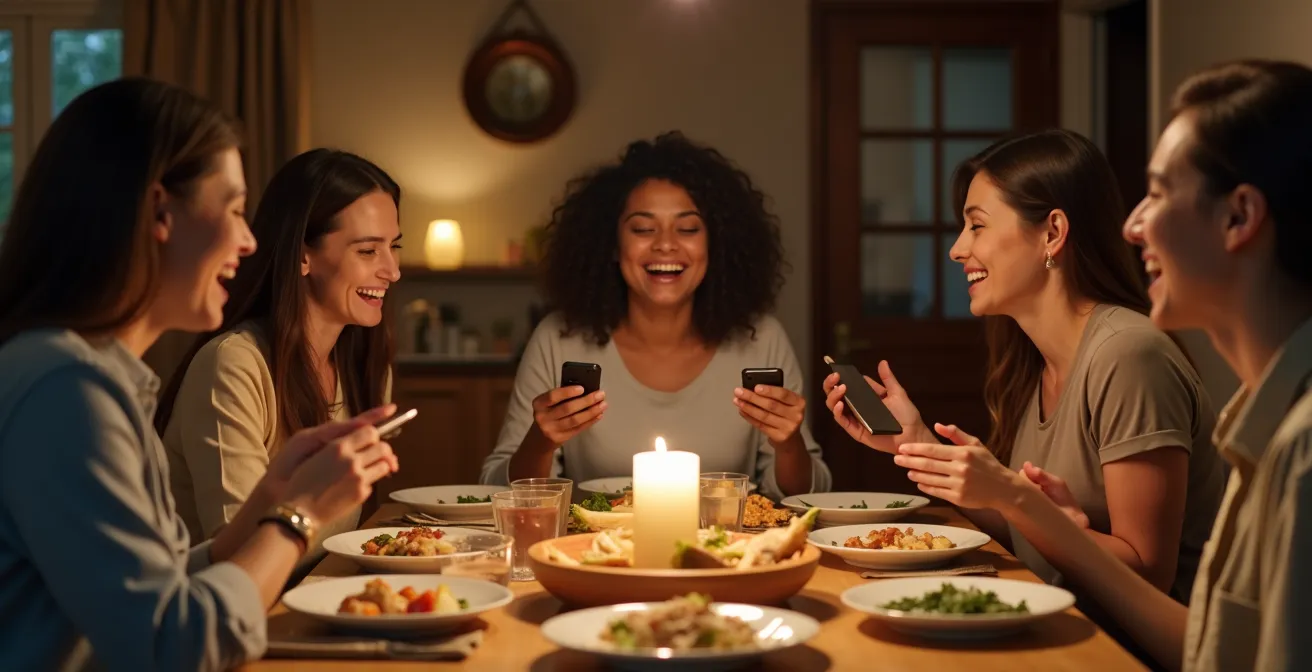
To make these gatherings even more effective, consider a strategic approach to your guest list. Instead of just inviting your closest friends, you can architect the group for maximum connection. The goal is to create a dynamic social mix that naturally expands your circle. Here are some principles to follow:
- The Anchor: Invite one established friend who you are comfortable with. They act as a social co-host, helping to keep the energy relaxed.
- The Target: Include one new acquaintance you’d like to know better. This is your specific goal for expanding your network.
- The Wildcard: Ask your “anchor” friend to bring someone you don’t know. This introduces an element of serendipity and prevents the group from feeling cliquey.
- The Charter: Establish simple ground rules at the outset, like “phones in a basket” and “no apologies.” This makes the purpose of the gathering explicit: connection over perfection.
- The Relay: End the evening by passing a symbolic “torch”—like a wooden spoon—to the next person who will host. This creates a self-perpetuating system of connection.
Service or Hobbies: Which Creates Stronger Bonds for Newcomers?
When trying to build a new community, we’re often told to “find a hobby.” Joining a book club, a pottery class, or a running group can certainly be a great way to meet people. However, from a sociological standpoint, not all group activities are created equal when it comes to the speed and depth of bond formation. The key difference lies in the distinction between shared interest and shared purpose.
Activities based on shared interest, like a weekly board game night, are often “parallel play.” Participants engage in the same activity alongside each other, but the interaction may remain superficial. The focus is on the activity itself. In contrast, activities based on shared purpose—especially service or volunteering—create a context of interdependence. When you’re working together to clean up a park, build a community garden, or support a local cause, you face challenges together. You have to rely on each other, solve problems collectively, and often witness each other in moments of struggle or frustration.
This shared struggle is a powerful accelerator of intimacy. It’s a form of Forced Vulnerability Training where the situation itself creates the need for trust and cooperation. The post-activity connection also becomes more natural. After a challenging day of work, grabbing a coffee or a beer to “debrief” feels like a logical and necessary extension of the shared experience, whereas it might feel more forced after a hobby class.
The following table illustrates how different types of activities foster connection, highlighting the crucial role of shared purpose and the potential for vulnerability.
| Activity Type | Vulnerability Potential | Bond Strength | Post-Activity Connection |
|---|---|---|---|
| Service/Volunteering | High – shared struggles | Strong & Fast | Natural debriefs over coffee |
| Competitive Sports | Medium – team reliance | Moderate | Victory celebrations |
| Hobby Groups | Low – parallel activities | Gradual | Less organic follow-ups |
| Purpose-Driven Hobbies | Very High – dual engagement | Strongest | Multiple touchpoints |
This doesn’t mean you should abandon your hobbies. The most powerful combination is a “purpose-driven hobby,” such as joining a choir that performs for charity or a cycling group that raises money for a cause. This merges the enjoyment of a shared interest with the deep bond-forming power of a shared purpose, creating the strongest foundation for a new village.
The Networking Mistake That Prevents Authentic Friendships
In our quest for connection, many of us fall into a common trap: we become the central “hub” in a “hub-and-spoke” social network. We collect individual friends but rarely, if ever, connect them to one another. This model requires constant energy to maintain each individual spoke, and it creates a fragile social life. If we, the hub, get busy, move away, or go through a difficult time, the entire network can weaken or collapse because the connections don’t exist independently of us.
The strategic mistake is viewing friendship as a transactional ledger rather than a collaborative ecosystem. The antidote is to shift your mindset from a hub to a “mesh network” architect. A mesh network is resilient and decentralized; each person (or “node”) is connected to multiple others. The community thrives even if one person is absent. Your role as a social architect is not just to make friends, but to actively facilitate connections between the people you know.
This means consciously introducing friends to each other who you think would get along. It means hosting small gatherings (like a “crap dinner”) and seeing yourself as a facilitator, not the star of the show. This approach cultivates what sociologists call a “gift economy” mindset. Instead of keeping a tally of who owes whom a dinner invitation, you contribute to a shared pool of social goodwill. Research on urban isolation has shown that this is a key factor in creating resilient neighborhood communities where people feel a sense of belonging.
This need for deep, interconnected community is not just a preference; it is a biological signal. As the current U.S. Surgeon General, Dr. Vivek Murthy, powerfully stated in his report on the epidemic of loneliness:
We now know that loneliness is a common feeling that many people experience. It’s like hunger or thirst. It’s a feeling the body sends us when something we need for survival is missing.
– Dr. Vivek Murthy, U.S. Surgeon General’s Report on Loneliness
Building a mesh network is how we answer that biological call. It transforms our social life from a series of individual transactions into a thriving, self-sustaining village that can support us through all of life’s challenges.
How to Use Front Porch Design to Encourage Spontaneous Neighbor Chats?
In classic village design, the front porch was a brilliant piece of social architecture. It was a “semi-private” space—not as public as the street, but not as private as the living room. This transitional zone created a perfect, low-stakes environment for spontaneous interactions. In today’s world of sealed-off apartment buildings and private garages, we have lost these critical “soft interfaces.” The result is a hard barrier between our private lives and the community around us, with urban isolation being a significant consequence; in major hubs, with a survey revealing that 52% of Londoners report feeling lonely.
The solution is to consciously recreate these soft interfaces in our modern environments. We need to become architects of our immediate surroundings, using subtle cues and predictable rituals to lower the psychological barriers to interaction. This isn’t about forcing conversations, but about making them more likely to happen organically. It’s about turning hard, anonymous spaces into soft, inviting ones.
This can involve creating predictable “rituals of presence.” For example, making a habit of drinking your coffee every Saturday morning at 9 AM on your balcony signals availability without being demanding. It creates a recurring, low-pressure opportunity for a neighbor to say hello. Similarly, finding a “Third Place Proxy”—a specific park bench or corner cafe table you frequent—can establish a sense of place and ownership that attracts connection. The goal is to create small pockets of predictability and welcome in an otherwise anonymous urban landscape.
You can audit your own living situation and identify opportunities to introduce these “soft interfaces.” The following checklist provides concrete actions you can take to make your immediate environment more conducive to spontaneous connection.
Action Plan: Auditing Your Environment for Connection
- Identify Points of Contact: List all the places where you might naturally cross paths with neighbors (lobby, mailroom, laundry room, hallway, local park).
- Inventory Existing Elements: What’s currently in these spaces? Is it sterile and empty, or are there any existing community-builders (e.g., a dusty bulletin board)?
- Assess for Coherence: Do these spaces feel welcoming? Use simple environmental cues to lower barriers: place a welcoming doormat, tend to plants by your door, or even put out a bowl of free candy during holidays.
- Create Malleable Spaces: Introduce an element that invites passive collaboration. Set up a shared puzzle table in a common room, install a small book-swap shelf in the lobby, or start a “plant-sitting co-op” sign-up sheet on the bulletin board.
- Establish a Plan for Presence: Commit to one “ritual of presence.” This could be the ‘Saturday 9 AM coffee on the balcony’ or claiming a nearby ‘Third Place Proxy’ through regular, predictable visits.
How to Host a Candlelight Gathering That Focuses on Connection?
In our world of digital overstimulation, creating a space for deep, focused connection requires a deliberate act of subtraction. A “Candlelight Gathering” or “Analog Evening” is a powerful tool for this. The core concept is to radically simplify the environment to elevate the quality of the human interaction. By reducing visual and digital noise, we force our brains to rely on more ancient and intimate modes of communication: listening to the tone of a voice, noticing subtle body language, and being fully present in a shared space.
The low, warm light of candles does more than create a cozy atmosphere; it’s a piece of social architecture. It minimizes visual distractions and lessens the self-consciousness that can come with bright, harsh lighting. When we can’t be distracted by our phones (which should be banned for the evening) or by scanning the room, we are more inclined to truly listen. This creates an environment ripe for the kind of meaningful storytelling that builds strong bonds.
However, simply lighting candles is not enough. To prevent the evening from defaulting to superficial small talk, it’s crucial to introduce elements of gentle structure. This provides a safe container for vulnerability and ensures that everyone has a chance to be heard. The goal is not to be rigid, but to provide a light framework that guides the group toward deeper connection.
Consider these structured elements for your next gathering:
- The Silent Start: Begin the evening with a brief, shared ritual. For instance, have a central flame and allow each guest to light their own small candle from it in silence. This 2-3 minute ritual quiets the external world and focuses the group’s energy.
- Structured Storytelling: Instead of an open-ended “how are you,” introduce a specific prompt. Themes like “a story about a turning point in your life,” “a time someone showed you unexpected kindness,” or “something you’ve changed your mind about recently” invite reflection and substance.
- Tactile Foods: Serve food that requires interaction, like a fondue, a shared platter of bread and dips, or anything that needs to be passed around. This creates a natural, physical rhythm of giving and receiving.
- The Closing Word: End the evening by going around the circle and having each person share one word that describes how they are feeling. This provides a sense of closure and shared emotional experience.
Why Navigating a New Language Builds New Neural Pathways?
The act of learning a new language is often praised for its cognitive benefits—improving memory, staving off dementia, and literally building new neural pathways. But from a community-building perspective, its most powerful effect is social, not just neurological. The process of language acquisition forces us into a state of profound vulnerability. As a beginner, you are constantly making mistakes, asking for help, and accepting correction. You must surrender the comfort of being an articulate adult and embrace the humility of a learner.
This state of being a novice is an incredible accelerator for social bonding. When you ask someone, “How do you say this?” or “Did I pronounce that correctly?”, you are not just requesting data; you are implicitly saying, “I trust you enough to be incompetent in front of you.” This act of trust is the bedrock of any meaningful relationship. It bypasses months of superficial small talk and gets straight to the heart of human connection: interdependence and mutual support.

However, research suggests an even more potent and accessible form of this process. For building a village, learning the “social lexicon” of your chosen tribe can be even more crucial than learning a foreign language. Every deep community—whether it’s a CrossFit gym, a Dungeons & Dragons group, a choir, or a programming team—develops its own micro-language of inside jokes, technical jargon, and emotional shorthand. To become a true member, you must learn this lexicon.
This process is a form of what some urban design researchers call Forced Vulnerability Training. Asking what a specific acronym means or why a certain joke is funny rewires the brain to better handle the minor embarrassments and potential rejections inherent in making new friends. It builds social resilience. It demonstrates a willingness to be an outsider in order to become an insider, a journey that is deeply respected in any established group. So, whether it’s Spanish or the specific slang of your local climbing gym, the path to belonging is paved with the courage to ask, “Can you teach me?”
Key Takeaways
- Loneliness is a physiological threat, not just an emotional state. Prioritizing social health is as critical as diet and exercise.
- Shift from a “hub-and-spoke” social model to a “mesh network” by connecting your friends to each other, building a resilient community.
- Embrace “structured vulnerability” through concepts like Crap Dinners and Analog Evenings to bypass superficiality and foster genuine connection.
How to Find a Men’s Group That Goes Beyond Surface-Level Chat
For many men, the path to connection is different. Mainstream social scripts often emphasize face-to-face, emotionally expressive conversation, which can feel intimidating or unnatural for some. Sociologically, many men bond more effectively through “shoulder-to-shoulder” communication—working on a shared task or facing a common challenge side-by-side. The conversation that happens during these activities can be more open and less pressured.
This is why so many men’s groups that focus solely on “talking about feelings” can fail. A more effective model combines a shared, tangible purpose with structured moments for deeper connection. The ManKind Project, a global organization that has served over 70,000 men, provides a powerful case study. They use a “Shared Artifact” approach, where men might work together to restore a boat, build a pizza oven, or complete a service project. This creates the shoulder-to-shoulder context for natural communication to emerge.
This practical activity is then paired with moments of Structured Vulnerability. Instead of an unstructured free-for-all, they use formats like “Rose, Thorn, Bud” check-ins (sharing a positive, a challenge, and something with potential) or give each man a dedicated, timed slot to receive the focused attention of the group. This structure provides safety and ensures the conversation goes beyond surface-level chat about sports or work. It reshapes concepts of masculinity by modeling a combination of strength, action, and emotional accountability.
If you’re looking to start or find such a group, focus on this dual model of shared challenge and structured sharing. A group that only offers one or the other is less likely to build the deep, resilient bonds men are often seeking. The following protocol offers a roadmap for the first five meetings of a new men’s group, designed to build this foundation from the ground up:
- Meeting 1 – The Call: Recruit 5-8 men through personal invitations. Emphasize that the group’s purpose is growth and mutual support, not therapy.
- Meeting 2 – The Charter: As a group, collaboratively define your purpose, set clear rules for confidentiality, and decide on a meeting frequency and format.
- Meeting 3 – The First Task: Choose a simple, shared project or challenge that requires collaboration. This could be anything from planning a camping trip to volunteering for a local cause.
- Meeting 4 – The First Structured Check-in: Implement a simple, structured sharing format. For example, give each man 10 uninterrupted minutes to talk about his ‘work’ or a current challenge, with the group’s role being to listen, not to ‘fix’.
- Meeting 5 – The Celebration: Mark the official formation of the group with a ritual or a shared meal to celebrate the commitment and solidify the bonds you’ve begun to build.
Building an urban village is an active, ongoing process of social architecture. It begins with the understanding that connection is a fundamental human need, not a social luxury. The first step isn’t to meet everyone; it’s to choose one strategy from this guide and begin architecting your own small corner of connection. Start with one ‘crap dinner’, one ‘soft interface’, or one courageous invitation. Your village is waiting to be built.