

Feeling the weight of winter darkness? While many suggest just adding cozy blankets, the true Danish art of ‘hygge’ is a powerful psychological tool against Seasonal Affective Disorder (SAD). This guide reveals how to go beyond mere aesthetics and intentionally design a ‘refuge’ space that calms the nervous system, reduces cognitive load, and fosters genuine connection, helping you not just survive the winter, but thrive in it.
As the days shorten and a familiar chill settles in the air, many people living in colder climates feel a sense of dread. The long, dark winter can take a toll on our mood, energy, and overall sense of well-being. The common advice is often to simply “get cozy”—buy more blankets, light a few candles, and wait for spring. While these suggestions have merit, they often miss the deeper, more intentional philosophy behind the Danish concept of hygge.
True hygge is not a consumer trend; it’s a conscious survival strategy. It’s about actively engineering your environment and your social interactions to create feelings of safety, connection, and contentment. It’s a proactive defense against the psychological impact of reduced daylight, which can lead to Seasonal Affective Disorder (SAD). For millions, this is more than just “winter blues”; the American Psychiatric Association notes that about 5% of adults in the U.S. experience SAD, a clinical form of depression.
But what if the key wasn’t just surrounding yourself with soft things, but understanding the psychological principles that make them effective? The real power of a hygge corner lies in its ability to create a mental and physical sanctuary. It’s less about what you buy and more about how you create a space that tells your brain it’s safe to relax and recharge.
This guide will walk you through the core principles of creating an authentic hygge corner. We will explore how to design a space that provides a sense of enclosure and safety, how to use light to influence your mood, and how to extend the feeling of hygge from your personal corner to genuine, pressure-free social connections.
To help you navigate these concepts, this article covers everything from the psychology of safe spaces to the art of hosting gatherings that truly foster connection. Explore the topics below to build your own winter wellness strategy.
Table of Contents: A Guide to Crafting Your Winter Sanctuary
- Why Feeling “Enclosed” and Safe Reduces Anxiety in Winter?
- How to Host a Candlelight Gathering That Focuses on Connection?
- Real Flame or LED: Does the Brain Distinguish the Comfort Effect?
- The Mistake of Buying Too Many Throw Pillows That Creates Chaos
- When to Indulge in Warm Drinks: The Ritual of the Afternoon Break
- How to Host a “Crap Dinner” Party to Foster Genuine Connection?
- How to Mix Kelvin Temperatures Without Creating a Visual Clash?
- How to Declutter Your Visual Field to Lower Daily Stress Levels
Why Feeling “Enclosed” and Safe Reduces Anxiety in Winter?
The fundamental purpose of a hygge corner is to create a “nest” or a refuge. This taps into a primal human instinct known as Prospect-Refuge Theory. The theory suggests that we are instinctively drawn to environments where we can see without being seen—think of a cave dweller looking out over a valley. An enclosed space, like a corner nook, provides a sense of protection and security from the back and sides, allowing our nervous system to switch from a state of hyper-vigilance to one of rest and recovery.
During winter, when the outside world can feel harsh and unwelcoming, this need for a safe haven is amplified. Creating a clearly defined zone of comfort helps counteract feelings of exposure and vulnerability that can contribute to anxiety. This isn’t just a feeling; it’s a physiological response. By reducing the “threat” signals in your environment, you lower cortisol levels and allow your body to relax more deeply. The Danish have culturally integrated this concept, understanding that their well-being during the dark months depends on creating these indoor sanctuaries.
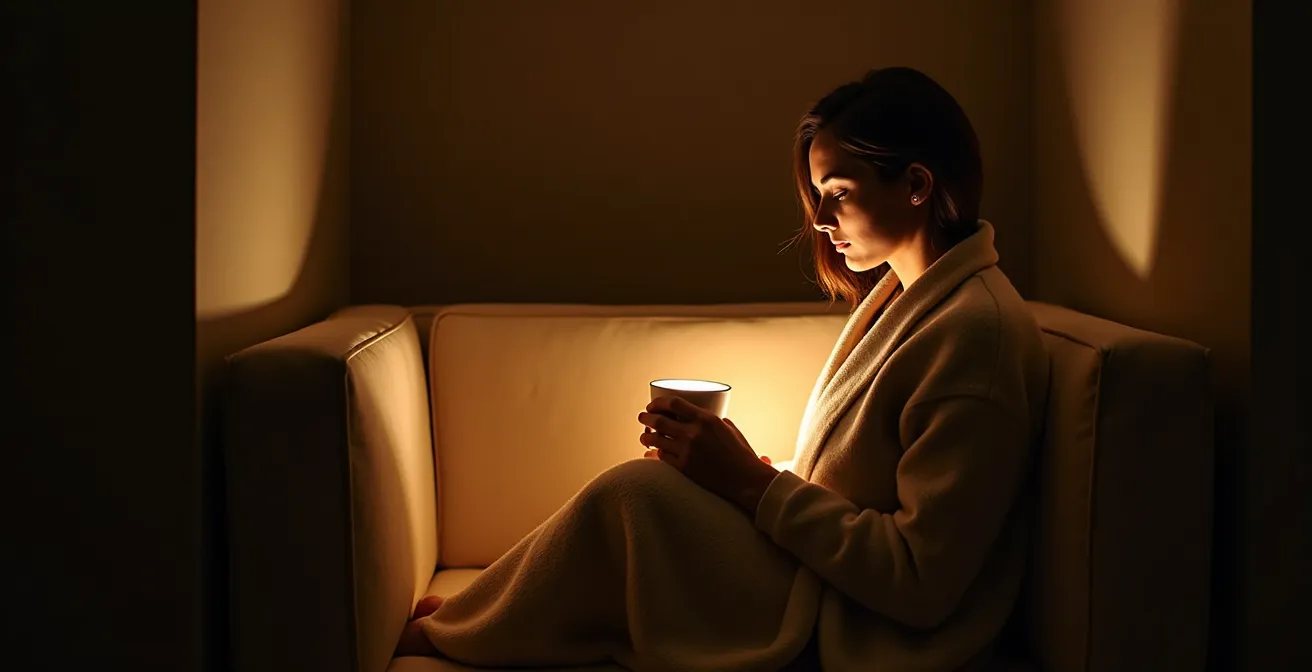
As the image above demonstrates, the ideal setup involves positioning yourself with your back to a solid wall or in a corner. This can be achieved with a comfortable armchair angled into a corner, a daybed against a wall, or even a strategic arrangement of a bookshelf and a plant to create a perceived boundary. The goal is to create a micro-environment where your brain receives constant, reassuring signals of safety, allowing you to let your guard down and truly unwind.
How to Host a Candlelight Gathering That Focuses on Connection?
Hygge is often a solitary practice, but its most powerful form is social. However, a hygge gathering is the antithesis of a performance-oriented party. It’s about creating an atmosphere of intentional intimacy where everyone feels safe, equal, and present. The focus shifts from impressing guests to connecting with them on a genuine level. Candlelight is essential to this, as its soft, forgiving glow naturally lowers inhibitions and makes the harsh glare of smartphone screens feel jarringly out of place.
The key is to design the evening around connection, not entertainment. This means removing pressure and expectation. As one Copenhagen resident observed, this is the heart of the practice. The goal is to foster an environment of genuine presence, a rare commodity in our hyper-connected world.
Hygge is fundamentally about intentional intimacy. It’s not about stuff. It’s about creating spaces and moments where people feel safe enough to be fully present with each other.
– Cultural observation from Copenhagen resident, I spent years in Copenhagen – Danish habits explained
To achieve this, consider establishing a phone-free zone, not as a strict rule, but as a gentle invitation to disconnect. Creating multiple small “islands of light” with candle clusters around the room encourages smaller, more intimate conversation groups rather than one large, performative discussion. The most important element is sharing the responsibility. In a true hygge gathering, everyone contributes, whether by bringing a dish, helping to clear the table, or lighting the candles. This shared ownership dismantles the host/guest dynamic and fosters a sense of communal comfort and equality.
Real Flame or LED: Does the Brain Distinguish the Comfort Effect?
In Denmark, a country that consistently ranks among the happiest in the world, candles are not just decoration; they are a non-negotiable part of daily life. This deep cultural affinity for real flame is not arbitrary. Our brains perceive the light from a real candle very differently from that of an LED alternative, and this distinction is crucial for achieving a true state of hygge. A real flame provides a unique sensory experience that a machine-made flicker cannot replicate.
The key lies in a concept called “soft fascination.” The gentle, chaotic-yet-predictable dance of a flame captures our attention effortlessly, allowing our minds to wander and rest without becoming bored or distracted. This is a form of passive mental engagement that helps reduce stress. In contrast, the often repetitive, robotic pattern of an LED candle can be perceived by the brain as artificial, failing to trigger the same deep-seated comfort response. A real flame also provides multi-sensory input—subtle warmth, a faint scent, and the ritualistic act of lighting it—all of which signal to our brain that it’s time to transition into a state of rest.
This table breaks down the key psychological and sensory differences:
| Aspect | Real Flame | LED Alternative |
|---|---|---|
| Visual Pattern | Non-repeating, chaotic-yet-predictable flicker that holds ‘soft fascination’ | Often robotic, repetitive patterns the brain perceives as artificial |
| Multi-sensory Input | Visual + subtle radiant heat + faint crackling + scent of burning wax | Visual only – sends incomplete comfort message to brain |
| Ritual Power | Act of lighting (striking match, watching wick catch) signals transition to rest | Effortless switch lacks ritualistic power to prime mind for relaxation |
| Biophilic Response | Natural flame triggers evolutionary comfort response | High-quality LEDs can approximate but lack authentic natural movement |
While high-quality LEDs are a safe and practical alternative, especially in homes with children or pets, understanding why real flame is so effective helps us appreciate the importance of natural, dynamic light. If using LEDs, opt for those with the most random and warm flicker available to get as close as possible to the authentic, brain-calming effect of a real fire.
The Mistake of Buying Too Many Throw Pillows That Creates Chaos
The modern, commercialized version of hygge often translates to “buy more cozy things.” This leads to a common mistake: overwhelming a space with an excess of decorative items, particularly throw pillows. While the intention is to add comfort, the result is often visual chaos that actively works against the goal of relaxation. Every object in our visual field demands a small amount of mental energy to process. When a space is cluttered, it increases our cognitive load, leading to a low-grade, persistent level of stress.
Research on environmental factors and mood confirms this. Excessive visual stimuli can elevate cortisol levels, undermining the very sense of peace we are trying to create. A truly hygge space is not about abundance; it’s about intentionality. Every item should have a purpose, whether functional or to evoke a specific feeling of joy or calm. Instead of piling on a dozen decorative pillows that need to be moved every time you sit down, a more effective approach is to choose a few high-quality, functional pillows that serve a clear purpose: one for lumbar support, one for hugging, one to prop your head.
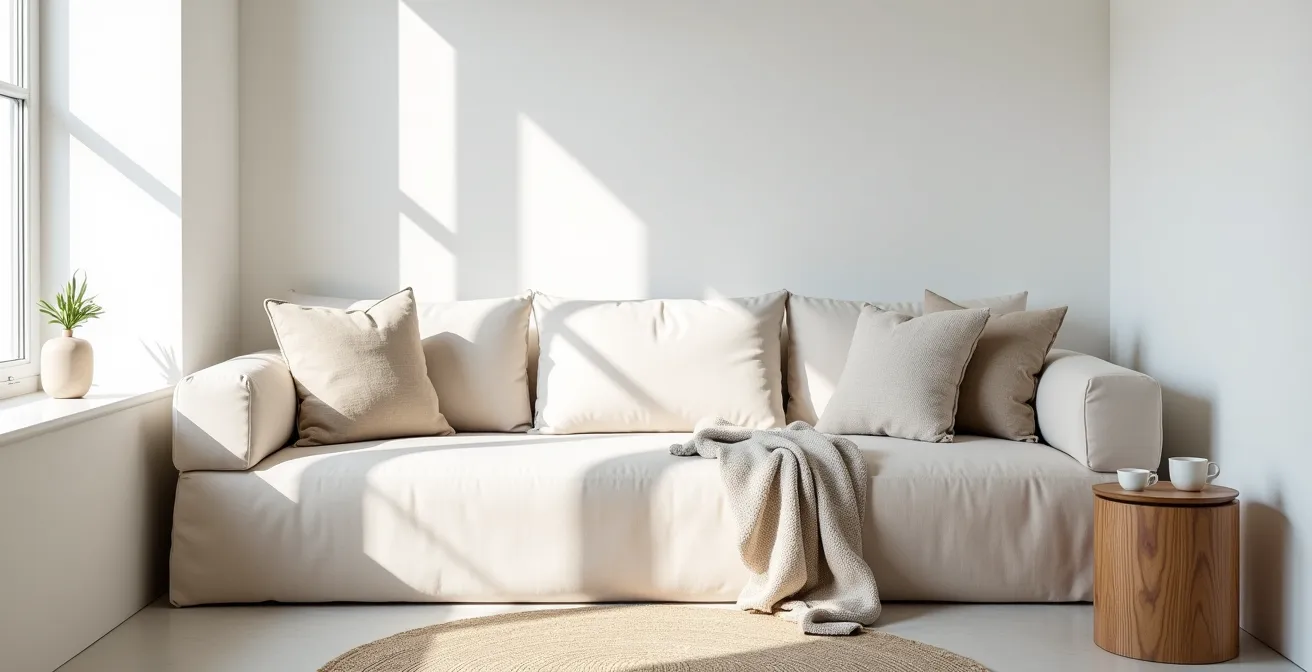
This minimalist approach, as shown in the image, reduces visual noise and creates a sense of order and calm. The goal is to curate your comfort, not to accumulate it. By being selective, you ensure that your hygge corner is a sanctuary that reduces mental effort, rather than a cluttered display that inadvertently adds to it. Before adding another item, ask yourself: “Does this serve a real purpose for my comfort, or is it just more visual information for my brain to process?”
When to Indulge in Warm Drinks: The Ritual of the Afternoon Break
A warm mug cupped in your hands is an iconic hygge image, but its power lies less in the liquid itself and more in the moment it represents. Indulging in a warm drink is about creating a ritualistic transition—a deliberate pause in the day to signal to your body and mind that it’s time to shift gears. This is especially important during winter, when our routines and moods are naturally disrupted. A 2022 poll confirmed this, revealing that 66% of adults noted behavioral changes during winter, including shifts in energy and social habits.
The Danish culture places a high value on work-life balance, which makes carving out time for these small rituals possible and encouraged. The afternoon coffee or tea break is not something to be rushed at a desk; it’s a protected moment. As Catarina Lachmund of The Happiness Research Institute explains, this focus on the present is central to the practice.
Hygge is about the now: how to enjoy the moment and make the best of it. The work-life balance in Denmark allows Danes to make time for hygge.
– Catarina Lachmund, Senior Analyst at The Happiness Research Institute in Denmark
The ideal time to indulge in this ritual is often mid-to-late afternoon, when energy levels naturally dip and the darkness begins to set in. This intentional break serves as a buffer between the demands of the day and the relaxation of the evening. The act of boiling the water, choosing a favorite mug, and inhaling the steam becomes a sensory anchor to the present moment. It’s a form of mindfulness that requires no special training—just the commitment to step away from your tasks and give yourself five minutes of quiet, warm comfort. This small act can be a powerful tool for punctuating the long stretch of a winter day with a moment of deliberate peace.
How to Host a “Crap Dinner” Party to Foster Genuine Connection?
Perhaps the most liberating and truly hygge social concept is the “crap dinner” party. The name is intentionally provocative. It’s a dinner party where the explicit goal is to put in the least amount of effort possible on the food and decor, shifting 100% of the focus to connection and conversation. This brilliantly simple idea combats the performance anxiety that so often accompanies hosting, which is a major barrier to the frequent, informal social contact that is vital for mental health, especially in winter.
The “crap dinner” is the ultimate expression of removing social pressure, a cornerstone of Danish culture that researchers believe contributes to their high happiness levels. It’s about creating an environment where guests feel they can show up exactly as they are, without any need to impress or perform. The “rules” are designed to enforce this liberating lack of effort, ensuring that the gathering is about people, not presentation. This creates a space of equality and shared vulnerability, where genuine conversations can flourish.
By lowering the barrier to entry for hosting, the “crap dinner” encourages more frequent get-togethers. It’s a powerful reminder that the best antidote to winter loneliness is not a perfect meal, but authentic human connection, however messy or imperfect it may be.
Your Action Plan: Rules for Creating a Performance-Free Dinner Zone
- The 30-Minute Rule: Nothing on the menu takes longer than 30 minutes to prepare.
- The Pantry Raid: Use only ingredients you already have at home. No special shopping trips.
- Themed Potluck Chaos: Everyone brings a dish starting with the same letter (creates playful randomness).
- No Instagram Rule: Explicitly state that this is not a photo-worthy event to remove the pressure of aesthetics.
- Conversation Starters: Place question cards on the table to ensure focus stays on connection, not cuisine.
How to Mix Kelvin Temperatures Without Creating a Visual Clash?
Lighting is arguably the most critical element in a hygge environment, but it’s more nuanced than simply choosing “warm” bulbs. To create a truly comfortable and functional space, you need to think like a lighting designer and use different “temperatures” of light, measured in Kelvin (K), in different zones of your home. A lower Kelvin number means a warmer, more amber light, while a higher number indicates a cooler, bluer light. The mistake many people make is using a single temperature everywhere, or mixing them randomly, which creates a visually jarring and psychologically unsettling environment.
The secret is to create a layered lighting scheme with distinct temperature zones. Your core hygge corner, the space dedicated purely to relaxation, should have the warmest light, ideally around 2200K, which mimics the color of firelight. This ultra-warm light signals the brain to produce melatonin, preparing you for rest. The general ambient light in the room can be slightly cooler, around 2700K, to provide comfortable visibility without being stimulating. Finally, any task lighting—for reading or kitchen prep—can be around 3000K to provide clarity without the harshness of daylight bulbs.
Here is a guide to creating these zones effectively:
| Zone | Kelvin Range | Effect on Brain | Best Application |
|---|---|---|---|
| Hygge Corner Core | 2200K (firelight color) | Triggers melatonin production, signals rest | Reading nook, meditation space |
| General Ambient | 2700K (warm white) | Maintains relaxation without drowsiness | Living areas, transitional spaces |
| Task Lighting | 3000K (soft white) | Allows focus while staying warm | Kitchen prep areas, desk lamps |
By intentionally layering these temperatures, you create a seamless and cohesive lighting environment that supports your body’s natural circadian rhythms. You guide your brain through different states—from alertness to relaxation to pre-sleep—using light as your tool. This thoughtful approach transforms your home from a collection of rooms into a dynamic environment that nurtures your well-being.
Key Takeaways
- Creating a ‘hygge corner’ is a psychological strategy, not just a decorating style, that leverages the brain’s need for safety (Prospect-Refuge Theory).
- True hygge prioritizes intentionality over abundance; reducing visual clutter lowers cognitive load and stress.
- Social hygge, like a “crap dinner,” focuses on removing performance pressure to foster genuine, restorative connection.
How to Declutter Your Visual Field to Lower Daily Stress Levels
Your hygge corner can be perfectly designed, but its calming effect will be immediately negated if it looks out onto a field of clutter. The final, crucial step in maintaining a peaceful environment is managing your entire visual field. This means actively decluttering the spaces within your line of sight from your relaxation spot. This practice is essential for lowering daily stress, as our brains are constantly, subconsciously processing everything we see. A messy environment keeps our minds in a state of low-grade alert, whispering of unfinished tasks and disorder.
The link between daylight and mood is well-documented. Research shows a clear correlation, with SAD prevalence ranging from 9.7% in New Hampshire to 1.4% in Florida. In the low-light months of winter, our sensitivity to our indoor environment increases dramatically. We can’t control the sun, but we can control our visual surroundings. A powerful way to do this is to adopt a “closing shift” ritual at the end of each day. Just as a café owner tidies up before closing, take five minutes to “put your space to bed.”
This simple ritual creates a firm mental boundary between the active part of your day and your time for rest. It involves clearing primary surfaces, returning items to their designated homes, and dimming the overhead lights. By consciously resetting your environment, you are sending a powerful signal to your brain that the day’s work is done. This small investment of time pays huge dividends in mental clarity and allows you to fully inhabit your peaceful hygge corner without the distracting “visual noise” of lingering chaos. It transforms your space from a passive backdrop into an active partner in your well-being.
Creating a hygge corner is an act of self-compassion and a powerful tool for navigating the challenges of winter. Start small, be intentional, and focus on how the space makes you feel, not just how it looks. Your well-being is worth the effort.