
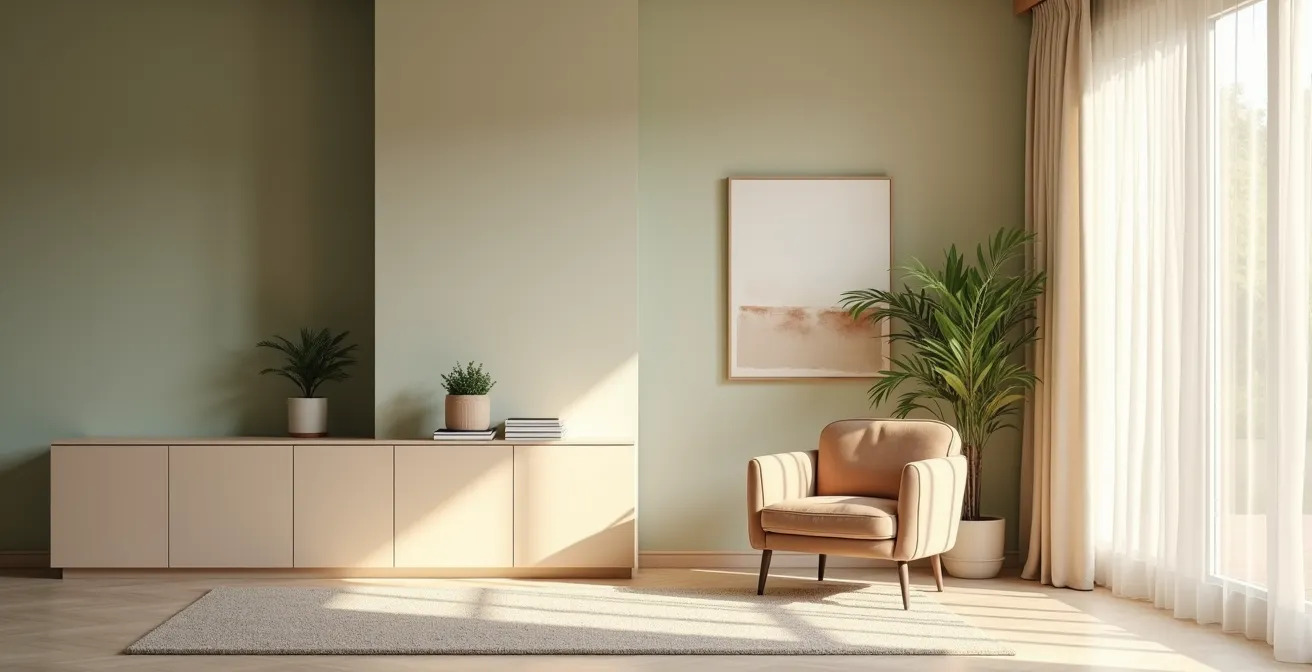
Designing for a Highly Sensitive Person is not about minimalism, but about sensory ergonomics—intentionally curating light, texture, and space to calm the nervous system.
- Visual calm is paramount: Replace open shelves with closed storage to reduce cognitive load and visual noise.
- Tactile and acoustic comfort are non-negotiable: Use heavy, sound-dampening textiles and layered rugs to ground the body and soften the environment.
Recommendation: Begin by auditing one room’s light and sound, applying a single principle from this guide to feel the immediate difference in your well-being.
For the Highly Sensitive Person (HSP), a home is not just a place to live; it is the primary tool for nervous system regulation. Yet, it can often feel like the source of the problem—a battleground of harsh lights, persistent noise, and visual chaos. You might find yourself retreating from the very space meant to be your sanctuary, feeling inexplicably drained or agitated by your surroundings. This experience is a biological reality for the estimated 15-20% of the population who are HSPs, whose brains process sensory information more deeply.
Common advice often circles around generic tips like “declutter” or “choose calming colors.” While not incorrect, these suggestions barely scratch the surface. They fail to address the underlying neurobiology of sensory overload. The key isn’t merely to have less stuff, but to fundamentally reshape your environment’s relationship with your senses. This requires a shift in perspective from interior decorating to a more precise, intentional practice: sensory ergonomics.
This approach treats every design choice—from the texture of a curtain to the temperature of a lightbulb—as a functional input for your well-being. It is the art and science of curating a balanced “sensory diet” within your home. Instead of just reacting to overstimulation, you will learn to proactively design an environment that respects your sensitive constitution, providing quiet, comfort, and restoration as its default state. This guide will walk you through the core principles of neuroarchitecture, offering precise strategies to control the visual, tactile, acoustic, and energetic stimuli in your home.
This article provides a detailed roadmap for transforming your living space. Explore the sections below to understand the science behind sensory-friendly design and discover actionable steps for each area of your home.
Summary: A Neuroarchitecture Framework for Your HSP Sanctuary
- Why Open Shelving Increases Cortisol Levels in Cluttered Minds?
- How to Create a “No-Tech Zone” Even in a Studio Apartment?
- Velvet or Linen: Which Textile Reduces Tactile Stress?
- The Paint Mistake That Makes a Room Feel Agitating Instead of Energetic
- How to Use Rugs and Curtains to Silence Echoes in Modern Condos?
- How to Create a Low-Stimulation Sanctuary in a Small Apartment?
- Why Your Bathroom Light Is Waking You Up More Than Espresso?
- How to Apply the Bagua Map to a New House to invite Prosperity
Why Open Shelving Increases Cortisol Levels in Cluttered Minds?
The trend of open shelving, celebrated in design magazines for its airy aesthetic, can be a significant source of chronic, low-grade stress for an HSP. Every object on display—each book spine, ceramic mug, and stack of plates—is a piece of visual data. For a highly sensitive brain, this isn’t just background decoration; it’s a constant stream of information that must be processed. This demand on your mental resources is known as cognitive load. When visual input is excessive and disorganized, it creates a state of “visual noise” that keeps the nervous system on high alert.
While direct studies on shelving and cortisol are niche, we can draw clear parallels from related fields. For example, extensive research on environmental stressors shows that prolonged exposure to occupational noise—another form of sensory intrusion—measurably increases cortisol levels. The principle is the same: the body perceives constant, uncontrollable sensory input as a threat, triggering a stress response. For an HSP, the visual chaos of open shelving acts much like this persistent noise, subtly elevating stress hormones and preventing the mind from ever truly resting.
The solution is not to get rid of your belongings, but to give your eyes a place to rest. Creating visual calm is about establishing clean lines and uninterrupted surfaces. Swapping open shelves for cabinets with solid doors is the single most effective change you can make to lower the cognitive load in a room. This simple act removes thousands of visual data points from your awareness, instantly creating a more serene and restorative atmosphere. It is a declaration that your home is a space for being, not for perpetual processing.
How to Create a “No-Tech Zone” Even in a Studio Apartment?
In a world of constant connectivity, the need for a space free from digital intrusion is more critical than ever, especially for an HSP. A “no-tech zone” is not a luxury reserved for large homes; it is a vital sanctuary that can be carved out of even the most compact studio apartment. The goal is not to eliminate technology, but to create intentional boundaries that protect your restorative downtime. This is less about physical walls and more about creating a ritual and a psychological shift.
The key is to designate a specific corner or small area as analog-only. This could be a single comfortable armchair with a floor lamp, a cluster of floor cushions, or a small meditation stool. The boundary can be created visually with a lightweight bamboo screen, a strategically placed plant, or even just a distinct rug. As a sensory-friendly apartment design implementation found, a minimalist approach with a ‘just-right’ amount of furniture and a dedicated… area that provided additional private space where someone could sit away from technology and stimulation is highly effective. This space should be populated with only non-digital, calming items: a soft blanket, a few books, a journal, or a plant.
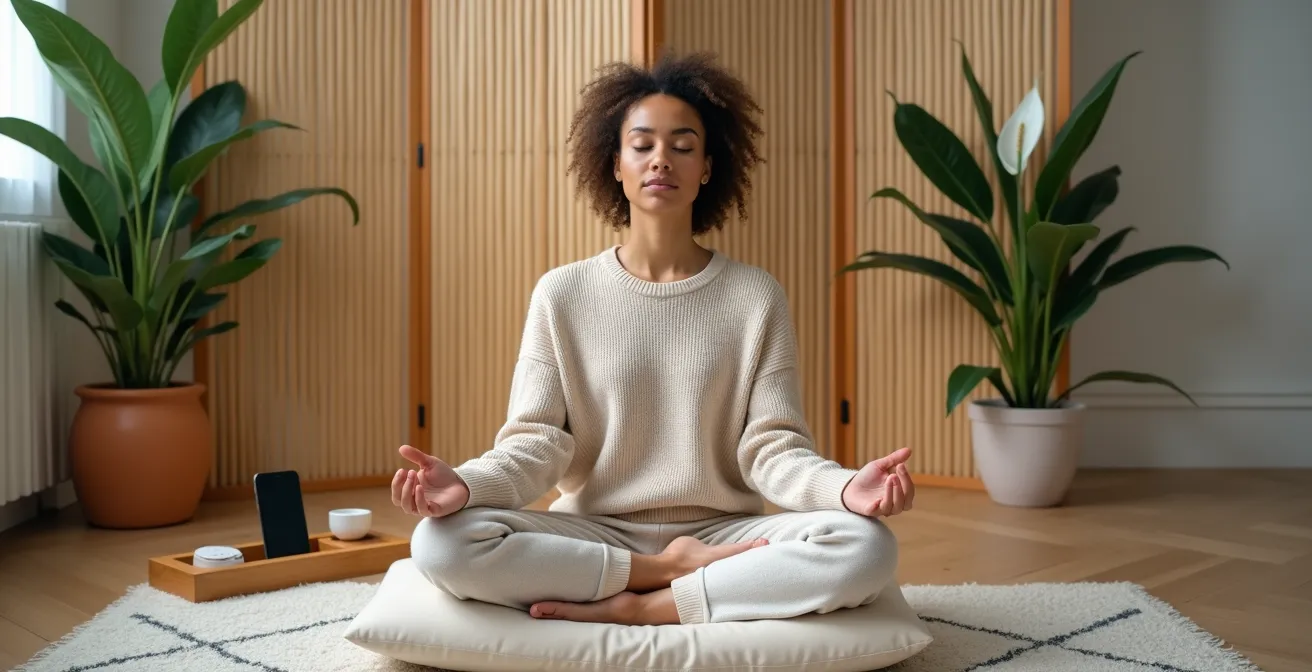
The most crucial element is the ritual. Make a conscious habit of placing your phone, tablet, and laptop in a designated “tech-dock”—perhaps a decorative box or a charging station on a dresser across the room—before you enter your sanctuary space. This physical act reinforces the mental boundary. By creating this small haven, you are sending a powerful signal to your nervous system that it is safe to power down, disconnect from the endless stream of notifications, and reconnect with your inner world. It becomes a predictable refuge from the digital noise that dominates modern life.
Velvet or Linen: Which Textile Reduces Tactile Stress?
For a Highly Sensitive Person, touch is a powerful sense that can either soothe or agitate. The choice of textiles in your home—from sofa upholstery to throw blankets—is a critical component of sensory ergonomics. While both velvet and linen are natural materials, they offer profoundly different tactile experiences, catering to different sensory needs. The right choice depends on whether your nervous system is seeking grounding and pressure or coolness and breathability.
Velvet is a superior choice for reducing anxiety and providing a sense of security. Its dense, heavy pile offers significant proprioceptive input—the sensation of deep, calming pressure on the body. This is similar to the effect of a weighted blanket, which can lower cortisol and increase serotonin and dopamine. Velvet’s smooth, consistent texture is predictable to the touch, avoiding the scratchy or irregular sensations that can be jarring for sensitive skin. Furthermore, its density makes it an excellent sound-dampening material, contributing to a quieter, more cocoon-like environment.
Linen, conversely, excels at reducing tactile stress related to overheating or feeling constricted. It is exceptionally breathable and cool to the touch, making it ideal for individuals who are sensitive to temperature fluctuations. Its lightweight nature provides minimal pressure, which can feel liberating if you dislike the sensation of being weighed down. However, its natural texture is more irregular and can feel coarse to some, which may be a source of sensory irritation. Understanding these distinct properties is key to making an intentional choice.
The following table, based on an analysis of textile sensory properties, breaks down the key differences to guide your selection.
| Property | Velvet | Linen |
|---|---|---|
| Thermal Feedback | Warm, heat-retaining | Cool, breathable |
| Proprioceptive Input | Heavy, grounding pressure | Light, minimal pressure |
| Texture Consistency | Smooth, predictable | Irregular, variable |
| Sound Properties | Sound-dampening | No acoustic benefit |
| Best For | Anxiety, need for grounding | Overheating, feeling constricted |
Ultimately, choosing between velvet and linen is about listening to your body. Do you crave the secure, heavy embrace of velvet to feel grounded, or the light, airy touch of linen to feel free and cool? By selecting textiles with this level of intention, you turn your furniture and decor into active tools for comfort and regulation.
The Paint Mistake That Makes a Room Feel Agitating Instead of Energetic
Color is one of the most powerful tools in sensory design, yet it’s also where a common and critical mistake is made. Many people, aiming for an “energetic” space, reach for bright, saturated colors like a vibrant yellow or a bold red. For an HSP, this choice often backfires, creating a room that feels agitating and draining rather than uplifting. The mistake isn’t choosing a warm color; it’s ignoring the crucial role of chroma (the intensity or purity of a color) and value (its lightness or darkness).
As color psychology researchers point out, the effect of color is nuanced. In a review of studies on the topic, a foundational finding is that “Warm colors like red and yellow tend to invoke energy and excitement while cooler colors like blue and green correspond with calmness, serenity, and relaxation“. However, an HSP’s nervous system is highly sensitive to the *intensity* of that energy. A high-chroma red can feel like a visual scream, while a muted, earthy terracotta can feel like a warm, grounding hug. Both are warm, but their impact is worlds apart. An energetic room for an HSP is achieved with colors that are warm but low in chroma—think mustard yellow instead of lemon, or dusty rose instead of magenta.
The finish of the paint is equally important. High-gloss or even satin finishes create specular reflections—sharp, focused points of light that can be visually jarring. A matte or eggshell finish, by contrast, diffuses light softly and evenly across the surface, eliminating harsh glare and creating a much gentler visual field. Choosing the right color is a delicate process that requires testing and observation, as the same shade can look dramatically different depending on the light and surrounding environment.
Your Paint Selection Audit for a Sensory-Calm Space
- Sample Selection: Test paint on large, movable boards (minimum 2’x2′), not small, static chips on the wall.
- In-Situ Observation: Place samples in the intended room for at least 48 hours, observing them in morning, midday, evening, and nighttime artificial light.
- Reflectance Check: Check the paint’s Light Reflectance Value (LRV), aiming for the 40-60% range for a balanced, non-glaring energy.
- Finish Selection: Commit to only matte or eggshell finishes to ensure light is diffused softly and harsh glare is eliminated.
- Undertone Analysis: Hold the sample against a sheet of pure white paper in different lighting conditions to accurately identify its true undertones (e.g., green, pink, gray).
How to Use Rugs and Curtains to Silence Echoes in Modern Condos?
Modern condos, with their open-plan layouts, high ceilings, and hard surfaces like concrete, glass, and hardwood, are often acoustic echo chambers. For most, this is a minor annoyance. For an HSP, the constant reverberation of sound—footsteps, voices, the clatter of dishes—creates an environment of auditory stress. This isn’t just a feeling; it has measurable physiological consequences. A study on noise in simulated open-plan offices found that students in high-noise conditions remembered fewer words, rated themselves as more tired, and were less motivated with work. The study confirmed this stress by measuring cortisol levels, demonstrating a direct link between ambient noise and cognitive fatigue.
The most effective way to combat this acoustic assault is through the strategic layering of soft, porous materials that absorb sound waves rather than reflecting them. Rugs and curtains are your primary tools. A bare floor is a reflective surface; adding a thick, high-pile rug is like laying down a blanket of silence. The denser the material, the better its sound-absorbing properties. Think thick wool, felt, or high-density shag rugs over thin, flat-weave options. For maximum effect, use a thick felt rug pad underneath to add another layer of absorption.

Curtains function on the same principle. Sheer, lightweight drapes do little to stop sound. Instead, opt for heavy, densely woven fabrics like velvet, thick linen, or lined blackout curtains. Extending the curtain rod well beyond the window frame allows the fabric to cover more wall space, further increasing its sound-dampening surface area. Layering is also a powerful technique: combining a functional blackout curtain with a heavy decorative drape creates a dual-layer sound trap. By deploying these soft armors, you can transform a jarring, echo-filled space into a serene, acoustically buffered sanctuary where your ears, and your nervous system, can finally be at peace.
How to Create a Low-Stimulation Sanctuary in a Small Apartment?
Creating a sanctuary in a small apartment presents a unique challenge: how do you carve out a zone of calm when space is at a premium? The answer lies not in adding more, but in making what you have more intentional and multi-functional. A low-stimulation environment in a small space is achieved through clever zoning, controlled storage, and a disciplined approach to sensory inputs.
First, embrace multi-functional furniture with hidden storage. An ottoman that stores blankets, a coffee table with drawers, or a bed with built-in storage are all essential. Every item that can be tucked away is one less piece of visual clutter demanding your brain’s attention. This directly supports the advice of HSP expert Julie Bjelland, LMFT, who recommends to “Keep your living area clutter-free“. Utilize vertical space with tall, closed-door cabinets to draw the eye upward and keep the floor clear, creating a sense of openness and reducing the feeling of being crowded.
Second, create “zones” of activity through sensory cues rather than physical walls. A soft, circular rug can define a reading nook. A smart lighting system can be programmed with pre-set scenes: a warm, dim “relax” mode for the evening versus a brighter, cooler “focus” mode for the desk area. This allows one room to serve multiple functions without feeling chaotic. A powerful strategy includes:
- Choosing furniture that is both functional and tactilely pleasing, like a storage ottoman with a soft texture.
- Installing a smart lighting system to shift the room’s mood with the press of a button.
- Dedicating one shelf as a “Sensory Toolkit” station, with noise-canceling headphones, essential oils, and fidget tools readily accessible but neatly contained.
- Adding one or two low-maintenance plants like a snake plant or pothos for a touch of nature without creating clutter.
By combining smart storage, flexible zoning, and curated sensory elements, even the smallest apartment can become a highly effective and restorative sanctuary.
Why Your Bathroom Light Is Waking You Up More Than Espresso?
That blast of bright, cool light from your bathroom fixture during a midnight trip or early morning routine is more disruptive than you might think. For an HSP’s finely tuned nervous system, it’s a jolt equivalent to a shot of espresso, effectively derailing your sleep-wake cycle. The culprit is blue light, a specific wavelength of light that is particularly effective at suppressing the production of melatonin, the hormone that regulates sleep.
The standard “daylight” or “cool white” LED bulbs common in many bathrooms are rich in these disruptive wavelengths. In fact, scientific research confirms that light in the 460-480nm spectrum—the peak range for blue light—has the most potent melatonin-suppressing effect. When your eyes are exposed to this light, your brain receives a powerful signal that it is daytime, even if it’s 3 AM. This can make it incredibly difficult to fall back asleep, and can leave you feeling groggy and “off” the entire next day as your circadian rhythm struggles to recalibrate.
Taming your bathroom lighting is one of the highest-impact changes you can make for better sleep and reduced sensory jarring. This involves a multi-pronged approach that provides the right kind of light at the right time.
- Warm the Temperature: Replace all primary bulbs with ones rated under 2700 Kelvin (K). This “warm white” or “soft white” light has significantly less blue light.
- Go Amber After Sunset: Use smart bulbs programmed to shift to a deep amber or red tone (around 2000K) after sunset.
- Rethink Midnight Lighting: Install motion-activated, low-lumen red LED strips along the baseboards. Red light has the least impact on melatonin, providing just enough light for navigation without waking your brain up.
- Control with Dimmers: Install dimmer switches on all fixtures. This gives you granular control to lower the intensity during the evening and morning.
By implementing this lighting protocol, you transform your bathroom from a source of circadian disruption into a space that respects your body’s natural rhythms.
Key Takeaways
- Your home’s primary function is to regulate your nervous system; aesthetics should serve this goal.
- Control sensory input by swapping visual noise (open shelves) for visual calm (closed doors).
- Layering soft, heavy textiles is the most effective way to manage both tactile and acoustic overstimulation.
How to Apply the Bagua Map to a New House to invite Prosperity
Feng Shui’s Bagua map is an ancient tool for understanding the energetic blueprint of a space. While often associated with mystical principles, it can be viewed through a modern, neuro-architectural lens as a powerful framework for spatial psychology. For an HSP, applying the Bagua map isn’t about superstition; it’s about using this time-tested system to create a home that consciously supports specific areas of life by aligning them with sensory-calming design principles.
The Bagua divides a space into nine areas, or “guas,” each corresponding to an aspect of life, such as Wealth & Prosperity, Health & Family, or Knowledge & Self-Cultivation. The traditional application involves placing specific colors or elements in each zone. For an HSP, we can adapt this by focusing on how the *sensory experience* of each zone can support its intention. True prosperity, for example, is not just about attracting money but about creating a sense of ease, abundance, and security—feelings that are impossible to cultivate in a state of sensory overload.
By adapting the Bagua for HSP needs, we shift the focus from traditional elements to sensory regulation. The “Wealth & Prosperity” corner, for instance, is traditionally associated with the color purple and the element of wood. For an HSP, the feeling of prosperity is more directly linked to a sense of order and control. Therefore, this area becomes the ideal location for well-organized, closed storage, eliminating clutter that creates a feeling of lack and chaos. Similarly, the “Fame & Reputation” area, traditionally linked to the element of fire and bright red, can be adapted with warm, gentle amber lighting from a beautiful lamp, creating a welcoming glow rather than an agitating glare.
This table offers a practical adaptation of the Bagua map, translating its traditional concepts into actionable sensory design strategies for a highly sensitive nervous system.
| Bagua Area | Traditional Element | HSP Adaptation |
|---|---|---|
| Knowledge & Self-Cultivation | Books, Study | Low-Stimulation Sanctuary Space |
| Health & Family | Wood, Green | Acoustic treatments, personal boundaries |
| Fame & Reputation | Fire, Red | Warm amber lighting, candles (not bright red) |
| Wealth & Prosperity | Purple, Gold | Organized closed storage, clutter-free surfaces |
| Center/Health | Earth, Yellow | Neutral calming tones, grounding textures |
To begin transforming your home into a true sanctuary, select one principle from this guide—such as upgrading your bathroom lighting or adding a heavy throw blanket—and implement it this week. Notice the difference it makes in your daily sense of calm and well-being.