
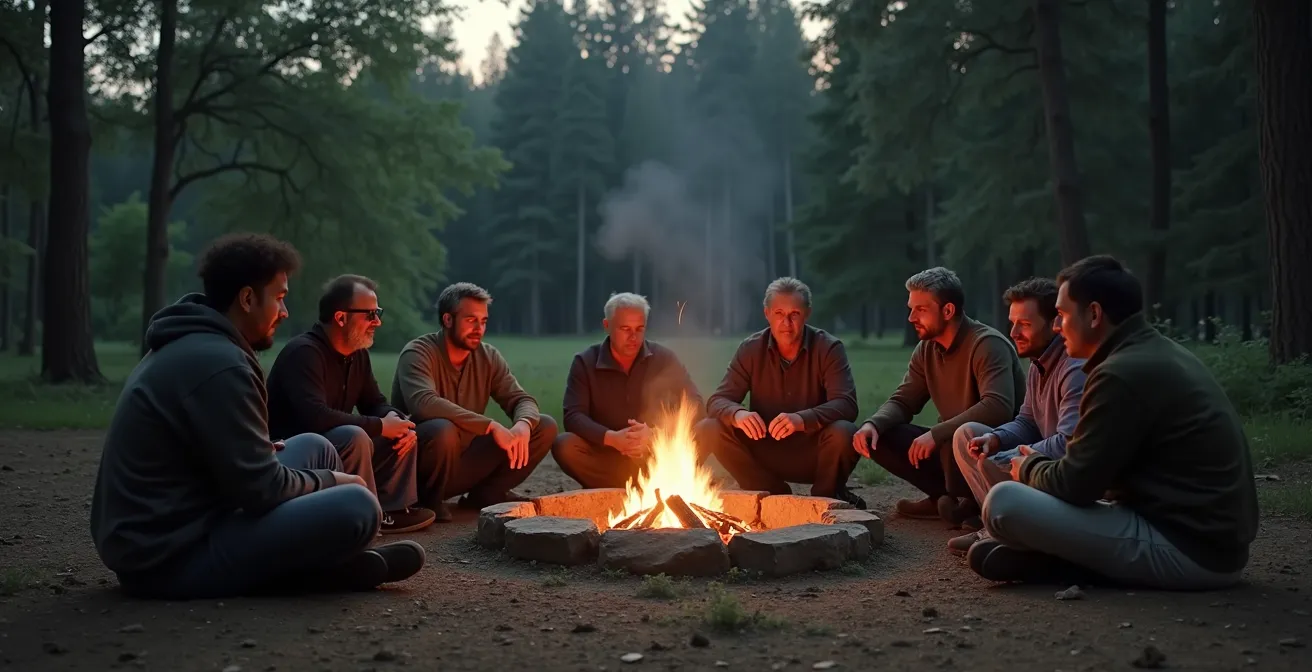
The solution to male isolation isn’t just ‘talking more’; it’s creating a structured space where honest communication is possible.
- Genuine connection is built on shared protocols and commitment, not just shared hobbies.
- Effective groups prioritize ‘witnessing’ (listening to understand) over ‘fixing’ (giving unsolicited advice).
Recommendation: Start by looking for groups with explicit ground rules, or introduce one simple protocol—like a ‘no cross-talk’ rule—to your existing circle of friends.
You know the feeling. You’re in a room full of men, maybe at a barbecue or watching a game, and you’ve never felt more alone. There’s conversation, but it’s a shield. It’s sports, work, a joke—a collection of well-rehearsed scripts designed to keep anything real at bay. The common advice for male loneliness is to “get out there” or “find a hobby,” but this often leads to more of the same: surface-level chatter that leaves you feeling unseen and unheard.
This search for connection is a fundamental human need, yet for many men, it feels like a puzzle with missing pieces. We’re told to be vulnerable, but we aren’t taught how to create the safety required for it. We crave depth but are only offered shallow ponds of interaction. This leaves many feeling emotionally isolated, navigating life’s biggest challenges—from career stress and relationship issues to addiction and fatherhood—in silence.
But what if the key wasn’t finding men with similar interests, but finding a group with a shared intention for growth? The transformative power of a true men’s group lies not in the men themselves, but in the structure—the container—they agree to build together. It’s a space forged by clear protocols and a commitment to a different way of communicating. It’s about learning to witness each other without judgment and to speak with radical honesty.
This guide breaks down the essential components of these powerful groups. We will explore the principles that make them effective, the communication tools that build trust, the common mistakes to avoid, and how you can begin fostering this level of connection in your own life, moving beyond the banter and into the realm of genuine brotherhood.
To help you navigate this journey toward deeper connection, this article is structured to provide a clear roadmap. The following summary outlines the key pillars we will explore, from the fundamental principles of peer support to the practical skills needed to build and sustain a transformative group.
Summary: A Man’s Guide to Building Deep Connection
- Why Peer Support Is More Effective Than Advice for Addiction Recovery?
- How to Run a Mastermind Group So Everyone Hits Their Goals?
- Zoom Circles or Fire Pits: Which Builds Trust Faster?
- The Communication Mistake That Ruins Support Circles
- When to Share Your Deepest Struggle: The Order of Disclosure
- How to Host a “Crap Dinner” Party to Foster Genuine Connection?
- How to Use “Reflective Listening” to Diffuse Conflict in 3 Minutes?
- How to Transition from “Code Expert” to “People Leader” Without Losing Respect
Why Peer Support Is More Effective Than Advice for Addiction Recovery?
The first and most critical shift in understanding a powerful men’s group is moving away from advice-giving and toward peer support. In most male friendships, the default response to a problem is to try and “fix” it. While well-intentioned, this impulse often shuts down vulnerability. It subtly communicates, “Your problem makes me uncomfortable, so here’s a solution to make it go away.” True support, especially in high-stakes situations like addiction recovery, is built on the opposite principle: connection.
The opposite of addiction is not sobriety; the opposite of addiction is connection. Men’s groups provide the social medicine men need.
– Johann Hari, MenSpeak Men’s Groups
This isn’t just a comforting idea; it’s backed by evidence. The power of being seen and heard by peers on a similar journey creates a foundation of trust that advice can’t replicate. It normalizes struggle and replaces shame with shared humanity. A 2024 systematic review of 28 studies involving over 12,000 individuals found that peer recovery services significantly improve treatment engagement and retention. The core function of the group is not to provide answers but to provide a consistent, non-judgmental presence—to witness another man’s truth without trying to change it. This is the bedrock of emotional hygiene.
The model shows that when men feel safe enough to share their reality without fear of being fixed, they begin to find their own solutions. The group doesn’t solve the problem; the group becomes the safe container in which the man can solve it himself. This distinction is the difference between a casual hangout and a transformative circle.
How to Run a Mastermind Group So Everyone Hits Their Goals?
A group that fosters deep connection doesn’t happen by accident. It is intentionally designed with clear agreements and a stable structure. Whether you call it a men’s circle, a mastermind, or a support group, the effectiveness hinges on a set of non-negotiable principles that create the container for honesty and growth. Without this structure, a group quickly devolves into the same surface-level chat it was created to escape.

These principles are the operating system of the group. They ensure fairness, safety, and focus, allowing every man to have his time and be fully heard. According to insights from experienced facilitators, a successful group requires clear protocols. The following elements are not suggestions; they are the essential architecture for a group that delivers results.
- Leadership: A stable leader or facilitator is crucial to guide meditations, time shares, and enforce the rules. They hold the container.
- Frequency: Fortnightly meetings are often the sweet spot, providing enough time for life to happen between sessions without losing momentum.
- Location: While the traditional setting is outdoors by a fire, the key is consistency and privacy, whether it’s in a living room or online.
- Attendees: A group size of 3-10 men is ideal. Fewer than three lacks group dynamic, while more than ten makes it difficult for everyone to share deeply in a reasonable time.
- No Cross-talk: When a man is sharing, everyone else’s only job is to listen. This is the most critical rule.
- Confidentiality: What is shared in the circle stays in the circle. This is the non-negotiable foundation of trust.
- Commitment: A financial or energetic contribution (like organizing a meeting) ensures that everyone present is serious about the work.
These rules aren’t about being rigid; they’re about creating freedom. By establishing a predictable and safe structure, men are freed from social anxiety and the need to perform. They can simply show up, speak their truth, and know they will be respected.
Zoom Circles or Fire Pits: Which Builds Trust Faster?
In our digitally connected world, a practical question immediately arises: can you build the same level of trust through a screen as you can around a fire? The format of your group—in-person or virtual—profoundly impacts its dynamics, accessibility, and the speed at which trust is forged. Neither is universally “better,” but they serve different needs and excel in different areas. Understanding their trade-offs is key to choosing the right container for you and your men.
In-person meetings, especially those held outdoors, tap into something primal and grounding. The shared physical space, the crackle of a fire, and the ability to read full-body language create an environment where trust can be built rapidly. However, they demand more logistical effort and are limited by geography. Online circles, by contrast, offer incredible accessibility and consistency. A man can join from anywhere in the world, making it easier to meet weekly and maintain momentum. The challenge lies in intentionally creating the psychological safety that physical presence provides more naturally. The following comparison, based on an analysis of men’s circle formats, breaks down the key differences:
| Aspect | Fire Pit Circles | Zoom Circles |
|---|---|---|
| Trust Building Speed | Faster due to shared physical presence and sensory input | Slower, requires intentional rituals and consistency |
| Accessibility | Limited by location and weather | Accessible from anywhere, anytime |
| Frequency Potential | Monthly or bi-weekly typical | Can meet weekly or more frequently |
| Cost | Travel, firewood, venue costs | Minimal to none |
| Atmosphere | Primal, grounding, traditional | Convenient but requires effort to create safety |
| Best For | Deep bonding, rites of passage, major breakthroughs | Regular check-ins, consistency, busy schedules |
Ultimately, the most effective format is the one your group can commit to consistently. A well-facilitated weekly Zoom circle will build more trust over time than a poorly attended, inconsistent in-person gathering. The key is to be intentional. For online groups, this means using rituals like a collective deep breath to start, ensuring everyone has their camera on, and being even more disciplined about the group’s protocols to compensate for the lack of physical cues.
The Communication Mistake That Ruins Support Circles
The single most destructive force in a men’s group is “cross-talk.” It’s the instinct to immediately react to someone’s share with a comment, a question, or a story of your own. It manifests as fixing (“You should…”), sympathizing (“Oh, you poor thing…”), relating (“That reminds me of a time…”), or questioning (“Why did you do that?”). While it often comes from a good place, it consistently derails the process and erodes safety. It shifts the focus away from the man sharing and recenters it on the reactor.
This mistake is so common because it’s the default mode of social interaction. A powerful men’s group is an exercise in unlearning this habit. The antidote is a strict “no cross-talk” protocol. When a man is sharing, the role of every other man is simply to listen—to witness. This silence is not empty; it’s a space that communicates respect, presence, and the confidence that he is capable of navigating his own experience. As documented by successful groups like MenSpeak, which has operated for over 23 years, this rule is paramount. Participants consistently report that being heard without judgment created a level of safety they had never experienced before.
To prevent this destructive pattern, a group must explicitly adopt a set of communication ground rules. These rules are the guardrails that keep the conversation on track and protect the vulnerable space being created.
- No Cross-talk Rule: When it’s another man’s turn to share, you only listen until he is finished. There are no immediate reactions or ping-pong conversations.
- No Fix-it Responses: Avoid giving unsolicited advice. Your presence is more valuable than your solutions.
- No Story-topping: Do not respond to a share with your own “bigger” or “better” story. This invalidates the original speaker.
- Moment of Silence: After each man shares, allow a brief pause before the next person speaks. This lets the weight of the words settle in the room.
- Confidentiality Always: Reiterate that what’s shared in the circle stays in the circle. This is the foundation for all other rules.
By enforcing these rules, particularly the ban on cross-talk, the group shifts from a reactive debate to a reflective, collective experience. It’s the primary mechanism that separates a deep, therapeutic space from a superficial chat.
When to Share Your Deepest Struggle: The Order of Disclosure
The goal of a men’s group is to create a space for radical honesty, but this doesn’t mean you unload your deepest trauma on day one. Trust is not a given; it is earned. Vulnerability is a dance, a gradual process of testing the waters and allowing the group to prove it is a safe container for your truth. Sharing too much, too soon, in an unvetted group can be retraumatizing. Therefore, a wise approach involves a calculated “order of disclosure.”
A ‘regular guy’ can step into this space and feel empowered to tell the unvarnished truth about his life. We’re not here to put on a show for each other.
– ManKind Project, ManKind Project Men’s Groups
The process of opening up should be intentional. You start by sharing smaller, less charged struggles to gauge the group’s response. Do they listen? Do they respect the “no cross-talk” rule? Do they hold what you’ve shared in confidence? Their response to your minor vulnerability is the data you need to decide if they have earned the right to hear your major struggles.

This methodical approach, sometimes called the “vulnerability test,” protects you while allowing genuine trust to build organically. It empowers you to control the pace of your own disclosure. Here is a practical framework for sharing safely:
- Start with Level 2 Struggles: Begin by sharing minor frustrations or manageable worries to test the group’s reaction.
- Observe the Response: Notice if your share is met with unsolicited advice, judgment, story-topping, or quiet, respectful acceptance. The latter is what you’re looking for.
- Let the Group Earn Trust: Wait for consistent demonstrations of confidentiality and non-judgment over the course of several meetings.
- Assess Your Capacity: Before sharing something deep, ask yourself if you have the emotional bandwidth to process whatever reactions may come.
- Build Gradually: Only move from surface-level concerns to deeper struggles as a solid foundation of trust is established and proven.
- Honor the ‘Pass’ Option: It is always acceptable to “pass” when it’s your turn to share. Exercising this boundary is a sign of strength and is respected in healthy groups.
How to Host a “Crap Dinner” Party to Foster Genuine Connection?
The idea of joining a formal “men’s group” can be intimidating. It might feel too structured or too intense, especially if you’re just starting to explore deeper connections. A powerful and accessible entry point is to begin with what you already have: your existing friends. The concept of a “Crap Dinner” or a low-pressure gathering is to intentionally, but gradually, introduce the protocols of a men’s circle into a familiar setting.
The beauty of this approach lies in its simplicity. You invite a few trusted friends over for a simple meal with one key difference: you create a small window for intentional sharing. You’re not trying to replicate a three-hour intensive circle; you’re simply planting a seed. By curating one powerful question, you can bypass the usual small talk and invite a moment of genuine reflection. The goal is to slowly build the muscle of vulnerability in a low-stakes environment.
Transforming a casual dinner into a space for genuine connection is a gradual process. It’s not about a sudden change but a series of small, intentional steps that build on each other over time. Here’s a framework for making that transition:
- Start Low-pressure: Begin with completely informal dinners. The only agenda is to connect. This reduces any sense of intimidation.
- Introduce One Protocol: After a couple of dinners, introduce a simple, structured sharing round, like “Share a win and a challenge from your past month.”
- Curate One Powerful Question: To bypass small talk, introduce a single thematic question for everyone to answer, such as “What’s a belief about masculinity you’ve had to unlearn?”
- Select for Introspection: As you continue, be mindful of who you invite. Prioritize men who show a capacity for curiosity and self-reflection, not just old friends.
- Create a Regular Rhythm: Once a core group forms, establish a consistent schedule (e.g., the first Thursday of every month) to build momentum and commitment.
- Gradually Deepen: As trust is built over months, you can slowly introduce more structured protocols from traditional men’s circles, like timed shares or reflective listening.
This method allows you to cultivate your own circle organically. You are testing the waters with men you already know and building a container based on a foundation of existing friendship. It’s a powerful way to bring this work into your life without having to search for an external group.
How to Use “Reflective Listening” to Diffuse Conflict in 3 Minutes?
No group of humans is without conflict. In a men’s group, friction is not a sign of failure; it is an inevitable and essential part of the group’s development—what psychologist Bruce Tuckman called the “storming” phase. The measure of a group’s strength is not its ability to avoid conflict, but its ability to navigate it constructively. The most powerful tool for this is reflective listening.
Reflective listening is the practice of mirroring back what you hear someone saying, both in content and in feeling, without adding your own interpretation or opinion. It’s a simple but profound technique that has one primary goal: to make the other person feel fully heard. When a man feels truly understood, his defensiveness naturally decreases, and the conflict begins to diffuse. As demonstrated by the ManKind Project’s 30-year history across 22 countries, groups that master these communication skills can resolve conflicts in a way that is energizing rather than draining.
This skill requires practice, but it can be broken down into progressive layers. Mastering it turns conflict from a threat into an opportunity to deepen trust. Here are the techniques to practice:
- Basic Reflection (Content): Start with the simple phrase, “What I hear you saying is…” and then repeat back the core facts of what they said.
- Feeling Reflection (Emotion): Go a layer deeper by identifying the emotion behind the words. “It sounds like you felt betrayed in that moment.”
- Meaning Reflection (Core Need): Try to get to the underlying value or need. “So, if I’m getting this right, the core issue for you is one of respect?”
- Practice During Low Stakes: Don’t wait for a crisis. Practice reflective listening during calm check-ins so the skill is available when tensions are high.
- Navigate the Storming Phase: Expect and welcome conflict as a natural stage of group development. Frame it as a chance to strengthen the container.
- Make it the Operating System: Establish reflective listening as the foundational communication protocol for the entire group, especially when disagreements arise.
When deployed effectively, reflective listening can de-escalate a heated exchange in minutes. It forces the listener to stop formulating a rebuttal and simply be present, and it validates the speaker’s experience, which is often all that is needed to find common ground.
Key Takeaways
- A group’s effectiveness is determined by its protocols (the ‘how’), not just its members (the ‘who’).
- The most critical skill to cultivate is ‘witnessing’—listening to understand without the impulse to ‘fix’.
- Trust is not a prerequisite but an outcome, earned through consistent demonstrations of safety, confidentiality, and respect for the rules.
How to Transition from “Code Expert” to “People Leader” Without Losing Respect
The skills forged in a men’s circle—vulnerability, active listening, and creating psychological safety—are not confined to the group. They are, in fact, elite leadership skills that are highly transferable to the professional world. This is especially true for men transitioning from roles as individual technical experts (like a senior developer) to people leaders. The mindset that makes you a great coder—finding and fixing bugs—is precisely the opposite of what makes you a great leader.
People are not code; they cannot be debugged. Trying to “fix” your team members creates an environment of judgment and fear. A true leader creates a safe container for their team to thrive, a space where failure is seen as a data point for learning, not a reason for blame. This is the same principle as in a men’s group. Your role as a leader shifts from having all the answers to creating an environment where the best answers can emerge from the team.
This transition requires a conscious shift in your operating model. It involves recognizing that emotional data and vulnerability are high-bandwidth forms of communication that build trust far more effectively than status reports and small talk. Here is a framework for making that transition:
- Shift from Debugging to Witnessing: Stop trying to ‘fix bugs’ in people. Instead, focus on creating a safe environment where your team members can be themselves, flaws and all.
- Recognize the High-Bandwidth API: Understand that vulnerability and emotional expression transmit far more critical data (trust, empathy, motivation) than surface-level professional talk.
- Lead by Committing First: Just as you commit code, make “emotional commits.” Be the first to share a mistake you made or a challenge you’re facing to model the behavior you want to see.
- Value Process Over Solutions: Focus on creating the right environment (the ‘process’) rather than always having the best answer (‘the solution’).
- Practice Active Listening: Apply the same intense focus you use for debugging a complex problem to truly hearing what your team members are saying—and not saying.
- Build Psychological Safety: Champion an environment where innovative ideas and calculated risks are encouraged, and where failure is treated as a valuable part of the growth process.
The journey from isolation to connection begins with a single, intentional step. Start today by applying one of these principles to your life, whether it’s practicing reflective listening with a partner or inviting a friend to a “crap dinner” with one powerful question.