
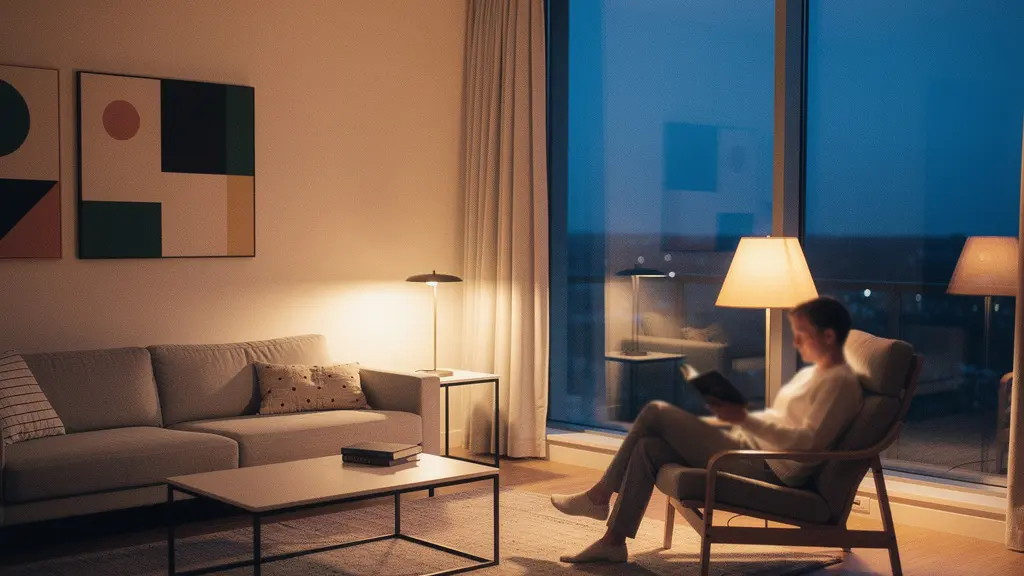
In summary:
- Treat light as a biological signal; your home’s lighting should be a dynamic system that changes from day to night.
- Prioritize bright, blue-enriched light exposure in the morning to set your internal clock and boost daytime alertness.
- Systematically decrease light intensity and color temperature (shifting to warm amber/red tones) in the 2-3 hours before bed.
- Architect the entire ambient environment for sleep, using tools like smart bulbs and dimmers, rather than relying solely on individual compliance with glasses.
For many struggling with sleep, the evening feels like a paradox: you’re physically exhausted, yet your mind races, refusing to power down. You’ve likely heard the common culprits—the glow of your smartphone, the late-night emails—and the standard advice: turn off screens, wear amber glasses, read a book. While these tips have merit, they treat the symptom, not the system. They place the burden of discipline on your tired mind, ignoring the most powerful, pervasive influence on your sleep cycle: the light architecture of your home itself.
The truth is, your home is likely sending your brain the wrong signals at the wrong time. A single blast of a bright bathroom light can be more disruptive than a shot of espresso, while a dimly lit morning can leave you feeling groggy and unmotivated for hours. True sleep optimization isn’t about fighting a losing battle against isolated sources of blue light. It’s about becoming the architect of your own circadian environment, conducting a daily light choreography that guides your biology from a state of peak alertness to one of profound rest.
This guide moves beyond simplistic rules and delves into the principles of environmental lighting design for sleep. We will explore how to use light—both its presence and its absence—as a tool. We’ll deconstruct the 24-hour light cycle, showing you how to manage morning exposure, execute a strategic “ambient tapering” in the evening, and transform your home from a source of circadian disruption into a sanctuary for sleep.
This article provides a detailed blueprint for redesigning your home’s light environment. The following table of contents outlines the key strategies we will cover, from leveraging morning sun to creating “biological darkness” before bed.
Summary: A Designer’s Guide to Home Lighting for Sleep
- Why Your Bathroom Light Is Waking You Up More Than Espresso?
- How to Use Morning Sun Exposure to Reset Your Biological Clock in 10 Minutes?
- Blue-Blocking Glasses or Smart Bulbs: Which Is More Effective for Families?
- The Mistake of Blocking All Morning Light That Makes Waking Up Harder
- How to Trick Your Brain into Sleep Mode After a Night Shift?
- When to Dim the Lights: The Perfect Timeline for a 10 PM Bedtime
- Why 20 Minutes of Morning Light Reduces Depression Symptoms?
- How to Position Mirrors to Double Natural Light in Dark Rooms
Why Your Bathroom Light Is Waking You Up More Than Espresso?
That late-night trip to the bathroom can feel like a biological ambush. The sudden flood of intense, cool-white light from standard overhead fixtures is a powerful alerting signal to your brain. This isn’t just a feeling; it’s a physiological event. The high intensity and blue-spectrum content of typical bathroom LEDs directly target the melanopsin receptors in your eyes, which are responsible for communicating “daytime” to your brain’s master clock. This signal can instantly slam the brakes on melatonin production, the key hormone that facilitates sleep.
The effect is far from negligible. Even a brief exposure can be highly disruptive. In fact, recent research shows that just one minute of exposure to a cool white LED can cause 12.3% melatonin suppression. This makes your standard bathroom vanity light a veritable “circadian bomb,” fragmenting your sleep and making it harder to fall back asleep. The goal is to navigate your home at night without sending your brain a wake-up call. This requires a dual-lighting strategy that separates daytime and nighttime functionality.
To achieve this, you need to create a low-impact lighting path for nighttime use. The solution is to add a secondary, sleep-friendly light source and reserve the bright, standard lights for your morning routine only. Here are the key components of a dual-mode bathroom lighting strategy:
- Install a motion-activated red or amber night light positioned low to the ground, ensuring the light level remains below 10 lux.
- Reserve the standard bright, cool-toned lights exclusively for morning routines when an alerting signal is beneficial.
- Use motion-activated lights to deliver minimal, targeted illumination only when and where it is necessary.
- Position all nighttime light sources to avoid direct eye exposure, ideally by bouncing light off the floor or a wall.
- Consider installing dimmer switches on your main lights to allow for gradual adjustment, providing more control over the ambient environment.
How to Use Morning Sun Exposure to Reset Your Biological Clock in 10 Minutes?
The foundation of a good night’s sleep is laid the moment you wake up. Morning light exposure is the single most powerful signal for synchronizing your internal biological clock, or circadian rhythm. When natural sunlight, particularly the blue-enriched light of the morning, hits your eyes, it triggers a cascade of hormonal responses designed to promote wakefulness and alertness. The most crucial of these is the Cortisol Awakening Response (CAR), a healthy spike in the hormone cortisol that helps you feel energized and ready for the day.
This is not a subtle effect; it’s a profound biological reset. Research demonstrates that morning bright light can cause up to a 50% elevation of cortisol levels, effectively kick-starting your body’s “day mode.” This robust morning signal does more than just wake you up; it also sets the timer for your sleepiness later on. A strong “on” signal in the morning leads to a clearer “off” signal in the evening, promoting a more timely release of melatonin. Just 10 to 20 minutes of exposure is often sufficient to send this powerful circadian signal.
This practice is about harnessing the right kind of light at the right time. The specific properties of morning light are key. A study on university students highlighted that exposure to blue-enriched white light in the morning didn’t just suppress lingering melatonin; it also significantly improved subjective perceptions of alertness, mood, and visual comfort. You are essentially providing your brain with the precise data it needs to anchor your 24-hour cycle. To implement this, simply step outside or sit by an east-facing window without sunglasses shortly after waking.

As the image illustrates, this practice is about absorption, not just observation. It’s about allowing the full spectrum of natural light to reach your photoreceptors. This simple, cost-free habit is a non-negotiable cornerstone of any effective light hygiene protocol. By anchoring your circadian rhythm with a strong morning light signal, you are programming your biology for better daytime function and a more natural transition to sleep 14 to 16 hours later.
Blue-Blocking Glasses or Smart Bulbs: Which Is More Effective for Families?
When it comes to managing evening blue light, two popular solutions emerge: blue-blocking glasses and smart bulbs. While both aim to reduce the melatonin-suppressing effects of artificial light, they operate on fundamentally different principles. Glasses act as a personal filter, protecting the individual wearer, while smart bulbs change the entire ambient environment. For a family or shared living space, this distinction is critical, making one approach far more effective and practical than the other.
Blue-blocking glasses require active, consistent compliance from every individual. For a household with children, teenagers, and adults with varying routines, achieving 100% compliance is nearly impossible. A single person not wearing them while the overhead lights are on still experiences circadian disruption. Smart bulbs, on the other hand, offer a passive, systemic solution. By programming bulbs in shared spaces like the living room and kitchen to automatically shift to warm, dim, low-blue-light settings in the evening, you create a sleep-friendly environment for everyone, without relying on individual discipline. This “architectural” approach ensures the ambient circadian signal is correct for everyone in the room, regardless of what they are doing.
As experts from Harvard Medical School note, personal devices are a key concern, which is where glasses can shine. In a statement on the topic, Harvard Health Publishing advises:
If you work a night shift or use a lot of electronic devices at night, consider wearing blue-blocking glasses or installing an app that filters the blue/green wavelength at night.
– Harvard Health Publishing, Harvard Medical School
This highlights the ideal use case for each tool. Glasses are perfect for individual screen time, creating a personal “bubble” of safe light. Smart bulbs are for managing the shared, ambient environment. The most effective family strategy often involves a hybrid approach: smart bulbs for communal areas and blue-blocking glasses for late-night personal screen use. The following table breaks down the key differences, drawing on data and analysis like that presented by sources like Harvard Health Publishing.
| Feature | Blue-Blocking Glasses | Smart Bulbs |
|---|---|---|
| Initial Cost | $20-100 per person | $30-60 per bulb |
| Compliance Required | Individual discipline needed | Passive/automatic |
| Family Coverage | Each person needs pair | Covers entire room |
| Effectiveness | Blocks blue light effectively | Changes entire light environment |
| Best Use Case | Individual screen use | Shared living spaces |
The Mistake of Blocking All Morning Light That Makes Waking Up Harder
In the quest for perfect darkness to sleep, many people install blackout curtains and then make a critical error: they keep them drawn well into the morning. While complete darkness is essential for quality sleep, blocking all morning light actively works against your body’s natural waking process. This habit creates a state of “circadian confusion,” robbing your brain of the essential light signals it needs to initiate the wake-up sequence, leaving you feeling groggy and reliant on an alarm clock’s jarring sound.
As discussed, morning light triggers the Cortisol Awakening Response (CAR). Depriving yourself of this light blunts this necessary cortisol spike. Instead of a robust hormonal signal to be alert, you get a sluggish, delayed start. Studies confirm the direct link between light and this process, showing a 20-35% increase in the morning cortisol rise from bright light exposure within the first few hours after awakening. By staying in a dark cave, you are telling your body it’s still nighttime, making the transition to wakefulness a struggle.
The ideal solution isn’t to sacrifice sleep quality with light leakage at night, but to design a “smart dawn” that allows light in at the appropriate time. This means transitioning from a purely passive system (blackout curtains) to an active or semi-active one. For light-sensitive sleepers, this can be a game-changer, replacing the jarring shock of an alarm with a gradual, natural awakening process that aligns with your biology.
Your 5-Point Action Plan: Designing a Smarter Dawn
- Program smart blinds to begin opening gradually 20 minutes before your alarm is set to go off, mimicking a natural sunrise.
- Invest in a wake-up light alarm that simulates the increasing brightness and changing color temperature of a natural sunrise, starting very dim and warm and getting brighter and cooler.
- Cultivate the habit of stepping outside for at least a few minutes within the first hour of waking to receive the full-spectrum signal of natural daylight.
- Position your bed so that it receives indirect morning light from a window, avoiding a direct beam but still benefiting from the ambient brightness.
- Replace heavy blackout curtains with high-quality, light-filtering “whiteout” or double-layered curtains that block most, but not all, light, allowing for a more gentle awakening.
How to Trick Your Brain into Sleep Mode After a Night Shift?
For night shift workers, the end of a shift marks the beginning of a biological battle. Commuting home as the sun rises means being exposed to the most powerful “wake-up” signal in nature precisely when you need to wind down for sleep. This direct conflict between your work schedule and the natural light-dark cycle is the primary driver of the health issues and sleep disturbances common among shift workers. To get restorative daytime sleep, you must create a period of “biological darkness” for yourself while the world outside is bright.
This involves tricking your brain into believing it’s dusk, not dawn. The key is to strictly avoid blue-spectrum light on the journey home and during your pre-sleep routine. This is where high-quality, wrap-around blue-blocking glasses become an essential tool, not just a gadget. By wearing them an hour or two before your shift ends and during your commute, you filter out the alerting wavelengths of light, preventing your brain from receiving the “it’s morning” signal and halting your melatonin production. This is no small tweak; studies show that circadian-informed lighting interventions can dramatically improve sleep for this population.
Case Study: The Impact of Light Therapy on Shift Worker Sleep
A meta-analysis of studies on light therapy for shift workers revealed significant benefits. The data showed that a structured light management protocol led to a meaningful improvement in sleep quality. Specifically, the analysis found that light therapy significantly increased total sleep time by an average of 32.54 minutes and improved sleep efficiency by 2.91% compared to control groups. This demonstrates that actively managing light exposure is a clinically effective strategy for mitigating the challenges of shift work.
The visual of a worker using this strategy highlights the core principle: creating a personal bubble of darkness. It’s about taking control of the light signals your eyes receive.

Once home, this protocol must continue. Your bedroom needs to be a cave: 100% blackout curtains, no standby lights, and a cool temperature. This combination of pre-sleep light avoidance and a pitch-black sleep environment helps create the strong “off” signal your body needs to initiate and maintain sleep during the day, even when the sun is high in thesky.
When to Dim the Lights: The Perfect Timeline for a 10 PM Bedtime
The transition from the bright, blue-rich light of day to the warm, dim light of evening is a critical phase in your daily light choreography. This process, which we can call “ambient tapering,” should be a gradual, deliberate wind-down, not an abrupt switch. Starting this process 2-3 hours before your desired bedtime sends a continuous “prepare for sleep” signal to your brain, allowing melatonin levels to rise naturally. For a 10 PM bedtime, your light-dimming schedule should begin around 7:00 PM.
This might seem early, but modern homes are often dangerously over-lit in the evenings. The ambient light in many households is bright enough to disrupt circadian rhythms significantly. A comprehensive study found that nearly half of homes had bright enough light in the evening to suppress melatonin by 50%. This means your standard living room lighting could be sabotaging your sleep long before you even think about heading to bed. The goal is to move from general overhead lighting to lower, warmer, and more localized light sources as the evening progresses.
Creating a structured timeline transforms this concept from an abstract idea into an actionable plan. Using smart bulbs that can be programmed to change color temperature and brightness automatically is the most effective method, but a manual approach with dimmers and different types of lamps also works. Here is a sample hour-by-hour light tapering schedule designed for a 10:00 PM bedtime:
- 7:00 PM: This is the first major transition. Switch off all bright overhead lights. Shift to using localized light sources like table lamps and floor lamps equipped with warm bulbs (ideally 2700K or lower).
- 8:30 PM: Begin the dimming process. If you have dimmers, reduce the brightness of your lamps to about 50%. The goal is to create a calm, relaxing ambiance.
- 9:00 PM: All screens should be turned off or set to their warmest “night shift” mode. Ambient lighting should now be very subdued, using only dim yellow or orange colored lights if possible.
- 9:30 PM: Only task-specific light should be used, such as a red or amber-hued reading light for a book. The ambient light level should be minimal, approaching “biological darkness” (less than 10 lux).
Why 20 Minutes of Morning Light Reduces Depression Symptoms?
The connection between light and mood is profound, and the timing of that light is crucial. The same morning light exposure that resets your biological clock also plays a significant role in mental well-being, including the reduction of depressive symptoms. This effect is largely mediated by its influence on neurotransmitter systems and hormonal regulation, particularly the relationship between cortisol and serotonin.
A well-regulated Cortisol Awakening Response (CAR), stimulated by morning light, is a sign of a healthy and resilient stress response system. In many individuals with depression, this morning cortisol rhythm is flattened or delayed. This dysregulation can contribute to feelings of fatigue, low motivation, and a depressed mood, especially in the mornings. By getting 15-30 minutes of natural sunlight within the first hour of waking, you provide a powerful, natural stimulus to help normalize this rhythm. As one expert source on the topic explains, this simple action “signals your brain to start the cortisol awakening response.”
Furthermore, morning sunlight is believed to boost the brain’s production of serotonin, a neurotransmitter that plays a vital role in mood regulation, feelings of well-being, and happiness. A lack of serotonin is strongly linked to depression. Therefore, a daily 20-minute dose of morning light can act as a natural antidepressant, helping to elevate mood and improve emotional resilience throughout the day. While it is not a replacement for professional medical treatment, incorporating this habit is a powerful, evidence-based lifestyle intervention that supports overall mental health by aligning our modern lives with a fundamental biological need.
Key takeaways
- A successful light choreography is a 24-hour process; bright morning light is just as crucial as dim evening light for anchoring your circadian rhythm.
- Focus on architecting the entire ambient environment with tools like smart bulbs and dimmers, as this is more effective for families than relying on individual compliance with glasses.
- The goal of evening light tapering is to achieve “biological darkness”—a light level so dim and warm (amber/red) that it doesn’t suppress your natural melatonin production.
How to Position Mirrors to Double Natural Light in Dark Rooms
In the art of lighting design, mirrors are not just decorative objects; they are powerful tools for manipulating and amplifying light. For rooms that suffer from a lack of natural light, strategic mirror placement can be a game-changer, effectively doubling the perceived brightness and extending the reach of a single window. This technique is particularly valuable for enhancing morning light exposure in bedrooms or brightening a dim home office space during the day.
The principle is simple reflection. A mirror placed directly opposite a window will capture the incoming light and bounce it straight back into the room, illuminating the space from a second direction. This not only increases the overall light level (lux) but also improves the quality of the light by making it feel more diffuse and multi-directional, reducing harsh shadows. The size of the mirror matters; a large, full-length mirror can have a dramatic effect, essentially acting as a secondary window.
However, placement is more than just putting a mirror opposite a window. The angle and position relative to your living space can be optimized to direct light exactly where you need it. For instance, angling a mirror can funnel light down a dark hallway or into a specific work area. It’s a low-cost, high-impact design strategy that leverages basic physics to improve your home’s light environment. Here are some key principles for strategic mirror placement:
- Position a large mirror directly opposite an east-facing window to capture and spread the vital morning sun throughout a bedroom or living area.
- If a direct opposite placement isn’t possible, angle a mirror to specifically funnel light towards a functional area like a breakfast nook or a home office desk.
- Place tall, floor-standing mirrors perpendicular to windows (on an adjacent wall) to catch light from the side and spread it laterally across the room.
- Critically, avoid positioning mirrors where they will reflect artificial light sources in the evening, such as bright lamps or a TV screen, as this will amplify unwanted light at the wrong time.
Start tonight. Choose one room—your living room or bedroom—and implement a single strategy from this guide. Whether it’s swapping a bulb, setting a dimming schedule, or simply turning off the overheads, begin the process of transforming your home from a source of circadian disruption into a sanctuary engineered for restorative sleep.