

The secret to a truly relaxing partner massage isn’t pressure or technique, but learning to speak the non-verbal language of the nervous system.
- Effleurage, a gentle gliding stroke, is designed to build trust by activating specific nerve fibers that release calming hormones like oxytocin.
- Your posture and intention as the giver are as important as the stroke itself; a calm giver helps to co-regulate and soothe their partner’s nervous system.
Recommendation: Start by focusing on the rhythm and warmth of your touch, not the force, to transform a simple massage into a profound act of connection.
There’s a beautiful intimacy in being able to soothe your partner with your own hands. So many of us want to offer that comfort, but we hesitate. We worry we’ll do it wrong, apply too much pressure, or that our touch will feel awkward and unskilled rather than relaxing. The common advice—light some candles, put on soft music—only sets the stage. It doesn’t teach you the script. The script, the language of a truly connecting massage, doesn’t begin with deep, muscle-kneading pressure. It begins with a whisper.
That whisper is called effleurage. It’s the foundational long, gliding stroke of massage, but it’s so much more than a warm-up. It’s a question you ask your partner’s body: “Are you ready? Can you trust me?” Most guides treat it as a preliminary step before the “real” massage begins. They miss the entire point. The magic isn’t in what comes after effleurage; the magic *is* effleurage.
This is where we’ll shift the focus. Instead of seeing this stroke as a mere introduction, we will explore it as the main event. We are moving beyond the purely mechanical and into the realm of the neurological and emotional. The key isn’t to learn a sequence of movements, but to understand how your touch becomes a dialogue with your partner’s nervous system. This guide is built to teach you that language—the science of safety, the art of presence, and the simple techniques that foster a bond far deeper than skin level.
Throughout this guide, we’ll explore the essential elements that transform a simple back rub into a meaningful ritual of connection. You will learn not just what to do, but precisely why it works, empowering you to give a massage that feels intuitive, confident, and deeply comforting.
Summary: A Deep Dive into the Art of Effleurage for Partner Connection
- Why You Must Start with Effleurage Before Applying Deep Pressure?
- Coconut vs Almond Oil: Which Provides the Best Glide for Long Strokes?
- How to Position Your Body to Massage Your Partner Without Hurting Your Back?
- The Pressure Error Over the Spine That Causes Pain Instead of Relief
- In What Direction Should You Stroke to Encourage Blood Return to the Heart?
- Co-regulation or Solitude: Which Is Best for Anxious-Avoidant Pairs?
- Why Gentle Strokes Reduce Cortisol More Effectively Than Painful Ones?
- How Hot Stones Melt Tension in Dense Muscle Tissue Without Deep Pressure
Why You Must Start with Effleurage Before Applying Deep Pressure?
Imagine walking into a quiet room and shouting. The instinctive reaction is to startle, to tense up. The same principle applies to touch. Starting a massage with immediate, deep pressure is the physical equivalent of that shout. It signals a potential threat to the nervous system, causing muscles to guard and resist. Effleurage, however, is a non-verbal whisper. It’s your way of knocking gently on the door before entering, and science shows us exactly why this is so effective for creating relaxation and trust.
Our skin is covered in a special class of nerve fibers called C-tactile afferents. These fibers don’t register pain or temperature; their sole job is to process gentle, “affective” touch. When you use a slow, light, skin-temperature stroke, you are speaking their language. In fact, research shows that gentle stroking at 3 cm/s optimally activates C-tactile afferents, which in turn triggers the brain to release oxytocin—the “bonding hormone” responsible for feelings of safety, connection, and well-being. You are literally telling your partner’s brain, “You are safe with me.”
This initial phase is about building a foundation of what we can call somatic permission. You are not just warming up the muscles; you are calming the nervous system. By using your whole, relaxed palm in long, continuous strokes, you cover a large surface area, which is inherently more soothing than poky fingers. You are communicating presence and care. As massage therapist Lisa Casanelia notes, these first touches are a “non-verbal way of asking for permission, building trust, and signaling safety to your partner’s nervous system.” Only when that trust is established, when the muscles feel safe enough to soften, can any deeper work be truly received.
Coconut vs Almond Oil: Which Provides the Best Glide for Long Strokes?
Once you understand that your first touch is a conversation, the oil you choose becomes part of that dialogue. It’s not just a lubricant; its texture, absorption rate, and even its energetic property contribute to the overall experience. For the long, flowing strokes of effleurage, you need an oil that provides a sustained, smooth glide without feeling greasy or disappearing too quickly. Coconut and sweet almond oil are two of the most popular and accessible choices, each offering a distinct feel.
Fractionated coconut oil is prized for its slow absorption rate. It stays on the surface of the skin longer, providing an excellent, long-lasting glide that’s perfect for effleurage. You won’t need to reapply it constantly, which means you can maintain continuous, unbroken contact with your partner—a key element for deep relaxation. Energetically, it’s considered cooling and calming, making it ideal for a massage focused on stress relief. In contrast, sweet almond oil has a moderate absorption rate. It feels slightly richer and more nourishing, and it’s often associated with a warming quality, making it a great choice for improving circulation or soothing dry skin. It provides good glide, but may require reapplication during a longer session.
The following table breaks down their key differences, but remember that personal preference and skin type are paramount. The best way to choose is to test a small amount on your partner’s arm first. A great professional tip is to combine a carrier oil with a small amount of lotion; this creates an ideal emulsion that offers the perfect balance of glide and grip, as this comparative analysis of massage oils shows.
| Property | Coconut Oil | Almond Oil |
|---|---|---|
| Absorption Rate | Slower, stays on skin longer | Moderate, absorbs steadily |
| Glide Quality | Excellent for long strokes | Good, may need reapplication |
| Energetic Property | Cooling and calming | Warming and nourishing |
| Best For | Relaxation, stress relief | Muscle tension, circulation |
| Skin Type | All types, especially sensitive | Dry to normal skin |
Your Action Plan: How to Warm and Apply Massage Oil Properly
- Pour a small amount of oil into your palm, never directly onto your partner’s skin to avoid a cold shock.
- Rub your hands together vigorously for 10-15 seconds. This warms the oil to body temperature, making the first touch pleasant and welcoming.
- Briefly test the temperature on your own forearm. What feels warm to your palms might feel hot to more sensitive skin.
- Apply the oil with full, open palm contact, using light effleurage strokes to spread it evenly and begin the process of signaling safety.
- For optimal glide without excessive slipperiness, consider mixing your chosen carrier oil with a small amount of a neutral, unscented lotion.
How to Position Your Body to Massage Your Partner Without Hurting Your Back?
As the giver, your comfort is not selfish; it is essential. If you are tense, hunched over, or straining, that tension will transfer directly through your hands to your partner. A truly relaxing massage can only come from a relaxed giver. The biggest mistake beginners make is trying to generate pressure from their arms and shoulders. This leads to quick fatigue and a sore back. The secret, used by all professional therapists, is to use your body weight, not your muscle strength.
To do this, you need to get your whole body involved. Whether your partner is on a bed, the floor, or a massage table, position yourself so you can lean into the strokes. The ideal stance is a variation of a lunge, which you can think of as a “Tai Chi Lunge.” Stand with one foot forward and one foot back, knees slightly bent. To apply pressure, you simply shift your weight from your back foot to your front foot, keeping your arms relatively straight but not locked. Your hands and arms act as conduits, transferring the weight of your torso into the massage. When you glide back, you shift your weight back to your rear foot. This rhythmic, rocking motion is not only effortless and sustainable, but it also creates a wonderfully soothing, consistent pressure for your partner.
Case Study: The Effortless Power of Professional Biomechanics
Professional massage therapists who work for hours a day understand that sustainability is everything. It’s not about being strong; it’s about being smart with movement. As demonstrated in studies of professional therapist biomechanics, therapists who use their body weight through proper stances like the “Tai Chi Lunge” report significantly less fatigue and are able to deliver more consistent, controlled pressure. Their hands remain relaxed, allowing them to be more sensitive to the feedback from their partner’s tissue. This proves that the source of a powerful massage isn’t in the hands, but in the grounded connection to the floor.
This image illustrates the correct stance, with the giver’s weight clearly shifted forward to power the stroke.
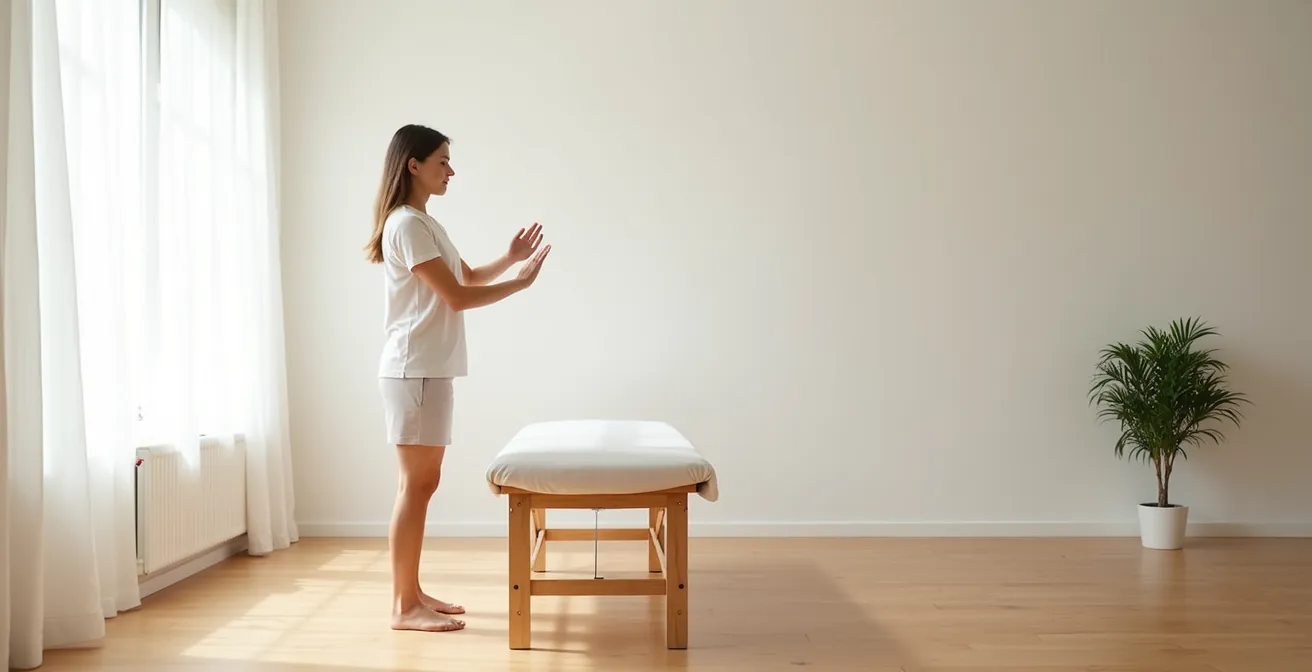
Notice how the arms are extended but the shoulders are relaxed and down. All the power comes from the legs and core. Mastering this single concept will revolutionize your ability to give a massage that feels both generous and effortless, allowing you to focus on connection rather than exertion.
The Pressure Error Over the Spine That Causes Pain Instead of Relief
There is a sacred, non-negotiable rule in massage: never apply direct, downward pressure on the spine. The spine is a delicate column of individual vertebrae and sensitive nerves, not a solid rod. Pressing directly onto the bony points, known as the spinous processes, doesn’t relieve tension—it creates it. This common mistake is not just uncomfortable; it can be painful and trigger a protective, defensive response in the body.
When you press on bone, the brain interprets it as an impact or threat. In fact, neuroscience research demonstrates that direct pressure on spinous processes triggers an immediate stress response and the release of cortisol. You are, quite literally, stressing your partner out while trying to relax them. The goal is to work on the long, thick muscles that run parallel to the spine, the erector spinae group. These are the muscles that hold tension and ache from poor posture or stress. They are your target, not the bone.
To do this safely and effectively, you must learn to “frame the spine.” Instead of working on top of it, you work alongside it. Use your thumbs, the heels of your hands, or your forearms to apply pressure to the muscular ropes on either side. Think of your hands creating a channel, with the spine resting safely and untouched in the middle. This not only protects your partner but also allows you to address the source of the tension much more effectively.
- Place your thumbs or the heels of your hands about an inch (2-3 cm) to the side of the bony centerline of the spine.
- Use the web between your thumb and index finger to create a “frame” around the spine, ensuring you feel muscle, not bone, under your contact points.
- Apply your gliding pressure only to this soft tissue, never on the hard prominences in the middle.
- Always verbally confirm comfort when working near the spine. A simple, “I’m working alongside your spine now, does this pressure feel good?” is an essential act of care and communication.
In What Direction Should You Stroke to Encourage Blood Return to the Heart?
Every effleurage stroke should have a clear intention and direction. While a random back-and-forth motion might feel nice, a directional stroke has a profound physiological purpose. The guiding principle for effleurage on the limbs and back is to always direct the main, pressure-bearing part of the stroke towards the heart. This isn’t an arbitrary rule; it’s based on the fundamental design of our circulatory system.
Our veins have a series of one-way valves that prevent blood from flowing backward as it travels from the extremities back to the heart. When you perform a long, gliding stroke up the leg or arm, or up the back, you are mechanically assisting this process, known as venous return. You are gently pushing the deoxygenated blood along its natural pathway, helping to reduce swelling and improve overall circulation. This same upward motion also supports the lymphatic system, which is responsible for clearing metabolic waste from the tissues. As the clinical team at Physio.co.uk explains, “The strokes are performed in an upwards direction so that the flow of blood can be moved towards the heart, improving lymphatic flow and drainage.”
This image artistically depicts the upward flow you are aiming to create with your strokes, helping to visualize the movement of fluid back toward the body’s core.
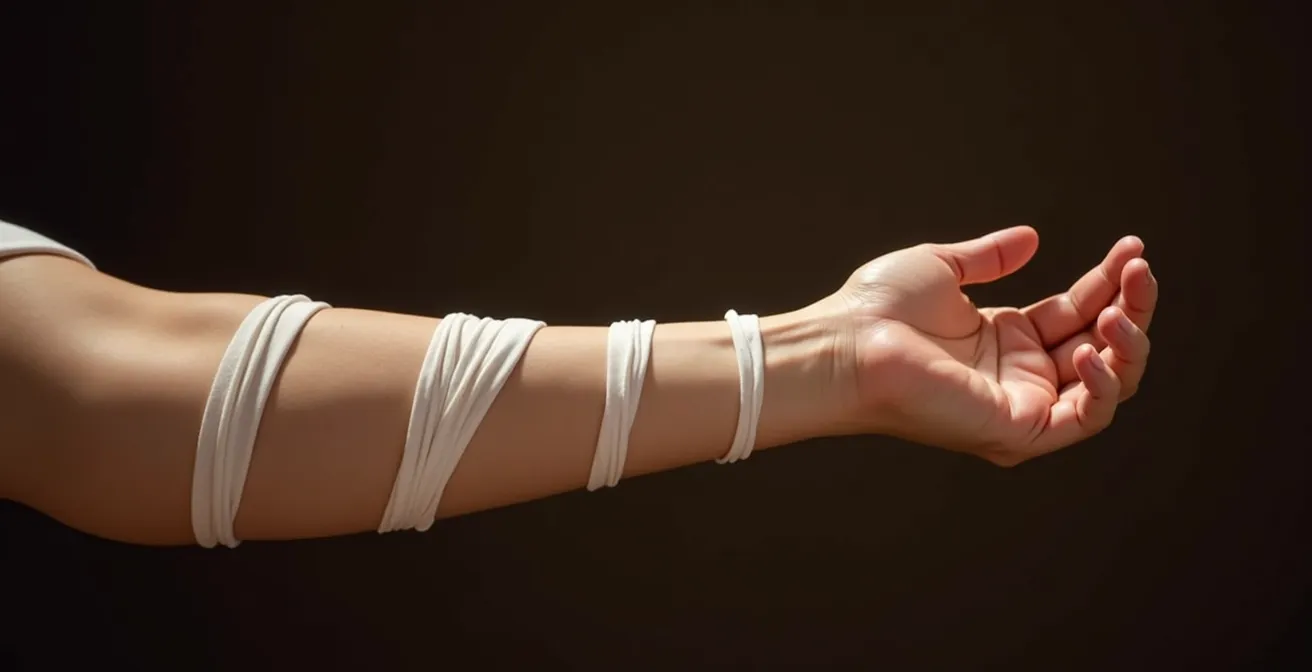
So, what about the return stroke? The return stroke should be exceptionally light, with almost no pressure, or you can even lift your hands off the skin completely to reposition for the next upward glide. The pattern is: pressure up, light touch down. On the back, this means your main strokes travel from the lower back up towards the neck and shoulders. On the legs, you stroke from the ankle towards the hip. On the arms, from the wrist towards the shoulder. This simple directional awareness transforms a pleasant sensation into a therapeutically beneficial action.
Co-regulation or Solitude: Which Is Best for Anxious-Avoidant Pairs?
Touch is profoundly relational. It’s a powerful tool for connection, but its effectiveness can be influenced by our individual attachment styles—the patterns of how we connect with others, often formed in childhood. For couples where one partner has an anxious attachment style (craving closeness, fearing abandonment) and the other has an avoidant style (valuing independence, feeling overwhelmed by too much intimacy), touch can be a tricky landscape to navigate. But effleurage, with its gentle and predictable nature, can be a perfect bridge.
The key concept here is co-regulation. This is the process where one person’s calm, regulated nervous system can help soothe and regulate another’s. As the giver, if you are breathing deeply, moving with a slow and predictable rhythm, and are fully present, you are sending a powerful non-verbal signal of safety. This is especially reassuring for an anxiously attached partner, as the consistent, rhythmic touch provides the steady reassurance they crave without them having to ask for it.
“A calm giver, breathing deeply and using rhythmic strokes, can non-verbally entrain their partner’s nervous system, calming them without a single word being spoken.”
– McGlone et al., Frontiers in Psychology – Affective Touch Research
Case Study: Bridging Attachment Gaps with Touch
For an avoidant partner, who may feel suffocated by demands for intimacy, the non-demanding nature of effleurage is its greatest strength. It is a form of touch that gives without asking for anything in return. Research from Linköping University on touch and attachment styles highlights this. The study found that consistent, predictable touch patterns were highly effective at regulating individuals with different styles. Specifically, starting with less intimate areas like the hands or feet, and using non-verbal communication (the touch itself) was a successful strategy for helping avoidant partners feel safe and receptive. The act of massage becomes a space where connection is offered freely, reducing the pressure that can cause an avoidant partner to withdraw.
In this context, massage is not solitude; it is a shared experience of co-regulation. It creates a third space where both partners’ needs can be met simultaneously. The anxious partner receives the consistent, calming contact they need, and the avoidant partner can receive affection in a structured, non-demanding way that respects their need for space.
Why Gentle Strokes Reduce Cortisol More Effectively Than Painful Ones?
There’s a pervasive myth in massage: “no pain, no gain.” Many believe that for a massage to be effective, it must be deep, intense, and even a little painful to “work out the knots.” But when the goal is relaxation and stress reduction, modern neuroscience tells us the exact opposite is true. Gentle, soothing strokes are biochemically more effective at reducing stress than painful ones.
The reason lies again with our friends, the C-tactile (CT) afferents. As we’ve learned, these nerves are specifically tuned to the pleasure of gentle touch. They are the physiological pathway for affection and social bonding. When these nerves are activated by slow, gentle effleurage, they send signals to the brain’s insular cortex, a region involved in emotional processing. This activation has a direct dampening effect on the body’s stress response. It tells the amygdala (the brain’s alarm center) to stand down and reduces the production of the stress hormone, cortisol.
In contrast, painful pressure bypasses this system entirely. It activates a different set of nerve fibers—the nociceptors, or pain receptors. This sends a warning signal to the brain, which can actually increase cortisol and muscle guarding, defeating the entire purpose of a relaxation massage. While deep tissue work has its place for specific muscular issues (and should be done by a professional), for at-home partner massage focused on bonding and stress relief, gentle is king. The sheer density of these pleasure-sensing nerves is astounding; recent neurophysiology research shows that up to 40% of our cutaneous nerve branches consist of these afferents. Your skin is literally built to respond to gentle, caring touch.
Key Takeaways
- The primary goal of partner effleurage is to signal safety to the nervous system, not to apply force to muscles.
- Your own posture and calm presence as the giver are critical, as your nervous system state helps co-regulate your partner’s.
- Always direct strokes toward the heart to support circulation, and never apply direct pressure on the spine.
How Hot Stones Melt Tension in Dense Muscle Tissue Without Deep Pressure
What if you want to provide a deeper sense of release for your partner’s dense, tight muscles—like in the shoulders or upper back—without resorting to painful, deep pressure that you aren’t trained to give? The answer is heat. Using warm stones is a safe and incredibly effective way to amplify the power of your effleurage strokes, allowing you to melt tension rather than fight it.
Heat works through a process called vasodilation. When the warm stone touches the skin, it causes the blood vessels in that area to widen. This increases the flow of fresh, oxygenated blood to the muscle tissue, which helps to flush out metabolic waste and deliver nutrients. More importantly, the heat has a direct effect on the muscle fibers and fascia, encouraging them to relax and release their grip. It’s like giving the muscle a warm bath from the inside out. A muscle that is warmed is much more pliable and willing to let go of tension.
Instead of just placing stones on your partner, you can use them as an extension of your hands. After applying oil, hold a warm, smooth stone in your palm and use it to perform your effleurage strokes. The combination of sustained heat and gentle, gliding pressure is profoundly relaxing. The weight of the stone does the work for you, allowing you to achieve a “deeper” feeling of release without any extra physical effort or risk of injury. It’s the ultimate “less is more” technique, providing significant therapeutic benefit through pure warmth and gentle movement.
To try this at home safely, follow these essential steps:
- Heat smooth river stones in a slow cooker or a pot of water to between 120-130°F (49-54°C). Use a kitchen thermometer to be precise; never guess.
- Always test the stone’s temperature on your own inner forearm before placing it on your partner. It should be pleasantly warm, not uncomfortably hot.
- Make sure you have applied massage oil to the skin first; never use a dry stone on dry skin.
- Keep the stones moving. Use them for gliding effleurage motions. Avoid leaving a static stone on the spine or any bony area for an extended period.
- Create a wonderful sensory contrast by alternating between strokes with the warm stone and strokes with your bare hands.
Mastering effleurage is a journey, not a destination. It’s a practice of presence, listening, and responding. By focusing on this single, foundational stroke, you are learning more than a massage technique; you are learning a new way to communicate care. Start with one principle from this guide—perhaps focusing on your lunge stance, or the direction of your strokes. Let that be your only goal for the next massage you give. As you build confidence, you will find that your hands know what to do, because you will be listening not just with your ears, but with your whole body.