
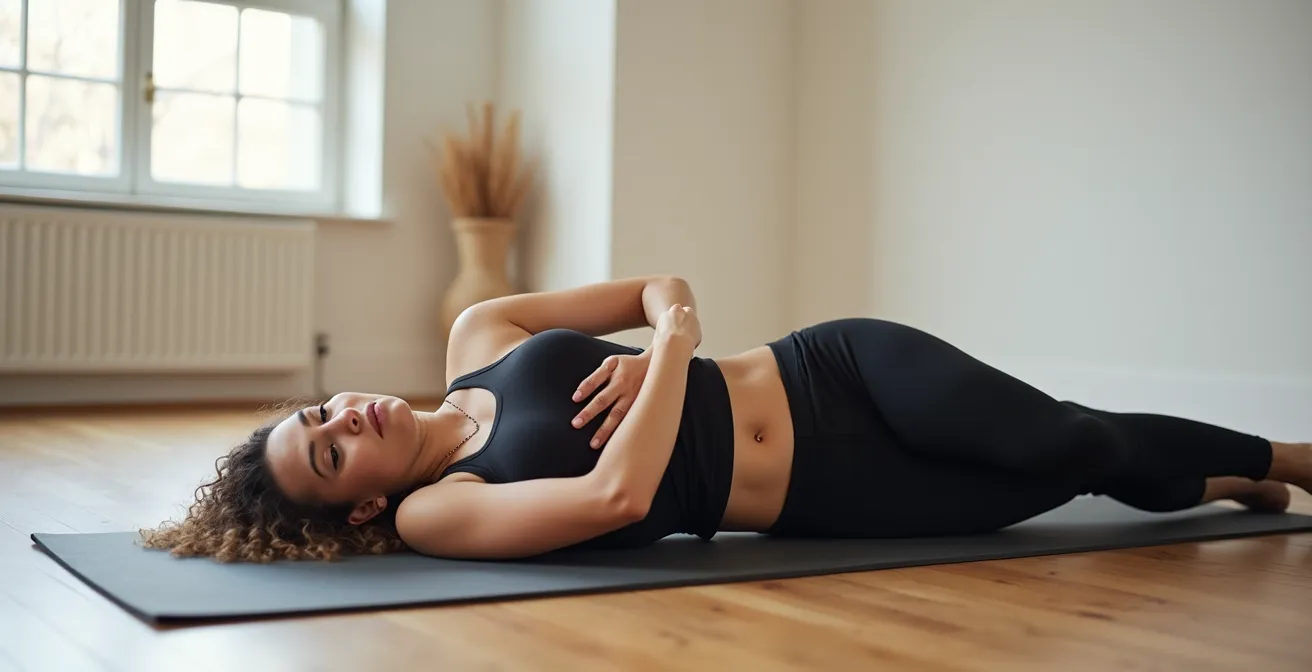
Contrary to popular belief, a six-pack doesn’t prevent back pain. The key is training the deep transverse abdominis (TVA) as an ‘inner corset’ through specific breathing and bracing techniques, not endless crunches. This guide teaches you how to activate this system to build real-world stability that protects your spine from the gym to the grocery store.
You’re diligent. You do your crunches, you hold a plank, and you feel the burn in your abs. Yet, when you bend over to lift a bag of groceries, you feel that familiar, dreaded twinge in your lower back. This frustration is common, and it stems from a fundamental misunderstanding of what a “strong core” truly is. The fitness world often glorifies the visible “six-pack” muscles, the rectus abdominis, but these muscles are not the heroes of spinal protection.
The real guardian of your lower back is a deep, hidden muscle you can’t see in the mirror: the transverse abdominis (TVA). Think of it as your body’s built-in weightlifting belt or an “inner corset.” When functioning correctly, it contracts to create intra-abdominal pressure, stabilizing your lumbar spine from the inside out. The problem is, for many, this muscle is dormant. Years of poor posture, improper breathing, and exercises that focus on spinal flexion (like crunches) have taught it to switch off.
But what if the key to a resilient back wasn’t about more sit-ups, but about re-learning a fundamental movement pattern? This guide will shift your focus from the superficial to the profound. We’re not just going to give you a list of exercises. We’re going to rebuild your core from the ground up by teaching you how to breathe, brace, and move in a way that awakens your TVA. You’ll learn why your six-pack might be a distraction, how to use your breath as your most powerful tool, and how to integrate this newfound stability into every movement you make.
For those who prefer a visual demonstration, the following video from a physical therapist shows you a simple, effective way to find and activate your TVA muscle. It’s a perfect primer for the concepts we’ll discuss.
This article provides a comprehensive roadmap to understanding and training your deep core for genuine, functional strength. We’ll deconstruct common myths and provide practical, evidence-based strategies to build a truly resilient spine. Explore the sections below to master each component of true core stability.
Summary: A Practical Guide to TVA Training for a Pain-Free Back
- Why Six-Pack Abs Don’t Guarantee a Strong Lower Back?
- How to Use Diaphragmatic Breathing to Brace Your Spine During Lifts?
- Static Planks or Dynamic Crunches: Which Is Safer for Discs?
- The Arching Mistake That Shifts Load to Your Spine Instead of Abs
- When to Train Core: Before or After Heavy Compound Lifts?
- Why Sitting for 8 Hours Deactivates Your Glutes and Tightens Hip Flexors?
- Leg Press or Barbell Squat: Which Is Safer for a Bad Lower Back?
- How to Use Pilates to Fix “Tech Neck” and Forward Head Posture
Why Six-Pack Abs Don’t Guarantee a Strong Lower Back?
The pursuit of a visible “six-pack” is often seen as the hallmark of a strong core, but this is a dangerous oversimplification. Those superficial muscles, the rectus abdominis, are primarily “mirror muscles.” Their main job is to flex the spine—to bend you forward. They do very little to provide the deep, segmental stability your lumbar spine needs to resist unwanted movement under load. In fact, research from a comprehensive ultrasound study shows that 31% of adults aged 30-50 experience chronic low back pain related to the dysfunction of a much deeper muscle: the transverse abdominis (TVA).
The TVA is your “inner corset.” It’s the deepest layer of your abdominal wall, and its fibers run horizontally, wrapping around your midsection from your ribs to your pelvis. When it contracts, it cinches your waist and increases intra-abdominal pressure, creating a rigid cylinder that protects your spine. A dysfunctional TVA is like having a weightlifting belt that’s too loose—it offers no support. Over-reliance on crunches can even exacerbate the problem by creating a muscular imbalance, strengthening the spinal flexors while neglecting the crucial stabilizers.
The first step is learning to differentiate between these muscle groups. You need to feel the deep, subtle contraction of the TVA, distinct from the bulging of the rectus abdominis. This simple self-assessment will help you identify what a true TVA contraction feels like, setting the foundation for all subsequent training. It’s not about sucking in, but about a gentle, deep tension.
3-Step TVA vs. Rectus Abdominis Self-Assessment
To feel the difference, lie on your back with your knees bent. Step 1: Place your fingers about two inches inside your hip bones and one inch down; this is where your TVA is located, not your six-pack muscles. Step 2: Cough gently. You should feel a deep tension under your fingertips just before the cough—this is your TVA firing pre-emptively. Step 3: Now, try to recreate that same deep tension without coughing by gently drawing your lower abdomen inward. If you feel your stomach bulging outward into your fingers, you’re primarily using your rectus abdominis.
Understanding this distinction is the most important step toward building a core that is not just aesthetically pleasing, but genuinely functional and protective.
How to Use Diaphragmatic Breathing to Brace Your Spine During Lifts?
The most powerful tool for activating your TVA isn’t an exercise—it’s your breath. Most people are “chest breathers,” using their neck and shoulder muscles for shallow breaths. This pattern fails to engage the diaphragm, the primary muscle of respiration, which works in tandem with the TVA and pelvic floor to create core stability. To protect your spine, you must master diaphragmatic or “360-degree” breathing. This means when you inhale, your entire canister—front, sides, and back—should expand like a balloon.
This creates what’s known as a “brace,” which is fundamentally different from the common cue to “hollow” or “suck your belly button to your spine.” Hollowing deflates the canister, reducing stability and limiting your ability to breathe under load. A brace, on the other hand, involves co-contracting the TVA and other deep core muscles to create a rigid, pressurized cylinder. This is the mechanism that allows powerlifters to squat hundreds of pounds safely. You need to apply the same principle when lifting a box or your child.
The key is to initiate a deep breath that expands your ribcage in all directions, then use the exhale to create tension. This visual demonstrates the goal: not just pushing the belly out, but creating a wide base of support all around your midsection.

As the illustration suggests, the expansion is global. You should feel pressure in your obliques and even your lower back muscles. This turns your entire core into a solid unit. The following sequence breaks down how to translate this breath into a functional brace that you can use before any lift, whether it’s a heavy barbell or a full laundry basket.
Your Action Plan: 4-Step Breathing-Bracing Sequence for Spine Protection
- Inhale: Begin by taking a deep breath in through your nose, focusing on a 360-degree expansion. You should feel your ribcage expand into your sides and your lower back, not just your belly pushing forward.
- Exhale & Engage: Start a slow, controlled exhale through pursed lips while simultaneously and gently drawing your navel toward your spine. This is the moment your TVA contracts.
- Maintain Brace: Hold this deep abdominal tension at about 30% of your maximum effort. You should be able to continue breathing “over the top” of this brace. This is your stable, protective state.
- Lift & Release: Maintain this brace throughout the entire range of motion of your lift. Only release the tension once the weight has been safely returned to its starting position.
This technique transforms breathing from an automatic function into a conscious act of spinal stabilization, forming the bedrock of a truly resilient core.
Static Planks or Dynamic Crunches: Which Is Safer for Discs?
The debate between static holds and dynamic movements is central to modern core training. For individuals with a history of back pain, the choice is clear: prioritize exercises that promote a neutral spine. Dynamic crunches and sit-ups force the spine into repeated cycles of flexion and extension. This movement can place significant pressure on the posterior aspect of your intervertebral discs, potentially leading to irritation or injury over time. It’s a movement pattern we rarely need in daily life and one that does little to train the stabilizing function of the TVA.
Static exercises like the plank, on the other hand, are “anti-extension” exercises. Their goal is to teach your core to *resist* movement and maintain a stable, neutral spinal position against the force of gravity. This directly mimics the primary function of your deep core muscles in everyday life—preventing your spine from buckling when you carry, push, or pull. The continuous isometric contraction required in a plank is a perfect way to build endurance in the TVA and other stabilizers.
The table below clearly outlines why planks are a superior choice for building a foundation of spinal health. They train the core for its true purpose: stabilization, not movement.
| Factor | Static Plank | Dynamic Crunch |
|---|---|---|
| Spinal Position | Neutral (maintains natural curves) | Flexed (rounds spine) |
| TVA Activation | Continuous isometric contraction | Intermittent, often delayed |
| Disc Pressure | Evenly distributed | Concentrated on posterior disc |
| Functional Transfer | High (mimics daily spine stability needs) | Low (rare need for repeated flexion) |
The evidence overwhelmingly supports training the core for stability. By choosing exercises that challenge your ability to hold a neutral position, you build a foundation that translates directly to a safer, more resilient back in all your activities.
Core Stability Training Impact on TVA Activation
The science confirms this approach. A 2017 randomized trial published in the *International Journal of Sports Physical Therapy* provides compelling evidence. The study involved 42 participants and found that the group performing anti-extension exercises like planks showed a 71% improvement in TVA activation ratio. They also demonstrated significantly improved timing of muscle contraction, all while successfully maintaining a neutral spine position during the movements. This highlights how static holds are not just safer, but more effective at teaching the TVA to do its job.
When it comes to protecting your discs, the goal isn’t to move your spine more; it’s to give it the strength to resist unwanted, potentially harmful movement.
The Arching Mistake That Shifts Load to Your Spine Instead of Abs
One of the most common and destructive mistakes in core training is allowing the lower back to arch. This “hyperextension” is a tell-tale sign that your TVA has disengaged and your body is compensating. When you perform an exercise like a leg raise or even a plank, and your TVA isn’t strong enough to maintain a neutral pelvic position, your powerful hip flexors (psoas) take over. They pull on your lumbar spine, causing it to arch, which shifts the load from your abdominals directly onto the delicate joints and ligaments of your spine.
This isn’t just a bad habit; it’s a neurological pattern. As experts Selkow, Eck, and Rivas noted in the *International Journal of Sports Physical Therapy*, this compensation is a hallmark of core dysfunction.
Individuals with LBP have a decrease in TrA activation measured via real-time ultrasound, as well as delayed muscle activation
– Selkow, Eck, and Rivas, International Journal of Sports Physical Therapy
This delayed activation is precisely why your back arches—the TVA doesn’t fire on time to stop it. The goal, then, is not to “push through” the exercise but to stop, correct the arch, and re-engage the TVA. You must teach your body to maintain a posterior pelvic tilt—a slight backward rocking of the hips that flattens the lower back and engages the deep core. This is a non-negotiable foundation for any and all ab exercises.
If you feel your back starting to arch during any movement, it’s a signal to stop immediately. Your body is telling you that the lever is too long for your current level of TVA strength. The solution is to regress the exercise by shortening the lever (e.g., bending your knees) until you can perform the movement with perfect, arch-free form.
Every rep performed with an arched back reinforces a dysfunctional movement pattern. Conversely, every rep performed with a neutral spine retrains your nervous system for safety and strength.
When to Train Core: Before or After Heavy Compound Lifts?
The question of when to schedule core work is a common one in the gym. Should you fatigue your core before heavy lifts like squats and deadlifts, or save it for the end? The answer, according to modern research, is nuanced and depends on your goal. It’s not about one single “core session,” but about two distinct types of core training: activation and strengthening.
Light activation work should be done *before* heavy lifting. The goal here isn’t to cause fatigue, but to “wake up” the TVA and improve the mind-muscle connection. This is about motor control. Performing a few minutes of gentle TVA activation and bracing drills (like the 4-step sequence) primes the nervous system. It ensures your “inner corset” is firing correctly and ready to stabilize your spine when you put it under significant load. Ultrasound measurements reveal that TVA thickness during simultaneous core and pelvic floor contraction increased by 18% after this kind of targeted pre-activation training, indicating a more robust and ready support system.
High-intensity strengthening work should be done *after* heavy lifting, or on a separate day. This includes exercises like loaded planks, rollouts, or heavy carries. Performing these to the point of fatigue *before* a heavy squat would compromise your ability to maintain a stable brace, increasing injury risk. By saving the high-intensity work for afterward, you can push your core to its limits to drive strength and hypertrophy adaptations without negatively impacting the safety of your main lifts.
Two-Phase Core Training Protocol
A 2021 study on 44 patients with chronic low back pain (CLBP) validates this two-phase approach. The study found that a protocol involving light TVA activation exercises (performing a 5-minute session) before the main training significantly improved motor control. Meanwhile, performing high-intensity core work (a 10-minute session) *after* the heavy lifting phase was most effective for maximizing strength gains without compromising the spinal stability required during the compound movements themselves. This demonstrates the wisdom of separating activation from exhaustion.
In short: activate your core to prepare for work, and exhaust it later to make it stronger for next time.
Why Sitting for 8 Hours Deactivates Your Glutes and Tightens Hip Flexors?
Your lower back pain might not be starting in your back at all. For many office workers, the root cause lies in the chair they sit on for eight hours a day. Prolonged sitting creates a double-edged sword of dysfunction. Firstly, it places your hip flexors—the muscles at the front of your hips—in a constantly shortened position. Over time, these muscles become chronically tight, pulling your pelvis into an anterior pelvic tilt. This forward tilt increases the arch in your lower back and effectively disengages your TVA, putting your lumbar spine under constant strain.
Secondly, sitting is the enemy of your glutes. When you sit on your gluteal muscles all day, they are not required to do any work. The constant pressure can also restrict blood flow and dull the neural signals to the area. This leads to a condition sometimes called “gluteal amnesia,” where your brain essentially forgets how to fire these powerful muscles effectively. Since the glutes are primary hip extensors and pelvic stabilizers, their deactivation forces the smaller muscles of your lower back and hamstrings to work overtime, leading to fatigue, strain, and pain.
This creates a vicious cycle: tight hip flexors pull your pelvis forward, and sleepy glutes are too weak to pull it back into a neutral position. Your lower back is caught in the middle. The solution involves both re-activating the glutes and re-establishing the connection to the TVA. A 2023 randomized controlled trial demonstrates that after 12 weeks of targeted TVA and glute activation exercises, office workers showed a 42% reduction in lower back pain scores. To combat the effects of sitting, it’s crucial to integrate small, frequent movement breaks into your day. Simple actions like standing up every hour to perform a posterior pelvic tilt, or consciously squeezing your glutes while seated, can help counteract this postural decline.
Your best posture is your next posture. By frequently breaking up periods of sitting with simple activation drills, you can fight back against the deactivating effects of a desk job and reclaim your core stability.
Leg Press or Barbell Squat: Which Is Safer for a Bad Lower Back?
When navigating the gym with a sensitive lower back, exercise selection is paramount. The leg press machine often seems like the “safer” choice. After all, your back is supported by a pad, removing much of the stability requirement. However, this perceived safety is a trap. The leg press provides so much external stability that it teaches your deep core, including the TVA, to be lazy. It does nothing to train the crucial motor pattern of stabilizing your own spine under load.
Furthermore, the fixed path of the leg press can be problematic. As you lower the weight, many people lack the hip mobility to maintain a neutral pelvis, resulting in “butt wink”—where the lower back rounds and lifts off the pad. This rounding under heavy load places immense flexion stress on the lumbar discs. The barbell squat, while technically more demanding, is a far superior functional exercise. It forces your TVA and other core stabilizers to work maximally to keep your torso upright and your spine neutral. It trains your body as an integrated system, which has a much higher carryover to real-world activities like lifting a heavy box.
Of course, this is only true if the squat is performed with perfect form. The key is progression. You must earn the right to add weight by first mastering a bodyweight squat, ensuring you can maintain a neutral spine and active TVA throughout the entire movement. This table summarizes the critical differences:
| Assessment Factor | Leg Press | Barbell Squat |
|---|---|---|
| External Stability | High (machine-supported) | Low (self-stabilized) |
| TVA Activation Requirement | Minimal | Maximal |
| Risk of Butt Wink | High at bottom position | Moderate (form-dependent) |
| Functional Carryover | Low | High |
| Recommended Progression | Use for hypertrophy only | Master bodyweight first, then load |
For long-term back health, choose the exercise that teaches your body to create its own stability. Don’t rely on a machine to do the job that your transverse abdominis was designed to do.
Key takeaways
- Your “inner corset” (TVA) is for stability; your “six-pack” (rectus abdominis) is for flexion. Prioritize the TVA for back health.
- Master 360-degree diaphragmatic breathing to create a solid brace before any lift. This is non-negotiable for spinal protection.
- Choose static, neutral-spine exercises like planks over dynamic flexion exercises like crunches to build functional core endurance and protect your discs.
How to Use Pilates to Fix “Tech Neck” and Forward Head Posture
The stability of your spine doesn’t stop at your lower back. Your body is a kinetic chain, where dysfunction in one area can create problems far away. A prime example of this is the connection between “tech neck” and core weakness. Forward head posture, a hallmark of our screen-obsessed culture, isn’t just a neck problem; it’s a full-body postural issue that is often linked to a disengaged core. When your head juts forward, your upper back rounds to compensate, and your pelvis often tilts anteriorly, deactivating your TVA.
This creates a full-spine kinetic chain disruption. A groundbreaking 2024 study of 849 chronic back pain patients reinforces this link, finding that individuals with forward head posture showed an equal prevalence of diastasis recti (a condition signifying profound TVA weakness) in both men and women. This suggests that the postural collapse starts deep in the core and manifests all the way up the chain to the head and neck. Treating the neck in isolation is like trying to fix a leaning tower by only painting the top floor.
This is where principles from Pilates become incredibly valuable. Pilates emphasizes axial elongation—the concept of creating space between each vertebra—and initiating all movement from a strong, engaged core. Instead of isolating muscles, it teaches the body to move as an integrated whole. Exercises like the “Swan Prep” train you to engage your TVA *first*, then use your deep neck flexors and upper back extensors together to lift, correcting forward head posture from the bottom up. The focus is on quality of movement and maintaining TVA activation throughout, which directly counteracts the postural collapse of “tech neck.”
Integrated Core-to-Neck Rehabilitation
The 2024 study on back pain patients highlights the necessity of an integrated approach. The findings strongly suggest that rehabilitation for postural issues like forward head posture must include core stabilization work. Simply stretching the neck or strengthening the upper back is insufficient if the foundational support from the TVA and pelvic floor is missing. Effective, long-term correction requires a strategy that restores function to the entire kinetic chain, from the deep core all the way up to the cervical spine.
Stop thinking about your core and neck as separate parts. Start training them as the interconnected system they are. By focusing on axial elongation and core-first movement, you can begin to unwind years of postural strain and build a spine that is strong and stable from your pelvis to the top of your head.