
That persistent ache at the base of your skull, the tension radiating across your shoulders, and the nagging headaches are the all-too-familiar companions of the modern remote worker. This constellation of symptoms, often bundled under the term “tech neck,” is a direct consequence of hours spent hunched over a laptop. The common advice is to stretch your neck and chest, but for many, this provides only fleeting relief. The pain always returns because these stretches only address the symptoms, not the root of the problem.
The issue is not just local; it’s a systemic failure of your body’s support structure. The forward head posture you see in the mirror is the final link in a chain reaction of postural collapse that begins much lower down, in your hips and glutes. While many focus on the visible strain in the cervical spine, they ignore the foundational weakness that allows the entire structure to fall forward in the first place. The real culprit is a deactivated posterior chain and a network of “stuck” connective tissue, or fascia, that holds the body in this compromised position.
But what if the solution was not to pull your head back, but to rebuild its foundation from the ground up? This is the core principle of the Pilates method. It moves beyond simple stretching to re-educate your body’s proprioceptive awareness and reactivate the deep stabilizing muscles that form your true support system. Instead of fighting gravity, you learn to work with it, creating length and space where there was once compression and pain.
This article will guide you through the precise, anatomical approach of Pilates to dismantle tech neck. We will explore why your glutes are the key, how to decompress your spine, and why stretching alone often fails. You will learn how to reverse this postural decline not by focusing on the neck, but by re-establishing a powerful and intelligent core that supports your entire structure, from your pelvis to the crown of your head.
This guide provides a clear roadmap to understanding and correcting the underlying mechanics of forward head posture. We’ll break down the problem from its source and build up the solution, one precise movement at a time.
Summary: A Pilates-Based Approach to Correcting Forward Head Posture
- Why Sitting for 8 Hours Deactivates Your Glutes and Tightens Hip Flexors?
- How to Decompress Your Spine in 15 Minutes Before Bed?
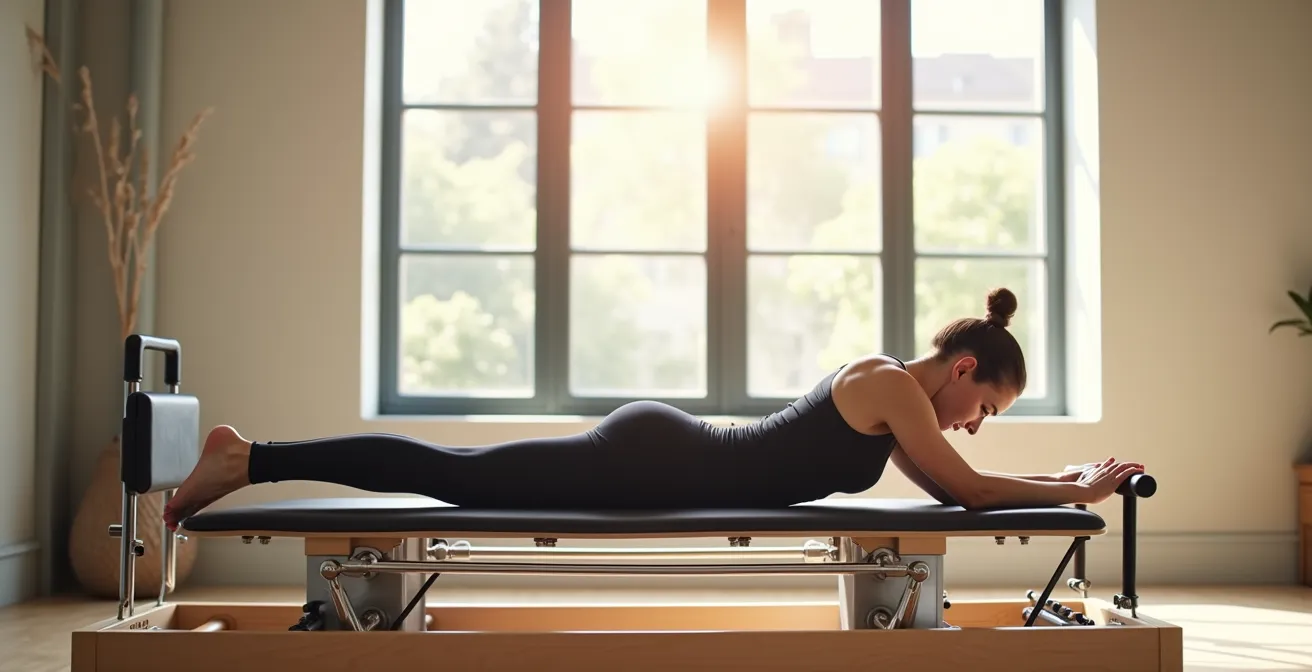
- Mat Work or Reformer Machine: Which Fixes Posture Faster?
- The Mistake of Stretching Tight Hamstrings That Are Actually Weak
- How to Do Invisible Pilates Moves During Zoom Calls?
- Why Stretching Muscles Won’t Fix Pain Located in the Connective Tissue?
- How to Release “Stuck” Fascia to Improve Mobility in stiff Shoulders
- How to Create a 5-Year Health Roadmap Based on Your Risk Profile
Why Sitting for 8 Hours Deactivates Your Glutes and Tightens Hip Flexors?
The origin of forward head posture is rarely in the neck itself. It begins in the chair. When you sit for prolonged periods, your body adapts to that position. The hip flexor muscles at the front of your pelvis are held in a shortened, contracted state, while the gluteal muscles—the powerful extensors of your posterior chain—are lengthened and inactive. This phenomenon is known as reciprocal inhibition: when one muscle group is chronically tight, its opposing group becomes neurologically inhibited, or “switched off.”
This imbalance creates a devastating chain reaction. With the glutes dormant, the body loses its primary engine for pelvic stability. To compensate, the hamstrings and lower back muscles become overworked, leading to a forward tilt of the pelvis (anterior pelvic tilt). This tilt forces the lumbar spine into an exaggerated curve, which then causes the thoracic spine (upper back) to round excessively forward (hyperkyphosis). To keep your eyes level with the horizon, your body’s final compensation is to jut the head forward and upward, placing immense strain on the cervical spine. Your “tech neck” is simply the last domino to fall in this pattern of systemic postural collapse.
Therefore, any attempt to fix forward head posture by solely focusing on the neck is futile. The primary intervention must be to break this cycle at its source: reactivating the glutes and restoring a neutral pelvic position. This is a foundational principle in Pilates, where every movement is initiated from a stable and engaged core, with the glutes playing a central role in supporting the entire spinal column.
Your Action Plan: 5 Steps to Reactivate Glutes Through Pilates
- Step 1: Start with neutral spine awareness – Find your comfortable lumbar position without forcing zero lordosis.
- Step 2: Practice precise glute contractions – Focus on isolating the gluteus maximus without compensating with hamstrings.
- Step 3: Progress to bridge exercises – Engage core first, then lift pelvis using glute strength.
- Step 4: Add resistance progressively – Begin bodyweight for 15 reps, then add bands or weights after 3 weeks.
- Step 5: Integrate into functional movements – Apply glute activation to standing and walking patterns.
How to Decompress Your Spine in 15 Minutes Before Bed?
After a day spent compressing your spine in a seated position, a targeted decompression routine before bed can be transformative. The goal is not aggressive stretching, but creating gentle, active length through the spinal column to counteract the effects of gravity and poor posture. This helps to hydrate the intervertebral discs, release tension in the deep spinal muscles, and calm the nervous system, preparing the body for restorative sleep.
Pilates offers several movements designed for this very purpose. The key is to focus on axial elongation—the sensation of lengthening from the tailbone to the crown of the head. This is an active process, not a passive collapse into a stretch. Movements should be slow, controlled, and coordinated with the breath. The exhale is used to deepen the flexion or extension, allowing the vertebrae to gently separate and create space.
A simple yet highly effective exercise is the Spine Stretch Forward. It focuses on sequential articulation, encouraging you to move one vertebra at a time. This mindful movement re-educates the neuromuscular pathways responsible for spinal mobility. To perform it, you create a “C-curve” with your spine, scooping the abdominals in and up to support the lower back as you reach forward. The emphasis is on the quality of the spinal curve, not how far you can reach.

As the image demonstrates, this movement is about creating a deep, rounded shape in the spine. This gentle flexion opens up the posterior aspect of the vertebral joints, relieving the compressive load built up during the day. Integrating a 15-minute routine of such movements can significantly reduce stiffness and improve sleep quality, making it a crucial tool for any desk worker.
Mat Work or Reformer Machine: Which Fixes Posture Faster?
When embarking on a Pilates journey to correct posture, a common question arises: is it better to start with mat work or on the Reformer? While both are powerful tools, they offer different benefits, particularly in the initial stages of postural re-education. There is no single “faster” method; rather, there is a more strategic approach depending on the individual’s needs and body awareness.
Mat work is the foundation of the Pilates system. It challenges your body using its own weight and gravity as resistance. This requires a high degree of intrinsic body awareness and core control from the very beginning. For a beginner struggling with proprioception (the sense of where their body is in space), it can be difficult to find correct alignment without external feedback. However, the skills learned on the mat are directly transferable to daily life, making it the ultimate tool for long-term maintenance and integration.
The Reformer, on the other hand, uses a system of springs, straps, and a moving carriage to provide both assistance and resistance. For someone with significant postural imbalances like tech neck, the springs offer invaluable proprioceptive feedback. They guide the body into correct alignment, support it through challenging ranges of motion, and make it easier to isolate and activate specific muscles (like the deep neck flexors or lower trapezius). This external feedback can accelerate the initial learning phase, helping the brain to quickly understand what correct alignment feels like.
The following table, based on an insightful comparison for tech neck, outlines the key differences to help you decide on the best starting point for your postural journey.
| Aspect | Mat Work | Reformer |
|---|---|---|
| Proprioceptive Feedback | Relies on body awareness alone | Springs provide tactile cues for alignment |
| Portability | Completely portable, practice anywhere | Studio-based, requires equipment |
| Learning Curve | Harder initially without feedback | Faster initial progress with spring assistance |
| Cost | Minimal (mat only) | Higher (studio membership required) |
| Best For | Phase 2: Integration & maintenance | Phase 1: Education & alignment learning |
The Mistake of Stretching Tight Hamstrings That Are Actually Weak
One of the most common complaints among people with desk jobs is “tight” hamstrings. The instinctive response is to stretch them aggressively. However, in the context of postural collapse caused by prolonged sitting, this can be a significant mistake. The sensation of tightness you feel is often not due to a shortened muscle that needs lengthening, but rather a symptom of a weakened muscle held in a constant state of protective tension.
As established, chronic sitting deactivates the glutes. When the powerful gluteus maximus isn’t doing its job to stabilize the pelvis and extend the hip, the hamstrings are forced to work overtime to assist in these roles—a job for which they are not designed. They are in a state of constant low-grade contraction to prevent the pelvis from tilting too far forward. This neurologically facilitated tension makes them feel tight. Stretching them provides temporary relief by overriding this signal, but as soon as you stand up, the brain, sensing the lack of gluteal support, will tighten them right back up to protect the spine.
The true solution is not to stretch the hamstrings, but to strengthen them in synergy with the glutes. The goal is to restore the proper lumbar-pelvic rhythm, where the glutes are the primary hip extensors and the hamstrings act as assistants. Pilates exercises like the Bridge or Leg Circles focus on this coordinated activation. By strengthening the glutes, you allow the hamstrings to finally “let go” of their protective tension. As research on pelvic stability reveals, the gluteus maximus muscle is involved in every activation pattern for correcting these imbalances. True flexibility in the hamstrings is achieved not through passive stretching, but through functional strength in the entire posterior chain.
How to Do Invisible Pilates Moves During Zoom Calls?
One of the biggest challenges for remote workers is finding time for movement during a packed schedule of back-to-back virtual meetings. The solution lies in integrating subtle, “invisible” Pilates exercises into your workday. These are not full-body movements but micro-activations that retrain postural muscles without anyone on the other side of the screen noticing. They serve to counteract the static load of sitting and maintain neuromuscular engagement throughout the day.
The focus of these movements is on the deep stabilizing system of the torso and cervical spine. Unlike larger, more obvious exercises, these techniques are about precision and internal awareness rather than external motion. They can be practiced while listening in a meeting, reading an email, or waiting for a call to start. Consistent practice of these micro-movements helps to build postural endurance, making it easier to maintain an upright position for longer periods without fatigue or strain.
These small adjustments are powerful because they target the exact muscles that become dormant during prolonged sitting. They prevent the body from “sinking” into a passive, collapsed posture and instead promote a state of active, supported sitting. The following techniques can be seamlessly woven into your desk-bound hours, transforming your chair into a tool for postural re-education.
- Practice ‘Centering’: Engage your deep core muscles by gently drawing your navel toward your spine. This is a subtle hollowing action, not a forceful “sucking in,” and is completely invisible to the camera.
- Apply ‘Axial Elongation’: Imagine a string pulling gently from the crown of your head toward the ceiling, creating a sense of length through the entire spine without any visible movement.
- Use ‘Ribcage Breathing’: Focus on breathing laterally into the back and sides of your ribcage. This prevents the collapse of the thoracic spine and maintains space in the upper body.
- Perform ‘Micro Chin Tucks’: Subtly glide your head backward by about 5mm, as if making a slight double chin. This tiny movement activates the deep neck flexors that support the head, directly counteracting forward head posture.
- Maintain ‘Active Sitting’: Gently and slowly alternate your weight distribution between your left and right sit bones every 10 minutes. This engages the deep core stabilizers and prevents pelvic stagnation.
Why Stretching Muscles Won’t Fix Pain Located in the Connective Tissue?
If you’ve tried traditional stretching for your neck and shoulder stiffness with little to no lasting effect, you are likely targeting the wrong tissue. While muscle pain often feels like a specific, localized “pull,” the chronic, diffuse stiffness associated with tech neck is frequently rooted in the fascia—the body’s web of connective tissue. Fascia surrounds and interpenetrates every muscle, bone, and organ, providing the body with its structural integrity.
Muscles are primarily ‘elastic’ tissue; they are designed to stretch and return to their original length. Fascia, however, is ‘plastic’ tissue. When subjected to prolonged static positions, like hunching over a desk, the layers of fascia can become dehydrated, “stuck” together, and lose their ability to glide smoothly over one another. This creates adhesions and restrictions that limit mobility and cause a sensation of deep, unyielding stiffness. Static stretching, which provides a brief, high-load pull, only affects the elastic component of the muscle-fascia unit. It does little to remodel the plastic nature of the restricted fascia, which is why the relief is so temporary.
To release fascial restrictions, a different approach is required. Fascia responds to slow, sustained pressure and multi-planar movement. As one study notes, “Chronic understretch is associated with increased passive muscle stiffness. However, regular exercise involving stretch-shorten cycles, like walking, could offset prolonged sitting effects,” as confirmed by research on prolonged sitting. Pilates excels in this area by incorporating rotational, three-dimensional movements that pull and shear the fascial layers from multiple angles, promoting rehydration and restoring glide. This is the key to unlocking true, lasting mobility, rather than just temporarily elongating an elastic muscle.
Chronic understretch is associated with increased passive muscle stiffness. However, regular exercise involving stretch-shorten cycles, like walking, could offset prolonged sitting effects.
– ScienceDirect Research Team, Prolonged sitting and physical inactivity study
How to Release “Stuck” Fascia to Improve Mobility in stiff Shoulders
Releasing fascial restrictions in the shoulders and upper back requires a move away from linear, static stretching and toward dynamic, multi-dimensional movement. The goal is to create a “wringing out” effect on the connective tissue, encouraging layers to glide over one another again and rehydrating the tissue matrix. This restores mobility not by forcing a range of motion, but by removing the underlying “stuckness” that was blocking it.
Pilates provides an ideal toolkit for this type of fascial remodeling. Exercises are often rotational and incorporate the entire body, addressing the long fascial lines that connect the shoulders to the torso and pelvis. The movements are performed with control and fluidity, which provides the slow, sustained load that fascia responds to. Unlike isolated stretching, these integrated movements teach the shoulder girdle how to move in coordination with the ribcage and spine, which is essential for healthy, functional mobility.
A well-designed sequence will start with gentle preparatory movements to bring awareness and warmth to the area, then progress to larger, more complex patterns. The focus should be on the sensation of “melting” or “unsticking” rather than pushing into pain. Using tools like a foam roller can also provide the sustained pressure needed to release trigger points and dense areas of fascia. Here is a simple yet effective sequence to begin releasing fascial tension around the shoulder girdle.
- Start with foam roller behind neck: Lie on your back with a foam roller supporting your neck. Let your head rest back into a gentle extension and slowly turn your head from side to side for 30 seconds to release the suboccipital fascia.
- Perform arm circles: Standing or lying down, perform large, slow, full-range arm circles in both directions. Imagine you are “scooping” the air to encourage full rotation within the shoulder socket.
- Add spine twists: In a seated or supine position, perform gentle spinal rotations. This addresses the fascial layers that wrap around the torso and connect to the scapulae.
- Practice ‘Swimming’ exercise: Lying on your stomach, lift your chest slightly off the floor and perform alternating arm and leg lifts. This creates a beautiful fascial glide across the entire posterior chain and shoulder girdle.
- Finish with chest opener: Lie over a foam roller placed vertically along your spine. Open your arms out to the sides and let gravity provide a gentle, sustained stretch to the pectoral fascia.
Key Takeaways
- “Tech Neck” is a symptom of whole-body postural collapse, starting with inactive glutes from prolonged sitting.
- Lasting correction requires reactivating the posterior chain (glutes) and strengthening the core, not just stretching the neck.
- Chronic stiffness is often caused by restricted fascia (connective tissue), which requires multi-dimensional movement to release, not static stretching.
How to Create a 5-Year Health Roadmap Based on Your Risk Profile
Correcting tech neck is not a one-time fix; it’s the first step in creating a long-term strategy for postural health. Viewing your posture through the lens of a 5-year roadmap transforms your efforts from reactive pain management to proactive health investment. This approach requires identifying your specific risk profile—dominated by sedentary desk work—and implementing a sustainable plan that addresses not just current symptoms but future vulnerabilities.
The consequences of inaction are significant. As some research predicts that children and adolescents are predicted to have osteopenia by age 40 due to the cumulative strain of forward head posture from device use. For today’s remote workers, this timeline is accelerated. Your roadmap must therefore be built on a foundation of consistent, intelligent movement that continually counteracts the compressive forces of your work environment.
The Efficacy of a Long-Term Pilates Practice
The value of this long-term approach is well-documented. A 2024 systematic review found that Pilates significantly improves postural alignment, spinal mobility, and muscle balance. Researchers noted that consistent practice helps retrain how the body supports itself against gravity, reducing neck and back tension while improving overall stability and control. This demonstrates that a sustained Pilates practice is not just exercise, but a method for progressively remodeling the body’s structural integrity over time.
Your 5-year plan should include phases: an initial corrective phase (3-6 months) focused on re-educating movement patterns and activating dormant muscles; a strengthening phase (Year 1-2) to build resilience and endurance in your new posture; and a maintenance and optimization phase (Year 3-5) where the focus shifts to integrating more complex, dynamic movements and maintaining postural health as a baseline habit. This long-term vision ensures that the gains you make today are not lost tomorrow, protecting your spine for decades to come.
Frequently Asked Questions on Fixing Tech Neck with Pilates
How can I tell if my pain is fascial or muscular?
Muscle pain typically feels like a pulling sensation at the muscle belly and responds to immediate stretching. Fascial restrictions feel like stiffness or ‘stuckness’ that requires sustained pressure to release.
Why doesn’t static stretching help fascial pain?
Fascia is ‘plastic’ tissue requiring slow, sustained load to remodel, while muscles are ‘elastic’ and return to original length. Static stretching only provides temporary relief to the elastic component.
What type of movement helps fascial health?
Multi-planar, rotational movements like those in Pilates are essential for releasing fascial layers, as opposed to linear stretching which only addresses one dimension.