
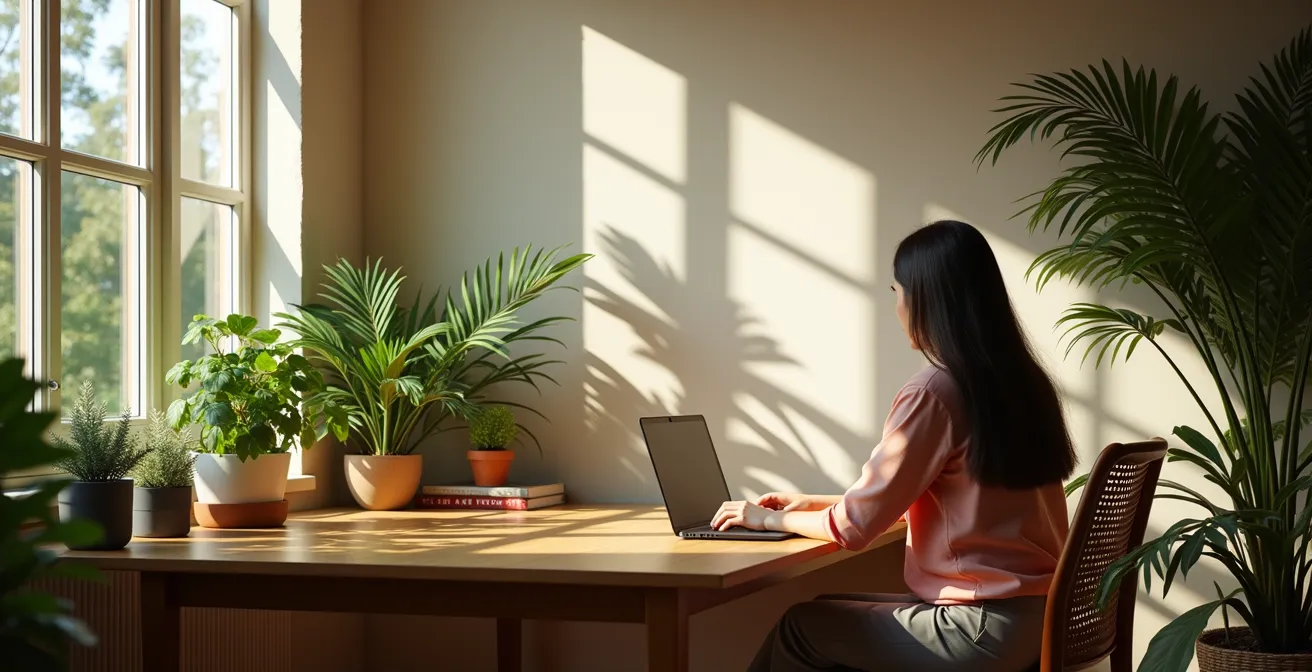
The key to productivity isn’t more discipline; it’s an environment that aligns with your evolutionary biology.
- Sterile, unnatural office spaces create a constant, low-grade stress that drains cognitive resources and fragments attention.
- Integrating specific biophilic elements—like fractal patterns and dynamic natural light—measurably reduces stress and enhances the brain’s capacity for deep work.
Recommendation: Stop decorating and start engineering. Intentionally modify your workspace with the science-backed principles in this guide to create an environment that actively supports, rather than sabotages, your focus.
The persistent hum of your computer, the flat white walls, the unchanging artificial light—this is the reality for many remote workers. We strive for productivity in sterile boxes, feeling inexplicably drained and distracted. The common advice is to simply add a plant or two, a token gesture of green in a digital desert. But this approach barely scratches the surface of a profound biological conflict: the evolutionary mismatch between our ancient brains and our modern workspaces.
Our species evolved over millennia surrounded by the complex, dynamic, and sensory-rich information of the natural world. Our cognitive functions are finely tuned to respond to these stimuli. When we strip them away, we force our brains into a state of chronic, low-level stress, constantly searching for the natural signals they are wired to expect. This isn’t just about aesthetics; it’s about cognitive load. A sterile environment is not a neutral backdrop; it is an active stressor that depletes our capacity for focus and creative thought.
But what if the solution wasn’t to fight our nature with more discipline, but to align our environment with it? This is the core premise of biophilic design. It’s not about interior decorating; it’s a design discipline rooted in evolutionary psychology and neuroscience. The true key to unlocking focus is to stop treating nature as an afterthought and start using it as an engineering tool. This guide will move beyond the platitudes and show you how to strategically integrate specific biophilic elements to reduce cognitive strain and reclaim your innate ability for deep, sustained work.
For those who prefer a visual format, the following video offers a great immersion into the core concepts and feelings behind creating these nurturing environments, perfectly complementing the practical strategies discussed in this guide.
This article provides a structured approach to transforming your home office. We will explore the science behind why natural elements affect us, provide practical guidance on choosing and maintaining them, and offer a clear framework for modifying your environment to support not just your well-being, but your peak performance.
Summary: A Practical Framework for a Biophilic Home Office
- Why Looking at Wood Grain Patterns Lowers Stress Levels?
- How to Choose Plants That Thrive in Dark Corners of Your Office?
- Vertical Gardens or Pots: Which Is More Maintainable for Busy Pros?
- The Mistake of Using Plastic Plants That Gather Dust and Look Cheap
- When to Look at Your Plants: The 20-20-20 Rule Adaptation
- How to Find “Micro-Wilderness” in a Concrete Jungle for Lunch Breaks?
- HEPA Filters or Houseplants: Which Actually Removes VOCs Effectively?
- How to Modify Your Home Environment to Reduce Chronic Inflammation Risks
Why Looking at Wood Grain Patterns Lowers Stress Levels?
The calming effect of a wood-grain desk or a view of a tree is not a coincidence; it’s a biological response known as fractal fluency. Fractals are self-repeating patterns found everywhere in nature—from the veins of a leaf and the branches of a tree to the intricate swirls in a piece of timber. Our brains evolved to process these patterns with remarkable efficiency. Unlike the stark, simple geometry of a blank wall, which can be visually boring and even subtly stressful, natural fractals engage our visual system in a way that is both stimulating and effortless.
This effortless processing induces a state of relaxed alertness. In fact, EEG research demonstrates that viewing fractals with specific dimensions, similar to those found in nature, can increase alpha brain waves—the same waves associated with a calm, meditative state and inward focus. When you glance at the grain of your wooden desk, you are giving your brain a micro-dose of this restorative visual information, momentarily lowering your cognitive load and reducing stress without you even realizing it. This isn’t just theory; it’s a principle being applied in commercial design to create verifiably less stressful environments.
Case Study: Relaxing Floors by Mohawk Group
In a powerful real-world application of this principle, the Mohawk Group collaborated with scientific labs to translate natural fractal patterns into commercial flooring designs. These designs were not just aesthetically pleasing; they were engineered to be “human-focused.” The resulting product line won ten awards, demonstrating that the strategic use of biophilic patterns can create spaces that are measurably more intriguing and restorative. This project confirms that even on a surface as common as a floor, as detailed in a human-focused design analysis, fractal patterns can be exploited to enhance well-being.
Therefore, choosing a desk with a visible wood grain, adding a moss wall, or even using a high-quality nature photograph with fractal elements is a direct tool for stress management. It’s an environmental intervention that helps regulate your nervous system throughout the workday.
How to Choose Plants That Thrive in Dark Corners of Your Office?
One of the most common hurdles in creating a biophilic office is the lack of natural light. Many home offices are relegated to basements, spare rooms with small windows, or corners far from direct sun. The good news is that nature has already solved this problem. Many plant species have evolved to thrive in the low-light conditions of a forest understory, making them perfectly suited for the dimmer parts of your workspace. Choosing the right plant isn’t about forcing a sun-loving species to survive; it’s about matching the plant’s natural habitat to your office’s environment.
For these low-light zones, you need plants that are not only tolerant of shade but also resilient to the occasional neglect that comes with a busy work schedule. Below is a list of exceptionally tough plants, categorized by their resilience, that are known to perform well in typical office lighting conditions. These species are your best allies in greening up a challenging space.

As you can see in the image above, even a dimly lit corner can become a vibrant focal point with the right selection of plants. Species with broad, dark green leaves are often adapted to capture as much ambient light as possible. Here are some of the most reliable choices for your office:
- Snake Plant (Sansevieria): The ultimate survivor. It tolerates very low light and infrequent watering (every 3-4 weeks is often enough). Its vertical leaves also have a small footprint, ideal for tight spaces.
- ZZ Plant (Zamioculcas zamiifolia): Famous for being nearly indestructible, the ZZ plant has waxy, deep green leaves and requires watering only about once a month. It actively thrives on neglect.
- Pothos (Epipremnum aureum): Often called Devil’s Ivy, this vining plant is incredibly forgiving. Its leaves will visibly droop when it needs water, providing a clear signal, and it adapts well to a range of low to medium light conditions.
- Spider Plant (Chlorophytum comosum): A classic for a reason. It’s highly adaptable and known for its air-purifying qualities. It also produces “pups” that can be easily propagated, allowing you to expand your indoor garden for free.
Vertical Gardens or Pots: Which Is More Maintainable for Busy Pros?
When deciding how to integrate plants, busy professionals often face a choice between a large, impressive vertical garden and a collection of individual pots. The decision shouldn’t be based on aesthetics alone, but on an honest assessment of cognitive load and maintenance style. While a living wall can be a stunning centerpiece, it represents a single, complex system. Individual pots offer a more modular and forgiving approach.
A vertical garden, especially one with an integrated irrigation system, requires periodic but high-effort technical checks. You have to monitor pumps, check for clogs, and ensure the system is functioning correctly. A failure in this single system can jeopardize dozens of plants at once, creating a high-risk, high-stress situation. Conversely, a collection of individual pots distributes risk. If you neglect one plant, the others remain unaffected. This approach allows you to start small, learn the needs of each plant, and scale your indoor garden incrementally as your confidence and routine develop. It transforms plant care from a technical chore into a series of small, mindful interactions.
As Dr. Chris Knight of Exeter University highlights, the simple presence of greenery has a profound impact. His research confirms the connection between an enriched environment and performance:
Employees perform better in offices with domestic plants, according to Dr. Chris Knight and colleagues at Exeter University. Years of studies have revealed that workers are 15% more productive when houseplants and décor are present. Employees that are more involved with their surroundings deliver more and are more focused.
– Dr. Chris Knight, Exeter University Research
This table breaks down the key differences to help you choose the system that best aligns with your work style and personality, a decision that a recent biophilic office design analysis shows is crucial for long-term success.
| Aspect | Vertical Gardens | Individual Pots |
|---|---|---|
| Cognitive Load | High-effort periodic checks (pumps, irrigation) | Low-effort daily attention |
| Risk Profile | Single point of failure (pump/irrigation failure affects all) | Distributed risk (each plant independent) |
| Scalability | Fixed commitment, no flexibility | Start small, gradually expand |
| Maintenance Style | Technical, system-focused | Mindful, plant-by-plant interaction |
| Initial Investment | High upfront cost | Low, incremental cost |
The Mistake of Using Plastic Plants That Gather Dust and Look Cheap
In an attempt to get the biophilic look without the commitment, many people turn to artificial plants. However, this is often a counterproductive strategy. Our brains are incredibly adept at distinguishing the real from the fake, and a cheap, dusty plastic plant doesn’t trigger the same positive neurological responses as a living organism. Instead, it can create a subtle sense of dissonance, a phenomenon one might call the “biophilic uncanny valley.” It looks vaguely like a plant, but it’s static, lifeless, and often collects dust, becoming a symbol of neglect rather than vitality.
Research consistently shows that the psychological benefits of biophilia—improved mood, creativity, and health—are tied to a genuine connection with nature. Access to real plants and authentic outdoor views provides a dynamic, living stimulus that a plastic imitation simply cannot replicate. A fake plant offers no growth to observe, no leaves to touch, and no living presence. It is a sterile object that fails the fundamental test of authenticity, and its presence can make a space feel cheaper and less cared for, undermining the very goal of creating a restorative environment.
Fortunately, there are far superior alternatives for those seeking low or zero-maintenance biophilic elements that still provide authentic natural texture and patterns. These options avoid the uncanny valley by being honestly what they are, rather than poor imitations of what they are not. Consider these superior options:
- Preserved/Stabilized Plants: These are real plants that have been chemically preserved to maintain their color and texture indefinitely without needing water or light. They offer the authentic fractal patterns of nature with zero maintenance.
- Moss Walls: Using stabilized moss, these installations provide a large-scale injection of green texture and complex natural patterns, delivering a powerful biophilic impact with no upkeep.
- Natural Wood Elements: Incorporate reclaimed wood panels, a live-edge desk, or even wooden sculptures. The grain and texture provide the fractal fluency benefits discussed earlier.
- Stone and Natural Materials: A slate coaster, a river stone paperweight, or a granite bookend can introduce authentic, grounding textures into your workspace.
- High-Quality Nature Photography: A large, beautifully composed photograph of a forest or a mountain landscape can serve as a powerful “window” to nature, providing a visual connection that has proven psychological benefits.
When to Look at Your Plants: The 20-20-20 Rule Adaptation
The 20-20-20 rule is a well-known strategy for combating digital eye strain: every 20 minutes, look at something 20 feet away for 20 seconds. This is an excellent baseline, but we can supercharge its restorative power by adapting it with a biophilic focus. Instead of looking at a blank wall or a distant building, intentionally shift your gaze to a plant. This simple act does more than just relax your eye muscles; it engages the brain’s affinity for natural patterns, offering a moment of genuine cognitive restoration.
This practice can be integrated into your existing productivity routines, such as the Pomodoro Technique. By pairing focused work sprints with deliberate moments of nature engagement, you create a powerful rhythm of stress and recovery. It’s not about taking longer breaks, but about making your existing micro-breaks more effective. This is an active form of rest, where you are mindfully engaging a different part of your brain, allowing the parts responsible for focused attention to recharge.
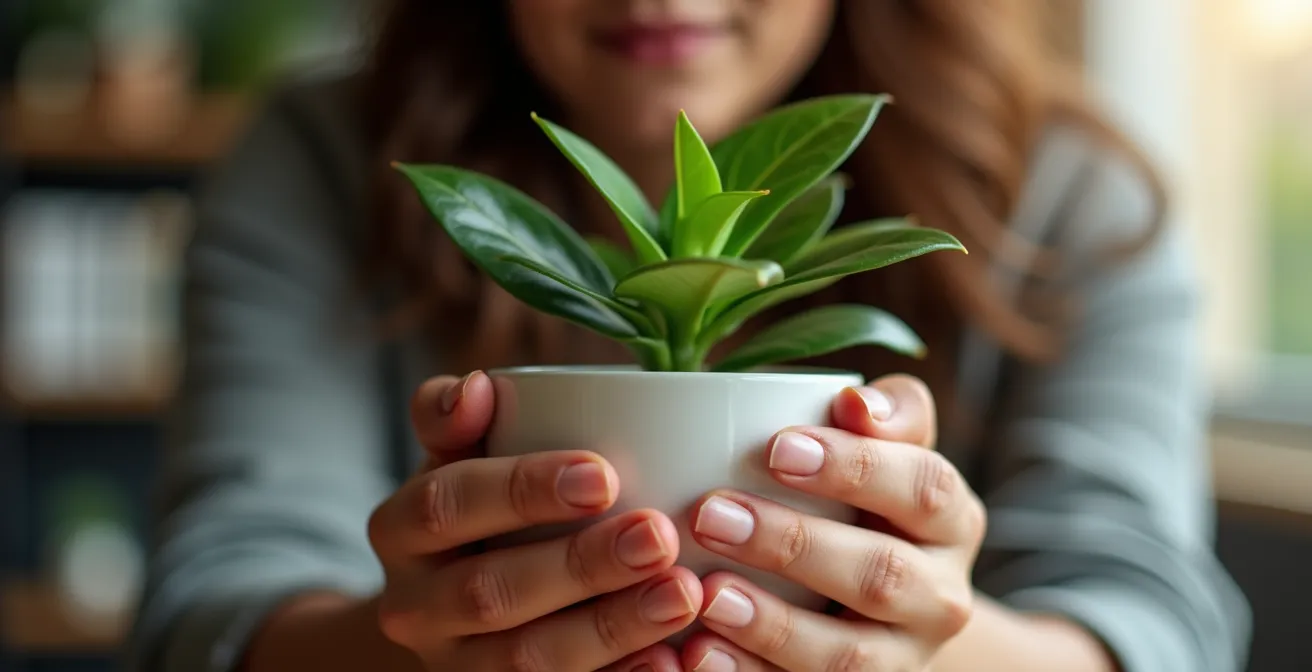
The goal is to move from passive viewing to active engagement. Don’t just glance at the plant; notice the texture of its leaves, the subtle variations in color, or any new growth. This mindful interaction transforms a simple object into a dynamic, engaging presence. Here’s a practical guide to integrating these moments throughout your day:
Your Biophilic Pomodoro Integration Plan
- Standard 20-20-20 Rule: Every 20 minutes of screen time, look at a plant at least 20 feet away for a full 20 seconds.
- Post-Sprint Reset: After a 25-minute focus session, use your 5-minute break for nature engagement. Water a plant, gently touch its leaves, or simply observe its patterns up close.
- Mid-Morning Micro-Break: Take 2 minutes to observe the “micro-wilderness” on your desk—the details of a small succulent or the way light hits a leaf.
- Lunch Break Sensory Reset: During your lunch break, spend at least 15 minutes engaging with nature, focusing on sensory details like texture, smell, and visual complexity.
- End-of-Day Transition: As you wrap up your work, choose one plant to care for. This simple ritual helps create a mental boundary between your work life and personal time.
How to Find “Micro-Wilderness” in a Concrete Jungle for Lunch Breaks?
For those working in dense urban environments, the idea of a restorative nature break can seem impossible. The “concrete jungle” feels devoid of the green spaces needed for a proper reset. However, the benefits of nature engagement don’t require a national park. The key is to train your attention to find and appreciate the “micro-wilderness” that exists everywhere, even in the most developed cityscapes.
The practice of “forest bathing” or Shinrin-yoku in Japan has demonstrated the powerful physiological effects of simply being in the presence of nature. Japanese research on forest walking shows benefits like a 15.8% decrease in the stress hormone cortisol and a 1.9% drop in blood pressure. While a forest walk may not be feasible on your lunch break, you can achieve a fraction of these benefits by mindfully seeking out small pockets of nature. This means shifting your perception from looking for a *park* to looking for *patterns*, *textures*, and *life*. A weed pushing through a crack in the pavement, the fractal pattern of lichen on a brick wall, or the sound of wind in a single street-side tree are all valid points of natural connection.
To make this practical, turn your lunch break into a sensory scavenger hunt. Instead of scrolling on your phone while you eat, take a 10-minute walk with a specific mission: to notice the natural world that is hiding in plain sight. This active observation pulls you out of your digital headspace and grounds you in the physical world. Here is a checklist to guide your urban nature exploration:
- Sound Quest: Close your eyes for 30 seconds and try to identify one sound that is not human-made. It could be a bird chirping, the buzz of an insect, or wind rustling the leaves of a potted plant on a balcony.
- Texture Hunt: Intentionally touch three different authentic natural surfaces. This could be the rough bark of a tree, the cool surface of a large stone, or the soft soil in a public planter.
- Scent Discovery: Pay attention to your sense of smell. Can you detect the earthy aroma of damp soil after a brief rain (petrichor) or the fragrance from a flowering bush?
- Visual Scan: Challenge yourself to find a view, however small, that contains more green than grey. This might be a small courtyard, a wall covered in ivy, or even just looking up at the clouds.
- Fractal Finding: Look for nature’s repeating patterns. Spot them in the ripples of a puddle, the intricate structure of a pigeon’s feather on the ground, or the branching patterns of frost on a window.
HEPA Filters or Houseplants: Which Actually Removes VOCs Effectively?
A common belief in workplace wellness is that houseplants are powerful air purifiers, diligently scrubbing the air of volatile organic compounds (VOCs) emitted by furniture, electronics, and cleaning products. While plants do absorb airborne chemicals, the scale of their effect is often misunderstood. When it comes to significant, rapid air purification, a mechanical filter is vastly more effective.
The popularization of plants as air purifiers stems from a famous 1989 NASA study. However, that study was conducted in small, sealed chambers—conditions that don’t reflect a typical home or office with normal air circulation. More recent analysis has put this into perspective: NASA research clarifies that in typical room conditions, you would need over 600 common houseplants to match the air-cleaning capacity (Clean Air Delivery Rate, or CADR) of a single, standard HEPA filter. Relying on a few plants to clean your office air is simply not an effective strategy for removing harmful particles and VOCs.
This doesn’t mean plants are useless; it means their primary benefit is psychological, not mechanical. Their role is to reduce stress, boost mood, and enhance well-being. A HEPA filter with an activated carbon layer is the tool for purification. The HEPA element traps fine particles like dust, pollen, and dander, while the carbon adsorbs gases and VOCs. The two technologies serve different, but complementary, purposes.
This table clarifies the distinct roles of HEPA filters and houseplants in a healthy home office environment.
| Factor | HEPA Filter with Carbon | Houseplants |
|---|---|---|
| Particle Removal | 99.97% of particles >0.3 microns | Minimal particle filtration |
| VOC Removal Rate | High-volume, rapid | Very slow, limited capacity |
| Primary Benefit | Air purification | Psychological wellbeing & humidity |
| Coverage Area | 200-500 sq ft per unit | 1-2 sq ft per plant |
| Best Strategy | Primary air cleaning | Complementary wellness support |
Key Takeaways
- Your brain is hardwired to respond positively to natural patterns (fractals), making elements like wood grain a passive stress-reduction tool.
- For low-light offices, choose resilient plants like Snake Plants or ZZ Plants that are adapted to forest understory conditions.
- Fake plants can be counterproductive (the “biophilic uncanny valley”); opt for authentic, low-maintenance alternatives like preserved moss or natural materials.
How to Modify Your Home Environment to Reduce Chronic Inflammation Risks
The connection between our environment and our physical health runs deeper than we think. A sterile, stressful workspace doesn’t just impact our mood and focus; it can contribute to a state of chronic, low-grade inflammation. This is the body’s prolonged stress response, a contributing factor in numerous modern health issues. Biophilic design, therefore, is not just a productivity hack—it’s a preventative health strategy. By reducing environmental stressors and aligning our surroundings with our biology, we can help mitigate this inflammatory response.
The mechanisms are straightforward. Exposure to natural light helps regulate our circadian rhythm and cortisol production. Interaction with plants and natural textures reduces psychological stress. Even improving air quality and microbial diversity by opening a window can have a positive impact. These are not just pleasantries; they are inputs that help down-regulate the body’s fight-or-flight response. In fact, dedicated research shows the tangible health benefits, as Human Spaces research indicates biophilic environments achieve as much as a 15% reduction in stress-related inflammation markers. This highlights a direct link between what we see and touch and what happens inside our bodies.
Creating an anti-inflammatory environment involves integrating these principles into your daily routine. It’s about thinking of your day in chronological phases and providing the right biophilic inputs at the right time. The following protocol provides a simple, actionable framework for modifying your home office environment throughout the day to actively reduce the risk of chronic inflammation.
Your Chrono-Biophilic Anti-Inflammation Checklist
- Morning (7-9 AM): Position your desk to receive maximum morning sunlight. This exposure is critical for regulating your cortisol awakening response and setting your internal clock for the day.
- Mid-morning: Combat sedentary inflammation by taking a two-minute standing break to water your plants. This simple movement pairs physical activity with a mindful nature connection.
- Noon: Open your windows for at least 15 minutes. This exchanges stale indoor air for fresh air, reducing the concentration of indoor pollutants and exposing you to a healthier diversity of natural microbes.
- Afternoon: When focus begins to wane, play a biophilic soundscape (like gentle rain or birdsong) at a very low volume. This can help lower cortisol levels without becoming a distraction.
- Evening (after 6 PM): Wind down your circadian system by switching from harsh overhead lights to warm, low-intensity lighting (around 2700K). Spend a few minutes tending to your plants as a screen-free transition away from work.
Start today by choosing one principle from this guide—whether it’s adding a wood-grain element, adopting a biophilic break routine, or investing in a resilient low-light plant—and begin the process of engineering an office that works with your biology, not against it.